Category: Cloud & DevOps

Unlock the power of Cloud & DevOps with expert insights, tools, and scalable strategies. Learn automation, CI/CD, cloud platforms, and infrastructure-as-code.

  • Infrastructure as Code for Startups: Scaling with GitOps

    Infrastructure as Code for Startups: Scaling with GitOps

    Why Infrastructure as Code Became a Startup Necessity, Not a DevOps Luxury

    For most of the last decade, Infrastructure as Code (IaC) was treated as something organisations adopted later, once they reached a certain size or operational maturity. Startups were encouraged to move fast, configure infrastructure manually in cloud dashboards, and optimise structure only after traction was secured.

    That assumption no longer reflects reality.

    Modern startups are born into an environment where cloud infrastructure is complex from day one. Even a relatively simple product often relies on multiple environments, managed cloud services, CI/CD pipelines, identity and access policies, monitoring tools, and third-party integrations. The operational surface area expands quickly. Managing this complexity manually does not create speed. It creates hidden fragility.

    This is where infrastructure as code for startups becomes a necessity rather than a DevOps luxury.

    At a practical level, IaC applies software engineering discipline to infrastructure. Cloud resources are defined declaratively, stored in version control, reviewed through pull requests, and applied consistently across environments. Infrastructure stops being something that lives in individual dashboards or in the heads of a few engineers. It becomes explicit, inspectable, and repeatable.

    For startups, this repeatability translates directly into leverage.

    Early-stage teams change rapidly. Engineers join and leave. Products pivot. New environments appear for testing, demos, and customer pilots. Without infrastructure automation, every change increases divergence between environments. What works in development behaves differently in production. A manual fix made under pressure is never documented. Over time, teams lose confidence in their own systems.

    This is why how startups use infrastructure as code differs from how large enterprises approach it. The primary driver is not compliance or governance. It is operational clarity at speed. IaC allows small teams to scale their systems without scaling operational chaos. Infrastructure changes follow the same workflows engineers already trust, such as Git history, code reviews, and automated pipelines.

    There is also a cultural shift underpinning this adoption. As DevOps practices became mainstream, responsibility for production systems moved closer to development teams. Startups benefit from this alignment more than most. When infrastructure is defined in code, engineers understand not just how the application works, but how it is deployed, secured, and scaled. This reduces handoffs, shortens incident resolution, and lowers the cognitive cost of change.

    Crucially, IaC is not about adding process for its own sake. It is about choosing repeatability over heroics. Manual infrastructure feels fast when systems are small and stakes are low. As soon as usage grows, teams expand, or reliability expectations increase, that speed evaporates. Infrastructure automation for startups helps teams move quickly without accumulating operational debt that later blocks progress.

    This evolution mirrors what happened with application development itself. Startups once deployed code directly to servers using ad-hoc methods. Version control and automated deployments were optional. Today, they are foundational. Infrastructure is following the same path, especially as DevOps practices mature, as discussed in our breakdown of DevOps for startups and modern continuous deployment strategies.

    For founders and CTOs, the real question is no longer whether Infrastructure as Code is relevant. It is when it should be introduced, and how deliberately it is embedded before growth forces the decision under pressure.

    The Scaling Problem Startups Face Without Version-Controlled Infrastructure

    Startups rarely hit scaling issues all at once. The problems usually appear gradually, hidden behind short-term wins and rapid feature delivery. Infrastructure is often where this slow breakdown begins. Without version-controlled infrastructure, teams lose visibility into how their systems actually behave as they grow.

    In the earliest stages, manual infrastructure feels efficient. An engineer spins up a database through a cloud console. Someone adjusts a firewall rule to fix an urgent issue. A staging environment is “close enough” to production. None of this feels risky when the system is small and the team is tight-knit.

    The trouble starts when growth introduces parallel change.

    As more engineers contribute, multiple environments begin to exist in practice, even if they are not formally defined. Development, staging, production, preview branches, customer-specific setups, and temporary test environments all emerge organically. When infrastructure is not defined in code, each environment becomes a unique snowflake. No one can say with confidence what differs between them or why.

    This is where scaling friction becomes unavoidable.

    A bug appears only in production. A performance issue cannot be reproduced in staging. A rollback fixes the application code but leaves infrastructure changes behind. Engineers start relying on tribal knowledge rather than documentation. The system works, but only because a few people know where the sharp edges are.

    For startups, this directly impacts delivery speed. Each infrastructure change becomes riskier than the last. Teams slow down not because they lack ideas, but because they no longer trust the environment they are deploying into. This is the opposite of what scaling is supposed to enable.

    Version-controlled infrastructure for startups addresses this problem at its root. By defining infrastructure declaratively and storing it in Git, every change becomes explicit. There is a record of what was changed, when it was changed, and why. Environments can be recreated rather than patched. Differences between staging and production are intentional, not accidental.

    This matters even more as architectural complexity increases. Many startups transition from a single service to multiple services, introduce managed Kubernetes platforms, or adopt composable architectures to support faster iteration. Without infrastructure being treated as code, these shifts multiply operational risk, as explored in our guide on shifting from monolith to microservices and our analysis of Kubernetes for startups.

    Another overlooked consequence of manual infrastructure is onboarding friction. New engineers struggle to understand how systems are provisioned. Setup instructions become outdated the moment someone makes a manual change. Instead of contributing productively, new hires spend weeks learning undocumented infrastructure quirks. For a startup, that lost momentum is costly.

    This is why building scalable infrastructure with IaC is less about technology choice and more about organisational clarity. Version control creates a shared source of truth. It reduces dependency on individuals and makes infrastructure understandable as the team grows. It also lays the groundwork for automation, testing, and safer experimentation.

    In practice, startups that delay infrastructure as code adoption often end up paying the price later. They are forced to retrofit structure under pressure, usually during a migration, an outage, or investor scrutiny. Teams that adopt IaC earlier avoid this trap by scaling infrastructure in the same disciplined way they scale their codebase.

    The lesson is simple but uncomfortable. Infrastructure that cannot be versioned cannot scale predictably. For startups aiming to grow without slowing down, that limitation becomes a strategic constraint rather than a technical detail.

    Early-Stage Constraints: Cost, Speed, Talent, and Cloud Complexity

    Startups adopt Infrastructure as Code in an environment defined by constraints. Budgets are tight. Timelines are aggressive. Teams are small and often stretched across product, platform, and operations at the same time. Any discussion of IaC strategies for early stage companies has to start from these realities rather than from idealised enterprise models.

    Cost is usually the first concern. Founders often associate IaC with additional tooling, longer setup time, and specialised skills. In practice, the cost question is more nuanced. Manual infrastructure appears cheaper because it avoids upfront investment. Over time, it creates indirect costs that are harder to see but far more damaging. These include slower deployments, production incidents, duplicated environments, and engineering time spent firefighting instead of building.

    This is where infrastructure as code cost optimization becomes relevant. IaC does not just automate provisioning. It makes infrastructure usage visible. Resources are declared explicitly, reviewed in pull requests, and removed when no longer needed. This transparency reduces cloud sprawl and supports more deliberate cost control, especially when paired with basic monitoring and tagging practices, as discussed in our analysis of cloud cost optimization for startups.

    Speed is the second constraint, and the most misunderstood one. Startups fear that introducing IaC will slow them down. The opposite is usually true after the initial learning curve. Manual infrastructure scales poorly with change. Every new environment, integration, or deployment path increases the amount of work required to keep systems consistent. Infrastructure automation allows teams to move quickly without repeating the same setup work again and again.

    Talent constraints amplify this effect. Early-stage startups rarely have dedicated platform or DevOps teams. Infrastructure decisions are often handled by product engineers who rotate responsibilities or learn on the job. Without IaC, critical knowledge remains implicit. Only a few people understand how systems are wired together. This creates single points of failure and increases onboarding time for new hires.

    An IaC implementation guide for startups should therefore focus less on advanced patterns and more on reducing cognitive load. Clear, readable infrastructure definitions act as living documentation. They make it easier for generalist engineers to understand how environments are structured and why certain decisions were made. This aligns with the broader build versus buy decisions many startups face, as outlined in our build vs buy framework.

    Cloud complexity is the final and often underestimated constraint. Modern cloud platforms offer hundreds of services, each with its own configuration model and failure modes. Startups adopt managed databases, messaging systems, serverless functions, and identity providers long before they have the capacity to reason about them holistically. Manual configuration increases the likelihood of inconsistent settings, insecure defaults, and accidental dependencies.

    Cloud infrastructure as code for startups provides a way to manage this complexity incrementally. Teams can start small, codifying only the most critical components, and expand coverage as the system evolves. The goal is not full abstraction on day one. It is progressive formalisation of infrastructure as it becomes business critical.

    Seen together, these constraints explain why IaC adoption in startups looks different from large organisations. The driver is not process maturity. It is the need to operate reliably with limited resources. When cost, speed, talent, and complexity are all constrained, infrastructure as code becomes a force multiplier rather than an overhead.

    The startups that succeed are not the ones that eliminate constraints. They are the ones that design systems which work within them.

    Hidden Risks: Security Drift, Manual Errors, and Operational Debt

    Many startups underestimate infrastructure risk because failures are often silent until they are not. Systems appear to work. Deployments succeed. Customers are mostly unaffected. Beneath the surface, however, unmanaged infrastructure accumulates risk in ways that are difficult to detect and expensive to unwind.

    One of the most common issues is security drift. When infrastructure is managed manually, security controls evolve inconsistently. A firewall rule is added to unblock a release. An IAM permission is widened to fix a failing job. A temporary exception becomes permanent because no one remembers why it was introduced. Over time, environments drift away from their original security posture.

    This drift is rarely malicious. It is a by-product of speed under pressure.

    For startup teams, the absence of IaC security practices means there is no reliable baseline to return to. Security settings live in dashboards rather than in version control. Reviews focus on application code while infrastructure changes bypass the same scrutiny. As a result, teams lose the ability to answer basic questions about their systems, such as who has access, which services are exposed, and whether environments are aligned.

    Manual errors compound this problem. Infrastructure changes are often irreversible or difficult to roll back. A misconfigured load balancer, an incorrectly scoped role, or an environment variable changed in production can trigger outages that are hard to diagnose. Without infrastructure being treated as code, there is no diff to inspect and no commit history to trace.

    These failures are not edge cases. They are structural weaknesses.

    As startups grow, operational debt begins to mirror technical debt in the application layer. Shortcuts taken early become assumptions baked into the system. Workarounds accumulate. Teams learn to avoid touching certain parts of the infrastructure because they are fragile or poorly understood. This creates bottlenecks and slows delivery, even when the product itself is moving in the right direction.

    The risk extends beyond uptime. Investors, partners, and enterprise customers increasingly scrutinise how startups manage their systems. Security posture, access control, and operational maturity are no longer concerns reserved for late-stage companies. During due diligence, undocumented infrastructure and ad-hoc security decisions raise red flags, as explored in our work on technical due diligence for startups.

    Infrastructure as Code addresses these risks by making change explicit. When infrastructure definitions are stored in Git, security becomes reviewable. Changes can be discussed, challenged, and audited before they are applied. Drift is reduced because environments are reconciled against a declared state rather than modified manually over time.

    This also enables stronger alignment between infrastructure and broader DevOps and security practices. Teams can integrate static analysis, policy checks, and automated validation into their pipelines. Infrastructure changes are no longer exceptional events. They follow the same discipline as application releases, a principle central to effective DevSecOps, as outlined in our guide to DevSecOps best practices.

    The most important shift is psychological. When infrastructure is managed manually, risk is implicit and often ignored. When it is managed as code, risk becomes visible. Teams are forced to confront trade-offs early rather than discovering them during incidents.

    For startups, this visibility is not about achieving perfect security. It is about preventing avoidable failure modes from becoming existential threats. Infrastructure that cannot be reviewed, versioned, or tested accumulates risk silently. Infrastructure defined as code turns that risk into something teams can actively manage.

    IaC and GitOps as a Strategic Operating Model for Startups

    As startups mature, Infrastructure as Code often starts as a tactical fix. It removes manual steps, reduces errors, and speeds up provisioning. Over time, however, teams that adopt IaC seriously discover something more valuable. IaC, combined with GitOps principles, becomes a strategic operating model rather than a collection of tools.

    At the centre of this model is a simple shift. Git becomes the source of truth not only for application code, but also for infrastructure and operations. Every change to the system is proposed, reviewed, approved, and applied through the same workflow. This is the essence of infrastructure as code and DevOps for startups when practiced intentionally.

    GitOps builds on this idea by tightening the feedback loop. Instead of engineers manually applying infrastructure changes, automated systems reconcile the running environment with what is declared in Git. If the deployed state diverges from the desired state, the system corrects it. This approach reduces the gap between intent and reality, which is where many operational failures originate.

    For startups, the strategic value lies in consistency.

    Small teams operate under constant change. Features evolve. Architectures shift. Compliance requirements appear unexpectedly. Without a unifying operating model, each change introduces friction. Decisions are revisited. Practices vary by team or individual. Over time, this inconsistency becomes a drag on execution.

    IaC and GitOps address this by standardising how change happens. Infrastructure updates follow predictable paths. Reviews are documented. Rollbacks are straightforward because previous states are known. This allows teams to move faster without relying on informal knowledge or heroics, reinforcing the same principles that underpin modern DevOps for startups.

    Another benefit is clearer ownership. In many startups, responsibility for infrastructure is ambiguous. Engineers deploy code, operations teams manage environments, and security reviews happen later. GitOps encourages shared responsibility by making infrastructure changes visible to everyone involved. When infrastructure lives in repositories alongside application code, it becomes part of normal engineering work rather than a separate concern.

    This shared visibility also improves decision quality. Trade-offs around scalability, cost, and reliability are easier to evaluate when infrastructure definitions are explicit. Teams can reason about the impact of changes before they reach production. Over time, this leads to more deliberate architecture choices and fewer reactive fixes.

    From a leadership perspective, IaC and GitOps offer operational clarity. Founders and CTOs gain confidence that systems can scale without constant intervention. The organisation becomes less dependent on specific individuals and more resilient to growth. This matters not only for day-to-day execution, but also during audits, partnerships, and funding discussions.

    It is important to note that GitOps is not a requirement for every startup on day one. The strategic model emerges gradually. Teams often begin with basic IaC to define core infrastructure. GitOps principles are layered on as complexity grows and automation becomes essential. What matters is the direction of travel, not the starting point.

    Ultimately, DevOps automation infrastructure for startups works best when it is aligned with how teams already think and collaborate. IaC and GitOps succeed because they reinforce familiar patterns rather than introducing parallel processes. They turn infrastructure from an opaque dependency into a transparent, manageable part of the product lifecycle.

    For startups aiming to scale without losing control, this shift from tactical automation to strategic operating model is where Infrastructure as Code delivers its greatest return.

    Choosing the Right IaC Tools and Frameworks for Startup Teams

    Once a startup commits to Infrastructure as Code, the next challenge is selection. The ecosystem is broad, opinions are strong, and most guidance is written with large enterprises in mind. For startup teams, choosing IaC tools is less about technical sophistication and more about operational fit.

    There is no universally “best” option. The right choice depends on team size, cloud footprint, delivery cadence, and tolerance for complexity.

    At a high level, infrastructure as code tools for startups fall into two broad categories. Declarative tools focus on describing the desired end state of infrastructure. Programmatic tools allow infrastructure to be defined using general-purpose programming languages. Each approach has trade-offs that matter more at startup scale than feature checklists.

    Declarative tools are often favoured by early teams because they enforce structure. The configuration describes what should exist, not how to build it step by step. This makes infrastructure easier to reason about, review, and standardise. It also aligns well with Git-based workflows and makes drift detection more straightforward. For startups prioritising predictability over flexibility, this approach reduces cognitive load.

    Programmatic approaches offer more expressiveness. They allow conditional logic, loops, and abstractions that can reduce repetition in complex environments. For teams with strong engineering depth, this can be powerful. The risk is that infrastructure definitions start to resemble application code, making them harder to understand for non-authors and more difficult to review.

    This trade-off becomes clear when startups attempt to compare IaC tools for startups purely on capability. Advanced features are attractive, but they often introduce hidden complexity. Early-stage teams benefit more from tools that make infrastructure boring, obvious, and easy to change safely.

    Tooling also needs to be evaluated alongside the broader platform direction. Startups adopting container orchestration, managed Kubernetes, or composable architectures need IaC frameworks that integrate cleanly with those environments. Mismatches here create friction later, particularly as systems evolve, a pattern we often see in teams exploring Kubernetes for startups.

    Another consideration is ecosystem maturity. Terraform for startups IaC remains popular not because it is perfect, but because it has a large community, extensive documentation, and broad cloud provider support. This lowers the barrier to entry and reduces long-term risk. Newer or more opinionated tools may offer elegance, but they can also increase dependency on niche knowledge that is harder to replace as teams grow.

    Templates and modules are often underestimated in these decisions. IaC templates for startup environments allow teams to standardise common patterns such as networking, databases, and CI integrations without reinventing them for every project. The ability to reuse and adapt proven configurations accelerates onboarding and reduces error rates.

    It is also worth considering how tooling fits into the wider delivery lifecycle. Infrastructure does not exist in isolation. It interacts with deployment pipelines, monitoring, and security controls. Tools that integrate smoothly into existing DevOps workflows reduce friction and avoid parallel systems, reinforcing the principles outlined in our broader work on DevOps for startups.

    The most effective approach for startups is pragmatic. Start small. Choose tools that are easy to adopt, well-supported, and aligned with current needs. Avoid over-optimising for hypothetical future scale. IaC tooling can evolve, but early decisions should prioritise clarity, maintainability, and team confidence.

    In the end, the goal is not to master every framework. It is to build an infrastructure foundation that supports growth without becoming a bottleneck. The right tools are the ones that make that outcome more likely, not more impressive.

    Executing IaC in Practice: Pipelines, Environments, and Governance

    Adopting Infrastructure as Code is only the first step. The real value emerges when IaC is executed consistently across environments, integrated into delivery pipelines, and governed in a way that supports speed without sacrificing control. For startups, this execution layer is where theory meets operational reality.

    Most teams begin by defining a small set of core environments. Development, staging, and production are the usual starting point. The mistake many startups make is treating these environments as loosely related rather than deliberately aligned. With IaC, environments should be variations of the same blueprint, not independent creations. Differences should be explicit and minimal, typically limited to scale, access controls, or cost-related parameters.

    This is where infrastructure as code examples for startups become practical rather than academic. A single repository can define shared components such as networking, identity, and observability, while environment-specific configurations adjust only what is necessary. This structure makes it easier to reason about changes and reduces the risk of surprises during deployment.

    Pipelines are the next critical layer. IaC pipeline automation for small companies does not require complex tooling, but it does require discipline. Infrastructure changes should move through the same lifecycle as application changes. A pull request proposes the change. Automated checks validate syntax and policy. A review confirms intent. Only then is the change applied to the target environment.

    This approach brings two advantages. First, it reduces manual intervention. Engineers are not applying changes directly to production. Second, it creates an audit trail that is invaluable during incidents or reviews. When something goes wrong, teams can trace exactly what changed and when. This mirrors the practices used in modern application delivery, as outlined in our overview of continuous deployment strategies.

    Governance is often misunderstood at startup stage. It is not about heavy approval processes or slowing teams down. It is about establishing guardrails that prevent avoidable mistakes. With IaC, governance can be encoded rather than enforced manually. Naming conventions, access boundaries, and resource limits can all be defined in code and validated automatically.

    For example, startups can restrict which environments are allowed to create certain resources, or enforce tagging standards that support cost tracking. These controls reduce risk without requiring constant human oversight. Over time, they also make compliance and due diligence far less painful, a recurring theme in mature DevOps setups discussed in our guide to DevOps for startups.

    Another practical consideration is change cadence. Infrastructure should not change at the same frequency as application code. Startups benefit from batching infrastructure updates and applying them deliberately. This reduces noise and makes it easier to isolate the impact of changes. IaC supports this by decoupling infrastructure evolution from feature delivery while still keeping both under version control.

    Execution also includes failure handling. Not every infrastructure change will succeed. Rollback strategies should be defined upfront. Because IaC captures previous states, reverting to a known configuration is usually straightforward. This is a significant improvement over manual changes, where rollback often relies on memory rather than evidence.

    In practice, successful IaC execution for startups is not about perfection. It is about consistency. Clear environment definitions, predictable pipelines, and lightweight governance together create an operating rhythm teams can trust. Once that trust exists, infrastructure stops being a source of anxiety and becomes a stable platform for growth.

    From Tactical Automation to Long-Term Scale: Where Startups Go Next

    For many startups, Infrastructure as Code begins as a practical fix. It removes manual steps, reduces errors, and makes deployments more predictable. Over time, however, teams that invest in IaC discover that its real value lies beyond automation. It becomes a foundation for long-term scale and organisational maturity.

    At this stage, the conversation shifts from tooling to intent.

    Startups that succeed with IaC stop asking how to automate infrastructure and start asking how infrastructure supports business goals. Reliability, cost control, security posture, and developer velocity are no longer treated as competing priorities. They become outcomes that are deliberately engineered. This is where the broader IaC benefits for tech startups become visible, not just in system performance, but in how teams operate.

    One of the clearest signs of maturity is confidence in change. Teams that have adopted IaC well are comfortable evolving their architecture. They can introduce new environments, scale services, or refactor components without fear of destabilising the system. Infrastructure is no longer a constraint that limits ambition. It is an asset that enables it.

    This confidence also influences strategic decisions. As startups grow, they face increasing scrutiny from customers, partners, and investors. Questions about uptime, security, and scalability are no longer hypothetical. Infrastructure as code adoption in startups makes these conversations easier because answers are grounded in documented, repeatable systems rather than informal assurances. This is particularly valuable during audits or funding rounds, where operational clarity matters as much as product vision.

    Cost discipline improves as well. When infrastructure is defined explicitly, it becomes easier to understand where resources are consumed and why. Teams can experiment responsibly, knowing that unused components can be removed cleanly. Over time, this supports more sustainable growth and avoids the common trap of scaling cloud spend faster than revenue, a challenge we explore further in our work on cloud cost optimisation for startups.

    Looking ahead, the most effective startups treat IaC as a living practice rather than a finished implementation. Tooling evolves. Architectures change. Teams grow. What remains constant is the principle that infrastructure should be understandable, reviewable, and aligned with delivery workflows. This mindset creates continuity even as the technical landscape shifts.

    It is also where Infrastructure as Code connects naturally with broader platform and DevOps strategies. As systems become more complex, startups often explore platform engineering, internal tooling, or more advanced automation patterns. Having a solid IaC foundation makes these transitions far less disruptive, as discussed in our comparison of platform engineering vs DevOps.

    For founders and CTOs, the takeaway is straightforward. Infrastructure decisions made early have long tails. Treating infrastructure as code is not about future proofing for some distant scale. It is about building systems that grow in step with the organisation, rather than lagging behind it.

    If you are assessing how Infrastructure as Code fits into your own growth plans, a focused conversation can help clarify priorities and trade-offs. Our team regularly works with startup leaders to design infrastructure strategies that balance speed, cost, and resilience. If that would be useful, you can explore a tailored discussion through our consultation process.

    At its best, IaC is not just a technical practice. It is a way for startups to scale with intent rather than urgency, and to turn infrastructure from a source of risk into a source of confidence.

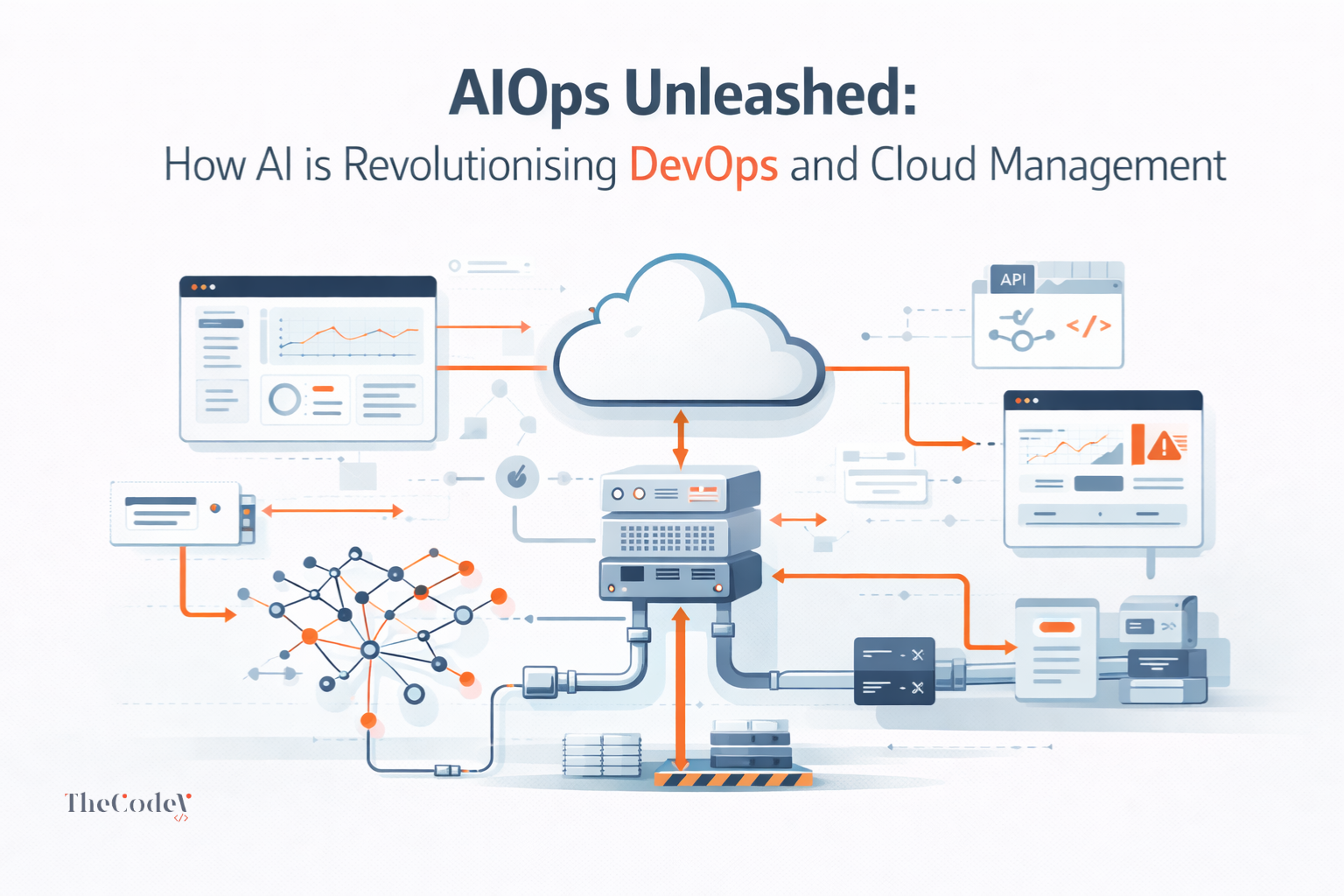
  • AIOps in DevOps: How AI Is Transforming Cloud Operations

    AIOps in DevOps: How AI Is Transforming Cloud Operations

    AIOps in DevOps: Why Intelligent Operations Are No Longer Optional

    Cloud systems were meant to simplify operations. Instead, they’ve created a maze of tools, alerts, and data streams.
    Modern DevOps teams are drowning in metrics, logs, and events. Speed has improved, but clarity has not.

    This is where aiops in devops steps in.

    AIOps brings machine intelligence into DevOps workflows. It turns raw operational noise into insight.
    Rather than reacting to failures, teams can now predict, prevent, and optimise in real time.

    For global software companies like TheCodeV, operating across regions and infrastructures, this shift is no longer optional. It’s foundational.

    What Is AIOps in DevOps?

    AIOps in DevOps refers to applying artificial intelligence and machine learning to operational data across the DevOps lifecycle.
    It enables systems to observe, learn, and act without constant human intervention.

    Unlike traditional monitoring tools, AIOps platforms analyse patterns across massive datasets.
    They correlate logs, metrics, traces, and events into a single operational narrative.

    This intelligence allows DevOps teams to move from reactive firefighting to proactive optimisation.

    According to Gartner, AIOps reduces operational complexity and improves service availability in dynamic environments.
    That’s why adoption has accelerated alongside cloud-native architectures and microservices.

    The Role of AIOps in Modern DevOps Teams

    Traditional DevOps relies heavily on predefined rules and manual thresholds.
    These approaches break down at scale.

    The role of AIOps in DevOps is to introduce adaptive intelligence into every operational layer.

    Instead of static alerts, AIOps systems learn what “normal” looks like.
    They adjust continuously as applications evolve.

    This capability is especially critical in environments using containers, Kubernetes, and multi-cloud deployments.

    AIOps also acts as a bridge between development and operations.
    It provides shared visibility, faster feedback, and data-driven decisions across teams.

    For organisations delivering complex systems worldwide, like those working with TheCodeV’s global clients, this intelligence ensures stability without slowing innovation.
    Learn more about how AI enhances DevOps workflows on our page about artificial intelligence in DevOps.

    Why DevOps Alone Is No Longer Enough

    DevOps solved many problems. It broke down silos and accelerated delivery.
    But it was never designed to manage today’s data volumes.

    Cloud-native systems generate millions of events daily.
    Human operators cannot process this manually.

    This is where machine learning in DevOps becomes essential.

    Machine learning models detect hidden patterns humans miss.
    They identify anomalies before they escalate into outages.

    This shift marks the rise of AI driven DevOps, where systems assist engineers rather than overwhelm them.

    IBM highlights that AIOps enables faster incident response and improved system resilience by automating insight generation.
    This aligns with how modern DevOps teams must operate at scale.

    The Business Impact of AIOps in DevOps

    AIOps is not just a technical upgrade.
    It delivers measurable business value.

    Teams experience reduced downtime, faster root cause identification, and improved customer experience.
    Operational costs also decline as manual effort decreases.

    For growing organisations, AIOps supports scalability without proportional team expansion.
    That’s a competitive advantage in fast-moving markets.

    If you’re exploring intelligent operational strategies, TheCodeV’s expertise across AI and cloud solutions can help you navigate this transition.
    Discover how we support modern digital transformation on our homepage.

    As cloud ecosystems grow more complex, DevOps must evolve.
    AIOps is that evolution, and it’s already reshaping how high-performing teams operate.

    AIOps vs DevOps: Why Automation Alone Can’t Keep Up Anymore

    DevOps promised speed and stability.
    At scale, it often delivers complexity instead.

    As systems grow distributed and cloud-native, traditional DevOps practices begin to strain.
    This is where the debate around AIOps vs DevOps becomes critical.

    The truth is simple.
    DevOps without intelligence cannot keep pace with modern infrastructure.

    Understanding Traditional DevOps at Scale

    DevOps focuses on collaboration, automation, and faster delivery.
    It relies on CI/CD pipelines, monitoring tools, and predefined rules.

    In smaller environments, this works well.
    At enterprise scale, cracks start to appear.

    Teams face alert fatigue from thousands of notifications.
    Root cause analysis becomes slow and manual.

    Static thresholds struggle with dynamic workloads.
    Cloud elasticity breaks rule-based monitoring.

    This is not a failure of DevOps philosophy.
    It’s a limitation of human-led automation.

    AIOps vs DevOps: The Core Difference

    The key difference between AIOps vs DevOps lies in decision-making.

    DevOps automates execution.
    AIOps automates understanding.

    AIOps introduces machine learning models that analyse behaviour across systems.
    They detect patterns, correlations, and anomalies automatically.

    Instead of asking engineers to interpret dashboards, AIOps surfaces insights directly.
    This reduces noise and accelerates action.

    With AIOps and DevOps integration, teams move from reactive operations to predictive control.
    Problems are identified before users are impacted.

    Red Hat notes that AIOps enables IT teams to manage complexity through continuous learning systems.
    This capability is essential for cloud-first organisations.

    Intelligent DevOps Automation in Practice

    Traditional automation follows scripts.
    Intelligent automation adapts.

    Intelligent DevOps automation allows pipelines to respond dynamically to system conditions.
    Deployments can pause, roll back, or reroute automatically.

    For example, if performance degrades during a release, AIOps can detect abnormal behaviour.
    It can trigger corrective actions without human input.

    This intelligence transforms DevOps from a delivery engine into a self-correcting system.

    It also improves collaboration.
    Both developers and operations teams work from the same data-driven insights.

    If you’re exploring scalable automation strategies, TheCodeV’s approach to cloud and DevOps services reflects this intelligent model.
    You can explore our capabilities on the services page.

    Predictive Analytics Changes the Game

    One of the strongest advantages of AIOps is foresight.

    Predictive analytics in DevOps allows teams to forecast incidents before they occur.
    Capacity issues, latency spikes, and resource exhaustion become visible early.

    This reduces downtime and improves customer trust.
    It also supports better planning and cost control.

    Instead of reacting to failures, teams prevent them.
    That shift defines modern operational excellence.

    Microsoft highlights that predictive analytics improves reliability in distributed cloud systems.
    This is especially relevant in multi-cloud environments.

    If you’re comparing infrastructure strategies, our guide on cloud providers comparison 2025 offers helpful insights.

    DevOps Isn’t Replaced. It’s Enhanced.

    AIOps does not replace DevOps.
    It completes it.

    DevOps provides speed and structure.
    AIOps provides intelligence and resilience.

    Together, they enable teams to scale confidently.
    This combination defines the future of high-performing digital organisations.

    As cloud complexity grows, DevOps must evolve.
    AIOps is the catalyst driving that evolution forward.

    AIOps in the DevOps Pipeline: Powering Smarter CI/CD and Continuous Delivery

    Speed is the currency of modern software delivery.
    Yet speed without insight often leads to failure.

    As deployment frequency increases, so does risk.
    This is where aiops in devops transforms the pipeline itself.

    By embedding intelligence directly into delivery workflows, teams gain control without sacrificing velocity.

    AIOps in the DevOps Pipeline Explained

    The AIOps in DevOps pipeline approach brings machine learning into every stage of delivery.
    From code commit to production release, systems observe and learn continuously.

    Traditional pipelines follow predefined paths.
    AIOps-enabled pipelines adapt in real time.

    They analyse historical deployment data, system behaviour, and performance signals.
    This allows smarter decisions during builds, tests, and releases.

    Instead of relying solely on pass or fail signals, pipelines gain context.
    That context reduces blind spots and late-stage surprises.

    Smarter CI/CD with AIOps

    AIOps in CI/CD pipelines enhances automation with intelligence.

    During continuous integration, AIOps models detect abnormal test failures.
    They distinguish between flaky tests and real defects.

    In continuous delivery, AIOps evaluates deployment impact.
    It correlates application changes with infrastructure performance.

    If anomalies appear, the pipeline can automatically pause or rollback.
    This reduces production incidents without slowing releases.

    Teams also benefit from faster feedback loops.
    Developers receive actionable insights, not raw logs.

    Atlassian highlights that intelligent pipelines improve deployment reliability in high-velocity teams.
    This aligns with the needs of cloud-native organisations.

    AIOps for Continuous Delivery at Scale

    As systems grow distributed, delivery complexity multiplies.
    Microservices, APIs, and third-party integrations add uncertainty.

    AIOps for continuous delivery brings predictability back.

    Machine learning models analyse previous releases and outcomes.
    They forecast the risk of new deployments.

    High-risk releases can be flagged automatically.
    Low-risk changes move forward without manual approval.

    This risk-aware delivery model supports both speed and stability.
    It’s especially valuable for teams managing global deployments.

    If you’re modernising delivery workflows, TheCodeV explores automation strategies in depth in our guide on how to automate your workflows using n8n.

    DevOps Automation Becomes Adaptive

    Traditional AIOps for DevOps automation replaces rigid rules with learning systems.

    Instead of static thresholds, pipelines adapt to real-world behaviour.
    This reduces false positives and missed issues.

    For example, performance benchmarks adjust automatically as usage grows.
    Seasonal traffic patterns are recognised without manual tuning.

    This adaptability improves release confidence.
    It also reduces the operational burden on engineers.

    GitLab notes that intelligent automation helps teams scale CI/CD without scaling complexity.
    This is essential for organisations shipping frequently.

    Connecting Delivery to Business Outcomes

    AIOps doesn’t just protect infrastructure.
    It aligns delivery with business goals.

    By correlating releases with user experience and performance metrics, teams gain visibility.
    They understand which changes drive value and which introduce risk.

    This insight supports better prioritisation.
    It also strengthens collaboration between engineering and leadership.

    If you’re building resilient delivery pipelines, TheCodeV’s experience in modern software engineering can support your journey.
    Explore our perspective on scalable development in software development in the modern era.

    As CI/CD pipelines evolve, intelligence becomes essential.
    AIOps ensures speed and safety grow together, not apart.

    AIOps for Cloud Operations: Mastering Infrastructure at Scale

    Cloud promised flexibility.
    What it delivered was complexity.

    Multi-cloud strategies, container orchestration, and microservices have multiplied operational data.
    Without intelligence, visibility quickly collapses.

    This is where AIOps for cloud operations becomes essential.

    AIOps for Infrastructure Monitoring

    Traditional monitoring tools rely on static thresholds.
    In dynamic cloud environments, those thresholds fail.

    AIOps for infrastructure monitoring uses machine learning to understand normal behaviour.
    It continuously learns from metrics, logs, and events.

    When patterns shift, AIOps detects meaningful anomalies.
    Noise is filtered out automatically.

    This approach reduces alert fatigue.
    Engineers focus on real issues, not endless notifications.

    Google Cloud explains that AI-driven observability improves reliability in elastic environments.
    This capability is now critical for modern DevOps teams.

    Kubernetes Monitoring with AIOps

    Kubernetes introduces orchestration power.
    It also introduces operational blind spots.

    AIOps for Kubernetes monitoring provides deep visibility across clusters and namespaces.
    It correlates pod behaviour with node performance and application health.

    Instead of isolated alerts, teams see cause-and-effect relationships.
    This shortens investigation time significantly.

    AIOps also helps predict scaling issues.
    It identifies resource contention before services degrade.

    For organisations managing containerised workloads globally, this intelligence is invaluable.
    It ensures Kubernetes remains an enabler, not a bottleneck.

    AIOps for Microservices DevOps

    Microservices increase agility.
    They also increase failure points.

    AIOps for microservices DevOps connects distributed components into a coherent picture.
    It traces requests across services automatically.

    When latency spikes, AIOps identifies the weakest link.
    No manual correlation is required.

    This visibility supports faster remediation.
    It also improves system design over time.

    Teams gain confidence to release frequently.
    Operational risk decreases despite architectural complexity.

    If you’re exploring modern cloud architectures, TheCodeV’s insights into distributed systems are covered in our article on edge computing and cloud transformation.

    Supporting SRE Teams with AIOps

    Site Reliability Engineering depends on data.
    Too much data can overwhelm.

    AIOps for SRE teams transforms raw telemetry into actionable signals.
    Error budgets, SLOs, and SLIs become easier to manage.

    AIOps predicts reliability risks.
    It helps teams prioritise preventative work over reactive fixes.

    This supports long-term system resilience.
    It also aligns reliability goals with business objectives.

    The CNCF highlights that intelligent observability is key to sustainable SRE practices.
    AIOps plays a central role in this evolution.

    Scaling Cloud Operations Globally

    Operating across regions adds another layer of complexity.
    Latency, compliance, and infrastructure variability must be managed carefully.

    AIOps provides a unified operational view.
    It normalises data across clouds and geographies.

    For global software providers and partners like EmporionSoft, this intelligence ensures consistent performance worldwide.
    It enables teams to scale without losing control.

    If you’re evaluating cloud strategies, TheCodeV’s analysis of platforms and providers can help.
    Explore our detailed guide on cloud providers comparison 2025.

    As cloud ecosystems grow more complex, manual monitoring falls short.
    AIOps brings clarity, control, and confidence back to cloud operations.

    AIOps Use Cases in DevOps: From Incident Chaos to Predictive Control

    Incidents rarely arrive quietly.
    They surface as floods of alerts, confused dashboards, and delayed responses.

    In high-velocity environments, every minute counts.
    This is where AIOps use cases in DevOps deliver measurable impact.

    By turning operational data into intelligence, teams move from chaos to control.

    AIOps for Incident Management

    Traditional incident management depends on human coordination.
    Alerts trigger tickets. Tickets trigger investigation.

    AIOps for incident management changes this flow.

    Machine learning models correlate alerts across systems automatically.
    Related events are grouped into a single incident.

    This reduces noise dramatically.
    Engineers focus on resolution, not triage.

    AIOps also prioritises incidents based on impact.
    Customer-facing issues surface first.

    According to IBM, intelligent incident management can cut response times significantly.
    That speed directly improves service reliability.

    Root Cause Analysis Without Guesswork

    Manual root cause analysis is slow and error-prone.
    Complex systems hide causal relationships.

    AIOps for root cause analysis uncovers those relationships automatically.

    By analysing historical and real-time data, AIOps identifies probable causes.
    It traces failures across applications, infrastructure, and networks.

    This reduces mean time to resolution.
    It also prevents repeat incidents.

    Engineers spend less time diagnosing.
    They spend more time improving systems.

    If you’re exploring automation-driven reliability, TheCodeV covers this evolution in our article on the future of AI-powered automation in software development.

    Detecting Anomalies Before Users Notice

    Not all failures are obvious.
    Some begin as subtle performance degradation.

    AIOps for anomaly detection identifies these early warning signs.
    It learns normal behaviour across time and conditions.

    When deviations occur, alerts are raised intelligently.
    False positives are reduced.

    This proactive approach protects user experience.
    It also supports service-level objectives.

    Predictive detection is especially valuable in cloud-native systems.
    Dynamic workloads make manual baselines unreliable.

    Smarter Log Analysis in DevOps

    Logs contain answers.
    They also contain noise.

    AIOps for log analysis in DevOps filters, clusters, and interprets logs automatically.
    Patterns emerge that humans would miss.

    Instead of searching endlessly, engineers receive insights.
    Error trends and correlations are highlighted.

    This speeds up investigations.
    It also improves long-term observability.

    As systems scale, automated log intelligence becomes essential.
    Manual analysis simply doesn’t scale.

    Performance Optimisation Through Intelligence

    Performance issues often stem from complex interactions.
    Finding them manually is difficult.

    AIOps for performance optimization analyses end-to-end behaviour.
    It identifies bottlenecks across services and infrastructure.

    Recommendations are data-driven.
    Optimisation becomes continuous, not reactive.

    This improves application responsiveness.
    It also reduces infrastructure costs.

    Microsoft notes that AI-driven performance insights help maintain reliability in distributed systems.
    That insight is increasingly valuable for digital-first organisations.

    If you’re aligning operational excellence with business growth, TheCodeV’s perspective on AI adoption is explored in our guide on AI in business UK 2025.

    From Reactive to Predictive Operations

    Together, these AIOps benefits for DevOps teams redefine operations.

    Incidents are predicted, not just resolved.
    Performance is optimised continuously.

    Teams regain control over complexity.
    Systems become more resilient with every cycle.

    AIOps doesn’t eliminate incidents entirely.
    It ensures they no longer define your operations.

    Implementing AIOps in DevOps: Tools, Strategy, and Best Practices

    Adopting AIOps is not a plug-and-play exercise.
    Success depends on preparation, alignment, and execution.

    Many teams fail not because of technology, but because of approach.
    Understanding AIOps implementation in DevOps is critical before investing.

    Choosing the Right AIOps Tools for DevOps

    The market offers a wide range of platforms.
    Not all are suited to every organisation.

    AIOps tools for DevOps typically focus on observability, incident intelligence, or automation.
    Some specialise in cloud monitoring, others in CI/CD analytics.

    Key capabilities to look for include data correlation, anomaly detection, and predictive insights.
    Integration with existing toolchains is equally important.

    Tools should support modern stacks.
    This includes Kubernetes, microservices, and multi-cloud environments.

    Vendor lock-in is a real concern.
    Open APIs and flexible architectures reduce long-term risk.

    Before selecting a platform, teams should assess maturity and goals.
    This avoids overengineering early implementations.

    AIOps Implementation in DevOps Environments

    Successful AIOps implementation in DevOps starts with data readiness.

    AIOps systems rely on high-quality telemetry.
    Logs, metrics, and traces must be accessible and consistent.

    Teams should begin with a focused use case.
    Incident management or anomaly detection are common starting points.

    Gradual rollout reduces disruption.
    It also builds trust in AI-driven insights.

    Cultural readiness matters as much as technical readiness.
    Engineers must understand how to work alongside intelligent systems.

    If you’re planning adoption, TheCodeV offers structured guidance through our consultation services.
    Strategic planning reduces risk and accelerates value.

    Best Practices for AIOps in DevOps

    Following AIOps best practices for DevOps increases success rates.

    Start with clear objectives.
    Define what success looks like.

    Ensure data quality early.
    Poor data leads to poor outcomes.

    Involve both development and operations teams.
    Shared ownership drives better results.

    Continuously train and refine models.
    Systems must evolve with applications.

    Below is a practical checklist to guide adoption:

    • Align AIOps goals with business outcomes

    • Integrate with existing CI/CD and monitoring tools

    • Start small and scale gradually

    • Monitor model performance regularly

    • Maintain human oversight during early stages

    These practices help teams avoid common pitfalls.

    Addressing Cost and Complexity

    AIOps investments must be justified.
    Costs extend beyond licensing.

    Implementation effort, training, and change management matter.
    Ignoring these leads to stalled projects.

    However, long-term savings are significant.
    Reduced downtime and faster resolution offset initial costs.

    Transparent pricing and phased adoption help control budgets.
    You can explore structured options on TheCodeV’s pricing plans.

    Preparing for the Next Phase of DevOps

    AIOps is not a one-time upgrade.
    It’s an evolving capability.

    As systems grow, models become more accurate.
    Operational intelligence deepens over time.

    Teams that invest thoughtfully gain a competitive edge.
    They operate with confidence in complex environments.

    Implementation done right sets the foundation.

    AIOps in DevOps: Challenges, Future Outlook, and the Path Forward

    AIOps is powerful, but it is not effortless.
    Understanding its limitations is just as important as understanding its benefits.

    As adoption accelerates, teams must approach aiops in devops with realism, strategy, and long-term vision.

    AIOps Challenges in DevOps Environments

    The biggest challenge is data.

    AIOps systems depend on large volumes of high-quality data.
    Inconsistent logs, missing metrics, and siloed tools weaken outcomes.

    Another common issue is noise during early adoption.
    Models need time to learn what “normal” looks like.

    Teams may initially distrust AI-driven insights.
    This is a cultural challenge, not a technical one.

    There are also governance concerns.
    Over-automation without human oversight can introduce risk.

    Security, compliance, and explainability must be addressed early.
    AIOps decisions should be transparent and auditable.

    Despite these challenges, most failures come from rushed implementations.
    Not from the technology itself.

    The Future of AI Driven DevOps

    The trajectory is clear.
    DevOps is becoming increasingly autonomous.

    Future AI driven DevOps systems will self-heal infrastructure.
    They will optimise performance continuously.

    Predictive analytics will extend beyond incidents.
    Capacity planning, cost optimisation, and release strategy will all become data-driven.

    We will also see deeper integration with business metrics.
    Operational decisions will align directly with revenue and user experience.

    As models mature, collaboration between humans and AI will improve.
    Engineers will focus on design and innovation, not firefighting.

    This evolution is already underway in forward-thinking organisations worldwide.

    Why AIOps Benefits for DevOps Teams Are Compounding

    The true value of AIOps grows over time.

    Each incident resolved improves future predictions.
    Each deployment analysed reduces future risk.

    Key AIOps benefits for DevOps teams include:

    • Faster incident resolution

    • Proactive issue prevention

    • Reduced operational costs

    • Improved system reliability

    • Better developer experience

    These benefits compound as systems scale.
    That’s why early, thoughtful adoption matters.

    Turning Strategy into Execution

    Technology alone does not deliver transformation.
    Execution does.

    Successful teams align AIOps with clear goals.
    They integrate it into existing workflows.

    They invest in people as much as platforms.
    Training and trust are essential.

    This is where experienced partners make a difference.

    TheCodeV works with organisations across the UK and globally to design intelligent DevOps strategies.
    Our teams understand cloud complexity, AI systems, and real-world delivery.

    You can learn more about our approach and values on our About Us page.

    Work with TheCodeV to Build Intelligent DevOps

    AIOps is redefining how modern systems are built and operated.
    The question is no longer if it should be adopted, but how.

    If you’re ready to move from reactive operations to predictive, intelligent DevOps, TheCodeV can help.
    We partner with teams to design, implement, and scale AIOps-driven DevOps ecosystems.

    Start a conversation with our experts today.
    Reach out through our Contact page and explore how intelligent operations can future-proof your digital infrastructure.

    The future of DevOps is intelligent.
    Now is the time to build it right.

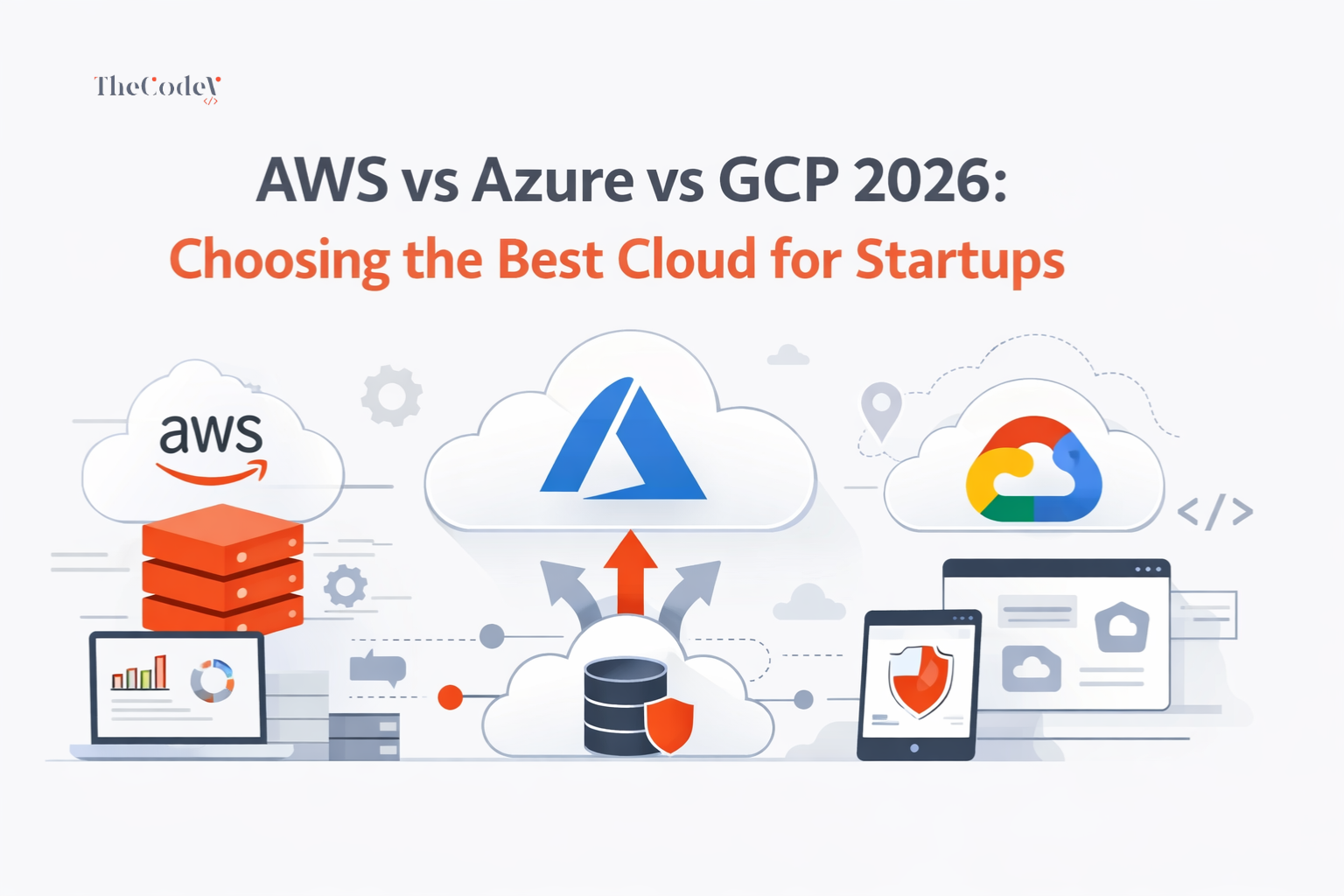
  • AWS vs Azure vs GCP 2026: Choosing the Best Cloud for Startups

    AWS vs Azure vs GCP 2026: Choosing the Best Cloud for Startups

    AWS vs Azure vs GCP 2026

    Cloud Computing for Startups – What’s at Stake?

    In today’s digital-first world, cloud computing has become a game-changer for startups. No longer do startups need to invest in costly on-premise infrastructure or worry about maintaining servers. Instead, they can leverage cloud platforms like AWS, Azure, and GCP to scale efficiently, enhance collaboration, and accelerate innovation without breaking the bank.

    The Role of Cloud Computing for Startups
    Cloud computing provides startups with the flexibility to grow and evolve without being tied to expensive hardware or IT resources. Whether it’s hosting websites, running applications, or storing data, cloud platforms allow startups to access the computing power they need on-demand. This flexibility enables startups to innovate faster, reach global markets, and maintain a lean operation. However, with so many cloud providers to choose from, selecting the right one is crucial to your business’s long-term success.

    Why Choosing the Right Cloud Platform Matters
    Choosing the right cloud provider can make or break a startup’s ability to succeed in a competitive market. Platforms like Amazon Web Services (AWS), Microsoft Azure, and Google Cloud Platform (GCP) offer a range of services and pricing models that cater to startups with different needs. However, each cloud provider has its own strengths and weaknesses, particularly when it comes to scalability, features, and pricing.

    For example, AWS is renowned for its robustness and vast range of services, but it may come with complexities in cost management. Azure excels in integration with Microsoft products, making it a great choice for businesses already embedded in the Microsoft ecosystem. GCP is often seen as the best option for startups focused on machine learning and data analytics, thanks to its advanced AI and big data tools.

    Setting the Stage for Comparison
    With this in mind, it’s essential for startups to consider several factors when choosing between AWS, Azure, and GCP: pricing, features, scalability, and the overall market relevance of each platform. By comparing these cloud providers based on real-world startup needs, businesses can ensure that they are investing in a platform that will support their goals as they scale. In the sections that follow, we will dive deeper into these cloud giants, comparing them in terms of pricing, performance, security, and features, helping you make a more informed decision for your startup’s future.

    For a detailed breakdown of these platforms, refer to our Cloud Providers Comparison 2025 blog. Additionally, if you’re ready to explore how these cloud solutions can benefit your business, visit TheCodeV Cloud Solutions.

    AWS vs Azure vs GCP: A Head-to-Head Comparison

    When choosing a cloud platform for your startup, it’s crucial to understand the core features, strengths, and weaknesses of the leading providers: Amazon Web Services (AWS), Microsoft Azure, and Google Cloud Platform (GCP). Each offers unique advantages, and the right choice depends on your startup’s specific needs, including scalability, budget, and technical requirements. In this section, we’ll break down these three platforms and compare them across key areas that matter most to startups.

    Core Features of AWS, Azure, and GCP

    Amazon Web Services (AWS)
    AWS is the most widely adopted cloud platform, offering a massive range of services across computing, storage, databases, machine learning, and more. With more than 200 fully-featured services, AWS provides startups with extensive options to tailor solutions to their business needs. Its most notable features include:

    • Elastic Compute Cloud (EC2): Virtual servers for running applications with varying computational needs.

    • Simple Storage Service (S3): Scalable object storage with high durability and accessibility.

    • Lambda: Serverless computing that allows startups to run code without managing servers.

    • RDS: Managed relational databases for easier and more secure database management.

    Strengths:

    • Market Dominance: AWS is the largest cloud provider, offering a global infrastructure with data centers in virtually every region.

    • Maturity & Features: AWS offers a deep and comprehensive set of tools for startups across all industries.

    • Scalability: AWS is known for its high scalability, which is crucial for startups anticipating rapid growth.

    Weaknesses:

    • Complex Pricing: The cost structure can be confusing, and startups might struggle with optimizing costs without careful monitoring.

    • Overwhelming for Beginners: The extensive service offerings can be overwhelming for startups without a dedicated cloud team.

    Microsoft Azure
    Azure is a strong contender, particularly for startups already embedded in the Microsoft ecosystem. With seamless integration into products like Office 365, Azure Active Directory, and SQL Server, Azure is a natural choice for businesses leveraging Microsoft software. Key features include:

    • Azure Virtual Machines (VMs): Flexible computing with various operating system choices.

    • Azure Blob Storage: Scalable object storage for unstructured data.

    • Azure Kubernetes Service (AKS): Managed Kubernetes to run containerized applications at scale.

    • Azure Functions: Serverless computing with event-driven scaling.

    Strengths:

    • Integration with Microsoft Products: Azure excels in integrating with legacy Microsoft technologies, making it the go-to choice for startups relying on tools like Windows Server, SQL Server, and SharePoint.

    • Hybrid Cloud Support: Azure offers excellent hybrid cloud solutions, making it a great option for startups transitioning from on-premises systems to the cloud.

    Weaknesses:

    • Complex Learning Curve: The platform is rich with features, but it can be tricky for startups to navigate, especially if they are not already using Microsoft products.

    • Less Global Reach than AWS: While Azure is growing rapidly, it still lags behind AWS in terms of global infrastructure and availability.

    Google Cloud Platform (GCP)
    GCP is widely regarded for its innovative services, especially in machine learning, big data, and AI. It is ideal for startups that are looking to build data-heavy applications or scale machine learning models. Core features include:

    • Google Compute Engine (GCE): Scalable virtual machines for computing.

    • BigQuery: A fully-managed enterprise data warehouse for fast SQL queries.

    • Google Kubernetes Engine (GKE): Kubernetes management for containerized applications.

    • Google Cloud Functions: Event-driven serverless computing.

    Strengths:

    • Data & Machine Learning: GCP is the best choice for startups focused on machine learning, data analytics, and AI, with products like TensorFlow and BigQuery offering top-tier performance.

    • Networking: Leveraging Google’s global network infrastructure, GCP offers exceptional performance, especially for startups targeting low-latency applications.

    Weaknesses:

    • Smaller Service Range: While GCP offers powerful tools for data-centric workloads, it doesn’t offer as many services as AWS or Azure for general-purpose cloud needs.

    • Smaller Market Share: As the smallest player in the cloud space, GCP might not have the same breadth of community support or third-party integrations.

    Market Share and Reliability

    AWS leads the market with the largest share, giving it a strong reputation for reliability and extensive ecosystem support. It has more than a decade of dominance in the cloud space, with a proven track record of uptime and availability.

    Azure is second, with strong ties to Microsoft’s enterprise client base and growing adoption in both public and hybrid cloud models. It’s highly reliable, with robust backup and disaster recovery solutions.

    GCP is smaller in market share but offers excellent reliability, particularly for startups looking for cutting-edge technologies in machine learning and big data. Google’s infrastructure benefits from its vast global network, ensuring good uptime and fast speeds for data-heavy applications.

    Major Differentiators

    • AWS: Unmatched breadth of services and infrastructure, with strong support for all types of applications and industries.

    • Azure: Best for startups already using Microsoft products, with excellent hybrid cloud solutions.

    • GCP: The go-to platform for startups focusing on machine learning, big data, and AI applications, offering superior network performance.

    In conclusion, each cloud provider brings something unique to the table. AWS excels in scalability and service variety, Azure stands out for seamless integration with Microsoft products, and GCP is the best choice for startups working with data-intensive applications or machine learning.

    For startups making the transition to the cloud, it’s important to understand your specific needs and priorities. To explore how these cloud platforms can help your business grow, visit Shifting from Monolith to Microservices and check out TheCodeV Cloud Migration Services.

    Pricing and Cost Comparison: AWS, Azure, and GCP for 2026

    When selecting a cloud provider for your startup, pricing is often one of the most critical factors. The pricing models of AWS, Azure, and GCP can be complex, with different rates based on the services you use, the region you operate in, and how much you scale. Understanding these pricing models—and how they compare—can help you make the best decision for your startup’s financial health. In this section, we’ll dive into the pricing structures of AWS, Azure, and GCP, including free tiers, hidden costs, and the flexibility that each platform offers.

    AWS Pricing Overview

    Amazon Web Services (AWS) is well-known for its flexibility, allowing startups to scale up or down as needed. AWS offers a pay-as-you-go pricing model, meaning you only pay for what you use, without any upfront commitments. However, this flexibility can also lead to confusion and unexpected costs.

    • Free Tier: AWS provides a free tier for 12 months, including services like Amazon EC2 (750 hours/month of t2.micro instances) and 5GB of Amazon S3 storage. After the free tier, you’ll be charged according to the services used.

    • Pricing by Service: AWS pricing varies greatly depending on the service. For example, EC2 instances are charged by the hour based on instance type, while storage (S3) is priced by the amount of data stored and the data transfer out of the platform.

    • Hidden Costs: AWS offers extensive services, but this can lead to additional costs for services that you might not initially need. Data transfer fees, for instance, can accumulate, especially if you’re moving large amounts of data out of AWS. It’s crucial to monitor your usage carefully to avoid surprise charges.

    Pros:

    • Pay-as-you-go flexibility.

    • Free tier available for startups to test and experiment.

    Cons:

    • Complex pricing structure that can be overwhelming without careful monitoring.

    • Hidden costs in data transfer, additional services, and storage.

    Azure Pricing Overview

    Microsoft Azure’s pricing is similarly pay-as-you-go, but it’s often preferred by businesses that already use Microsoft products, as it offers deep integration with the Microsoft ecosystem.

    • Free Tier: Azure offers a free tier for 12 months, providing services like 750 hours of B1S Virtual Machines and 5GB of Blob Storage. Beyond that, there are pay-per-usage charges, but Azure’s pricing calculator can help you estimate costs.

    • Pricing by Service: Azure’s pricing is based on the specific service you use, such as virtual machines (VMs), storage, and networking. It offers more flexibility when it comes to licensing, especially for startups that use Windows Server or SQL Server.

    • Hidden Costs: One potential drawback is the cost associated with hybrid cloud features. While Azure’s hybrid cloud is beneficial for many enterprises, it may add complexity and cost for startups that don’t require such features.

    Pros:

    • Strong integration with Microsoft products, perfect for Microsoft-dependent businesses.

    • Competitive pricing, especially for startups already using Microsoft software.

    Cons:

    • Can be more complicated for startups that are not using Microsoft’s ecosystem.

    • Potentially higher pricing for hybrid solutions or additional enterprise services.

    GCP Pricing Overview

    Google Cloud Platform (GCP) is often seen as the most cost-effective option for startups, especially those focusing on data-heavy operations or AI-driven applications. GCP also operates on a pay-as-you-go pricing model, but it offers unique advantages in pricing transparency.

    • Free Tier: GCP provides a 12-month free trial, which includes $300 in credits to spend across any GCP services. There is also always-free usage for limited resources, including 1GB of outbound data and 5GB of Cloud Storage.

    • Pricing by Service: Google Cloud’s pricing structure is straightforward and usually more affordable for startups, particularly with services like BigQuery for big data and Google Kubernetes Engine for container orchestration. GCP’s machine learning tools are also cost-effective for startups looking to implement AI and analytics.

    • Hidden Costs: One concern for GCP is that while the core services are priced competitively, certain advanced features like data analytics and AI tools can get expensive, depending on usage. As your startup scales, keep in mind that the cost of extensive machine learning and big data services can add up quickly.

    Pros:

    • Clear and competitive pricing, especially for startups focused on data and AI.

    • Generous free credits for new users to experiment with services.

    Cons:

    • GCP’s smaller market share means it may not offer as many services or third-party integrations as AWS and Azure.

    • While pricing is affordable, the advanced features can become costly as usage scales.

    Pricing Comparison and Flexibility for Startups

    When comparing the three platforms, startups should carefully consider their specific needs. Here’s how they stack up:

    • AWS: Best for startups that need a broad range of services and are prepared to manage complex pricing structures. While the pay-as-you-go model is flexible, the costs can add up quickly, especially for data transfer and storage.

    • Azure: Ideal for startups already within the Microsoft ecosystem. Pricing is competitive, but Azure’s hybrid cloud solutions may introduce additional costs if not carefully monitored.

    • GCP: The most affordable option for data-centric startups, particularly those focused on AI and machine learning. However, advanced features like big data services can become expensive as your startup grows.

    Cost Optimization Tips for Startups

    No matter which platform you choose, there are ways to optimize costs:

    • Monitor Usage: Regularly track usage to ensure you’re not exceeding free tier limits or using unnecessary services.

    • Preemptive Budgeting: Use cost calculators provided by each platform to estimate your expected costs based on projected usage.

    • Look for Discounts: AWS, Azure, and GCP offer discounts for long-term commitments or reserved instances, which can help reduce costs if your startup is certain about its resource needs.

    For more on how to optimize your cloud costs, visit Cloud Cost Optimization for Startups and explore FinOps for Startups.

    Security and Compliance: How AWS, Azure, and GCP Stack Up

    When it comes to cloud computing, security is a top priority for startups. Whether you’re storing sensitive customer data, developing applications, or handling payments, ensuring the safety and compliance of your information is crucial. AWS, Azure, and Google Cloud Platform (GCP) each offer robust security features and tools, but understanding how they differ and how each platform aligns with data protection regulations like GDPR and SOC2 is key for startups. In this section, we will compare the security offerings of AWS, Azure, and GCP, focusing on compliance and the tools available to safeguard your data.

    AWS Security Features

    Amazon Web Services (AWS) is known for its comprehensive security framework, which provides a wide range of features to protect data and applications. AWS offers:

    • Identity and Access Management (IAM): A powerful tool for controlling who can access your AWS resources, ensuring that only authorized users and systems can interact with your data.

    • Encryption: AWS encrypts data at rest and in transit by default, with several encryption options for various services like Amazon S3 and RDS.

    • Security Hub: This centralized service provides a comprehensive view of security alerts and compliance status, helping startups manage their security posture efficiently.

    • Compliance: AWS complies with numerous global standards, including GDPR, SOC2, HIPAA, and more. It provides tools to help startups meet these regulatory requirements, including the AWS Artifact service, which offers access to compliance reports.

    Pros:

    • Extensive compliance certifications.

    • Advanced encryption and security controls.

    • Strong global security infrastructure.

    Cons:

    • Complex security configuration, requiring careful management to ensure full protection.

    • The sheer number of security options may be overwhelming for startups without dedicated security teams.

    Azure Security Features

    Microsoft Azure offers an equally robust suite of security tools designed to protect data and maintain compliance with various regulations. Key features include:

    • Azure Security Center: A unified security management system that provides advanced threat protection, vulnerability management, and a comprehensive security dashboard to monitor your resources.

    • Azure Active Directory: Provides identity management and access control for applications and data, offering multi-factor authentication (MFA) to enhance security.

    • Encryption: Like AWS, Azure provides encryption at rest and in transit, with tools such as Azure Key Vault for secure management of encryption keys.

    • Compliance: Azure is particularly strong in industries that require high compliance standards. It meets GDPR, SOC2, HIPAA, and many other global regulations, and Microsoft offers compliance documentation and tools through Azure Compliance Manager to help startups manage their obligations.

    Pros:

    • Excellent integration with Microsoft tools, ensuring a smooth security experience for startups using Windows Server or SQL.

    • Comprehensive security and compliance features built-in, especially useful for highly regulated industries.

    Cons:

    • Azure’s security tools can be complex to set up, especially for startups without in-house expertise.

    • Integration with third-party tools can sometimes be challenging compared to other platforms.

    GCP Security Features

    Google Cloud Platform (GCP) is known for its advanced security features, especially when it comes to data and machine learning tools. GCP’s security offerings include:

    • Cloud Identity & Access Management (IAM): Helps startups control access to resources with detailed roles and permissions, ensuring that only authorized users can access critical data.

    • Google Cloud Security Command Center: A central dashboard for managing security risks across your GCP resources, with real-time threat detection.

    • Encryption: GCP uses strong encryption by default, with options to manage your encryption keys via the Cloud Key Management Service (KMS).

    • Compliance: GCP complies with major regulations, including GDPR, SOC2, and HIPAA. Google provides compliance documentation and tools like Cloud Compliance to help startups stay compliant with the regulations they need to follow.

    Pros:

    • Built on Google’s own infrastructure, which is known for its strong security practices.

    • Simplified security management and a user-friendly interface.

    • Strong focus on data privacy, especially useful for data-centric startups.

    Cons:

    • GCP has a smaller user base compared to AWS and Azure, which might impact the availability of third-party integrations and community support.

    • While security tools are comprehensive, GCP may not offer as many advanced compliance features for highly regulated industries compared to AWS and Azure.

    Comparing Cloud Security: Key Takeaways for Startups

    When it comes to cloud security for startups, each platform offers robust features, but the right choice depends on your specific needs:

    • AWS: Best suited for startups that need a wide range of security tools and extensive compliance certifications. AWS is highly secure and scalable, though it requires careful management of its security tools.

    • Azure: Ideal for startups already using Microsoft products, as it offers deep integration and strong security features, especially for enterprises. It also excels in hybrid cloud security.

    • GCP: Perfect for startups focusing on data-heavy applications, AI, or machine learning. GCP offers strong encryption, easy-to-use security management tools, and advanced data privacy protections.

    Ensuring Compliance with Data Regulations

    Startups must ensure that they meet data protection regulations like GDPR, SOC2, and HIPAA when choosing a cloud platform. Here’s how each platform helps with compliance:

    • AWS provides detailed compliance reports through AWS Artifact and supports GDPR and SOC2, ensuring your startup can easily meet these regulations.

    • Azure offers compliance tools like Azure Compliance Manager, helping startups manage their regulatory obligations and maintain secure environments.

    • GCP includes Cloud Compliance tools and has comprehensive GDPR and SOC2 certification, which is especially beneficial for startups focused on data privacy.

    For more insights into how these platforms handle security and compliance, check out our guide on Serverless vs Containerization and explore Cloud Security Solutions.

    Choosing the Right Cloud Provider for Your Startup’s Needs

    When choosing a cloud provider for your startup, it’s not a one-size-fits-all decision. AWS, Azure, and GCP all offer powerful solutions, but each platform excels in different areas. Understanding the specific needs of your startup—whether you’re focused on scalability, performance, or ease of use—will help guide your choice. In this section, we’ll walk through key considerations to help you decide which cloud platform is right for your business, with a focus on different industries and use cases.

    Key Considerations for Choosing AWS, Azure, or GCP

    Before diving into the specifics of each platform, consider these core factors when choosing a cloud provider:

    • Scalability: How quickly can your cloud infrastructure scale as your startup grows? This is particularly important for fast-growing startups or those planning to expand rapidly.

    • Performance: Does your platform need low-latency access to global users? Performance is critical for startups that rely on real-time applications, such as gaming, e-commerce, or SaaS platforms.

    • Ease of Use: For startups with small teams or limited technical resources, an easy-to-manage platform can save time and effort in the long run. Intuitive user interfaces and pre-configured templates can help reduce the complexity of cloud management.

    • Cost Efficiency: Different platforms have varying pricing structures. Startups should ensure they choose a platform that offers the most cost-effective solution for their anticipated usage.

    AWS: Best for Scalability and Comprehensive Feature Set

    AWS is a leader when it comes to scalability and the breadth of services offered. If your startup anticipates rapid growth or needs a wide range of cloud services, AWS is an ideal choice.

    • Use Case: AWS is perfect for startups in industries such as e-commerce, SaaS, and healthcare, where there’s a need for robust computing power, data storage, and performance. AWS’s flexibility and large number of services make it easy to scale as your business grows.

    • Industries: E-commerce platforms that need a global presence, SaaS providers needing reliable infrastructure, and data-driven startups benefiting from AWS’s advanced machine learning tools.

    • Best for: Startups looking for a well-established, highly flexible platform that can handle high traffic and complex architectures.

    Internal Link: Link to Startup Scaling Mistakes Tech

    Azure: Best for Microsoft-Dependent Startups and Hybrid Solutions

    For startups already using Microsoft products, Azure offers seamless integration that can make adoption much easier. Azure is also the go-to option for businesses needing hybrid cloud solutions or looking to maintain a mix of on-premise and cloud-based infrastructure.

    • Use Case: Azure is ideal for businesses in industries that rely heavily on Microsoft tools, such as enterprise software, financial services, and industries that require hybrid cloud deployments.

    • Industries: Startups working with enterprise software solutions, financial companies managing sensitive data, and businesses that need strong integration with Microsoft tools like Office 365 or Active Directory.

    • Best for: Startups in need of deep integration with Microsoft software or those requiring hybrid cloud solutions that combine on-premises systems with cloud resources.

    Service Link: Link to Consultation Services

    GCP: Best for Data-Driven Startups and Cutting-Edge Technologies

    GCP shines when it comes to data-heavy applications and startups focused on machine learning, big data, and artificial intelligence. If your startup relies on advanced analytics or AI, GCP’s services such as BigQuery, TensorFlow, and Google Kubernetes Engine make it a top contender.

    • Use Case: GCP is best suited for startups in industries like tech (machine learning), data analytics, media (video streaming), and AI-based solutions. It’s also an excellent option for startups that require high-performance computing for real-time data processing.

    • Industries: Media companies handling large video files, data-driven startups, SaaS businesses using machine learning, and startups developing cutting-edge AI applications.

    • Best for: Startups that are focused on data analytics, AI, and machine learning applications, or those that need advanced data processing capabilities.

    Platform-Specific Considerations for Your Startup

    • Performance: If performance is your key priority—especially for real-time applications—AWS and GCP provide strong performance across the globe, with GCP excelling in data-centric applications and AWS being robust for a range of performance needs.

    • Cost Efficiency: For startups on a tight budget, GCP may offer the most cost-effective solutions, especially with their focus on pricing transparency and machine learning services. AWS’s pay-as-you-go model is flexible but requires careful monitoring to avoid unexpected costs.

    • Integration: If your startup is already integrated into the Microsoft ecosystem, Azure offers a seamless integration that AWS and GCP might struggle to match. Azure’s deep integration with tools like Active Directory and Windows Server is a major advantage.

    Making the Right Decision for Your Startup

    Choosing between AWS, Azure, and GCP isn’t just about features—it’s about aligning the platform with your startup’s long-term goals. Whether you’re focused on scalability, performance, or ease of integration, each platform has strengths tailored to specific industries and use cases.

    To ensure that you make the best decision, it’s helpful to consider both your immediate needs and your long-term vision. For instance, if you’re a SaaS startup needing global scalability, AWS is likely your best bet. If you’re building a cutting-edge AI platform, GCP might be the ideal choice. And if you’re already using Microsoft tools and need hybrid cloud solutions, Azure is the clear winner.

    Choosing the right cloud provider is a decision that will impact your startup’s infrastructure and growth. To help navigate this choice, consider consulting with an expert who can guide you through the nuances of each platform and align the decision with your business objectives.

    For personalized guidance on selecting the right cloud solution, reach out to our Consultation Services.

    Market Trends and Predictions: The Future of AWS, Azure, and GCP

    Cloud computing continues to evolve at an astonishing pace, with each major player—AWS, Azure, and GCP—constantly innovating to stay ahead of the competition. As startups look to the future, understanding the growth trajectories of these platforms and the technologies they are prioritising will be key to making strategic decisions. In this section, we’ll explore industry trends, forecast the future of cloud computing, and examine the evolving features and capabilities of AWS, Azure, and GCP.

    The Growth Trajectories of AWS, Azure, and GCP

    AWS has long been the leader in the cloud space, holding the largest market share. Its extensive portfolio of services—from compute power to artificial intelligence—has made it a go-to choice for enterprises and startups alike. AWS continues to expand its global infrastructure, with data centers in virtually every region, allowing businesses to scale with confidence.

    However, as competition heats up, Azure has made significant strides in recent years, closing the gap with AWS. Azure’s strong integration with Microsoft products and its leadership in hybrid cloud solutions have helped it capture a significant portion of the market, particularly among enterprises already embedded in the Microsoft ecosystem.

    GCP, while the smallest player in the market, is growing rapidly due to its specialization in data-heavy industries, particularly in artificial intelligence (AI), machine learning (ML), and big data analytics. Google’s investments in these areas have made GCP a strong contender for startups focused on cutting-edge technologies, positioning it as a key player in the AI and machine learning revolution.

    Evolving Features and Capabilities for Startups

    Each platform is focusing on unique capabilities that will shape the future of cloud computing for startups. Here’s a look at the most significant features and how they are evolving:

    • AWS:
      AWS has been focusing on improving its machine learning and artificial intelligence capabilities. The launch of services like Amazon SageMaker and the deep integration of AI tools into its core offerings are making it easier for startups to develop sophisticated AI-driven applications. In addition, AWS continues to invest in serverless technologies, enabling startups to build and deploy applications without worrying about server management.

    • Azure:
      Azure’s hybrid cloud strategy is one of its defining features, offering startups the flexibility to manage both on-premise and cloud resources. Azure’s investments in edge computing and Internet of Things (IoT) technologies are positioning it to be a leader in industries like manufacturing, healthcare, and retail. Azure is also advancing its AI and machine learning tools, integrating them with other Microsoft services to provide a seamless experience for startups in the Microsoft ecosystem.

    • GCP:
      GCP continues to excel in the realm of data and AI. Services like BigQuery, TensorFlow, and Google Kubernetes Engine are leading the way in machine learning and data analytics, making GCP a preferred choice for startups with heavy data needs. Furthermore, Google’s innovations in cloud networking ensure startups using GCP benefit from low-latency, high-performance computing.

    The Future of Cloud Computing: Emerging Technologies and Innovations

    As cloud computing matures, we can expect to see several emerging trends that will define the next phase of innovation in the cloud space. Here are some key developments to watch:

    • AI and Machine Learning:
      All three platforms are investing heavily in AI and ML capabilities. Startups in fields like data analytics, healthcare, and financial services will increasingly rely on cloud-based AI tools for predictive analytics, automation, and personalized services. AWS, Azure, and GCP will continue to enhance their offerings in this area, making AI more accessible to startups of all sizes.

    • Edge Computing:
      As more devices become connected to the internet, the demand for edge computing will rise. Edge computing allows for processing data closer to where it’s generated, improving speed and reducing latency. Azure, with its focus on hybrid cloud solutions, is particularly well-positioned to take advantage of this trend, but AWS and GCP are also expanding their edge computing capabilities.

    • Serverless Computing:
      Serverless computing is already a key feature of AWS (with Lambda), and Azure and GCP are increasingly adopting this model. For startups, serverless computing means lower costs, as they only pay for actual usage and don’t have to manage servers. This trend is likely to accelerate as more startups embrace microservices and modular application architectures.

    • Quantum Computing:
      While still in its early stages, quantum computing is set to revolutionize industries like pharmaceuticals, logistics, and cybersecurity. AWS, Azure, and GCP are all making significant investments in quantum computing research and development, with cloud-based quantum computing services expected to become more accessible to startups in the near future.

    The Cloud Market Landscape: Predictions for 2026

    The cloud market will continue to grow, with AWS maintaining a strong lead in market share, but Azure and GCP narrowing the gap. By 2026, we can expect:

    • AWS to remain the largest player, but its dominance may decline as Azure and GCP continue to innovate and capture a larger share of the hybrid cloud and AI-driven markets.

    • Azure is likely to continue growing, especially in the enterprise sector, as more companies look for hybrid solutions and deeper integration with Microsoft products.

    • GCP will continue to be the cloud platform of choice for data-driven startups, particularly those in the AI, ML, and big data spaces. Its focus on performance and advanced analytics will drive growth in the startup sector.

    Startups should stay abreast of these trends to make strategic decisions about cloud adoption, ensuring that they choose the platform that aligns best with their business goals.

    For more insights into how these trends are shaping the future of cloud computing, check out our Cloud Providers Comparison 2025 and explore Cloud Strategy & Roadmap to plan your future cloud initiatives effectively.

    Making the Final Decision: AWS, Azure, or GCP?

    Choosing the right cloud provider is a pivotal decision for any startup. AWS, Azure, and GCP each offer unique strengths and capabilities, and understanding these differences is key to making an informed decision. In this final section, we’ll summarize the core distinctions between these platforms and provide guidance on how to choose the best one for your startup’s needs.

    Key Differences Between AWS, Azure, and GCP

    AWS (Amazon Web Services)

    • Strengths: AWS is the largest and most established cloud provider, offering the most comprehensive range of services. It’s ideal for startups that need scalability, flexibility, and robust support for diverse applications—from e-commerce to AI.

    • Best for: Startups that require extensive cloud services, global infrastructure, and scalability. Particularly suited for SaaS platforms, enterprise applications, and startups with complex needs.

    Azure (Microsoft)

    • Strengths: Azure is the best choice for startups already embedded in the Microsoft ecosystem. It excels in hybrid cloud solutions, making it ideal for businesses that want to combine on-premise and cloud infrastructures. Azure also offers strong security and integration with Microsoft tools like Office 365 and Windows Server.

    • Best for: Startups using Microsoft products and those in industries that benefit from hybrid cloud environments, such as finance, healthcare, and retail.

    GCP (Google Cloud Platform)

    • Strengths: GCP shines in areas like machine learning, data analytics, and artificial intelligence. It’s perfect for startups that need cutting-edge tools for handling large datasets or building AI-powered applications.

    • Best for: Data-heavy startups, AI-focused applications, and businesses in industries like tech, media, and finance that need advanced data processing capabilities.

    How to Choose the Best Cloud Provider for Your Startup

    When deciding between AWS, Azure, and GCP, it’s essential to consider the following factors based on your startup’s specific needs:

    1. Scalability: If your startup plans to scale rapidly, AWS may be the best choice due to its vast infrastructure and flexibility. GCP is also a strong contender if you need high-performance computing for data-intensive applications.

    2. Integration with Existing Tools: If your startup already uses Microsoft tools, Azure provides seamless integration. For startups with complex data needs, GCP offers unmatched tools for AI and machine learning.

    3. Industry-Specific Needs: Different industries have unique requirements. For example, startups in healthcare or finance may find Azure’s compliance features particularly useful. On the other hand, startups in tech or big data will benefit from GCP’s AI and machine learning capabilities.

    4. Cost Efficiency: All three platforms offer competitive pricing, but GCP’s transparent pricing and cost-effectiveness make it ideal for startups looking to optimize costs without compromising performance. AWS provides flexibility but requires careful cost monitoring, while Azure’s hybrid solutions may add extra costs for startups with complex infrastructure needs.

    5. Ease of Use: If your startup has a small tech team or limited cloud expertise, GCP’s user-friendly interface may be the easiest to navigate. Azure, though robust, may require more expertise, especially for startups without a Microsoft background. AWS, while highly flexible, can be overwhelming for those unfamiliar with cloud infrastructure.

    Get Expert Guidance on Choosing the Right Cloud Platform

    Selecting the right cloud provider is a decision that will shape the future of your startup. If you’re unsure which platform is best for your business, we recommend speaking with a cloud expert who can assess your specific needs and help you make the best choice.

    At TheCodeV, we specialize in providing tailored cloud strategies and solutions for startups. Our team can help you navigate the complexities of cloud computing and choose the platform that will best support your business goals.

    For personalized guidance on selecting the right cloud provider for your startup, reach out to our Consultation Services. We can help you build a robust cloud strategy that ensures your startup’s success in 2026 and beyond.

    If you’re ready to implement cloud solutions for your business, check out our Cloud Solutions page to learn how we can assist you with your cloud migration and strategy.

  • Kubernetes for Startups: Best Practices to Avoid Cost Overruns

    Kubernetes for Startups: Best Practices to Avoid Cost Overruns

    When Kubernetes Becomes a Startup Liability

    A familiar pattern plays out in many early-stage startups. After securing their first major client or round of funding, the engineering team decides it is time to “do things properly” and adopts Kubernetes. Within weeks, deployments slow down, cloud bills spike, and developers spend more time debugging infrastructure than building product. What was meant to future-proof the business quietly becomes a drag on momentum.

    This scenario explains why kubernetes for startups is a high-impact decision, not a neutral one. Kubernetes is powerful, but without clear guardrails, it often introduces risk faster than it delivers value.

    Why Startups Reach for Kubernetes Too Soon

    Startups rarely adopt Kubernetes because their systems demand it. More often, the decision is driven by perception. Kubernetes is associated with scale, maturity, and best practice, so teams assume it is the logical next step once traction appears.

    In reality, this mirrors broader startup scaling mistakes in tech, where infrastructure decisions are made to anticipate growth rather than support present needs. The result is technology that solves future problems while creating immediate ones.

    Overengineering Before the Problem Exists

    One of the earliest mistakes is designing for complexity that has not yet materialised. Multiple services, advanced networking rules, and layered deployment strategies are introduced for applications that could run reliably on far simpler setups. This overengineering increases cognitive load and slows everyday development work.

    For small teams, every additional abstraction matters. Kubernetes magnifies this effect by introducing concepts and failure modes that require ongoing attention, even when traffic and system complexity remain modest.

    Unmanaged Clusters and Operational Drift

    Another common issue is treating Kubernetes as a “set and forget” platform. Clusters are created, but ownership is unclear. Updates are postponed, configurations drift, and security patches lag behind. Over time, the platform becomes fragile and unpredictable.

    This operational drift places constant pressure on engineers. Instead of enabling autonomy, Kubernetes becomes a source of interruptions, on-call stress, and burnout, particularly when no one has explicit responsibility for cluster health.

    The Hidden Cost of Missing FinOps Discipline

    Cost overruns rarely appear overnight. They accumulate quietly through idle resources, oversized nodes, and unused workloads. Kubernetes makes this easier to miss by abstracting infrastructure behind layers of automation.

    Without deliberate cost visibility and control, startups lose track of spending until it becomes a problem. This is why cloud cost optimisation for startups must be considered alongside Kubernetes adoption, not after the damage is done.

    Setting the Context for Smarter Decisions

    Kubernetes itself is not the enemy. The risk lies in adopting it without understanding what it actually does, what it replaces, and what it demands from a team. Before discussing cost controls or best practices, startups need clarity on Kubernetes’ true role within their architecture.

    The next section addresses this gap by unpacking what Kubernetes really means in practical startup terms, correcting common misconceptions before moving deeper into architectural and financial considerations.

    Kubernetes Is Not the Same as Scalability

    A common belief among startups is that adopting Kubernetes automatically makes a system scalable, resilient, and future-proof. This assumption is misleading. Kubernetes does not create scalability on its own; it provides a framework to manage complexity once scalability already exists or is genuinely required.

    For early-stage teams, this misconception often leads to premature adoption. Instead of solving performance or growth challenges, Kubernetes is introduced before the product, traffic, or team maturity demands it, creating friction rather than leverage.

    What Kubernetes Actually Does (In Practical Terms)

    When startups search for what is Kubernetes or try to understand the kubernetes meaning, they often encounter abstract, enterprise-heavy definitions. In practical startup terms, Kubernetes is a container orchestration system. Its role is to decide where containers run, how they communicate, and how they recover when something fails.

    Kubernetes does not replace application architecture, deployment discipline, or engineering judgment. It coordinates existing workloads across infrastructure, enforcing rules about availability, networking, and lifecycle management. Used well, it reduces manual effort. Used poorly, it amplifies operational noise.

    Kubernetes Architecture Without the Jargon

    At its core, kubernetes architecture revolves around a few key building blocks. A kubernetes cluster is the environment where applications run, typically spread across multiple machines. Within that cluster, applications are executed inside kubernetes pods, which group one or more tightly coupled containers.

    A kubernetes deployment defines how many copies of a workload should exist and how updates are rolled out. These abstractions provide consistency, but they also add layers between engineers and infrastructure. Startups benefit from understanding these concepts at a high level before committing to them operationally.

    Docker vs Kubernetes: Not a Replacement Relationship

    One of the most persistent misunderstandings is that Kubernetes replaces Docker. In reality, Docker vs Kubernetes is not a competition. Docker focuses on building and running containers. Kubernetes focuses on orchestrating those containers at scale.

    Most startups can operate effectively with Docker alone for a long time. Kubernetes becomes relevant only when coordinating many services, managing failures automatically, or standardising deployments across teams becomes difficult to handle manually. Treating Kubernetes as a Docker upgrade often leads to unnecessary complexity.

    Kubernetes and Managed Services Are Not the Same Thing

    Another source of confusion is the assumption that Kubernetes removes operational responsibility. While managed services reduce some overhead, they do not eliminate the need for architectural decisions, governance, or cost awareness. Kubernetes still requires clear ownership and design intent.

    This distinction matters when startups compare infrastructure options or cloud platforms. Understanding where Kubernetes fits within broader cloud offerings helps teams make informed decisions, especially when evaluating providers and services across different growth stages, as explored in cloud provider comparison discussions.

    Why Architectural Literacy Comes First

    Before discussing cost optimisation or governance, startups must understand what Kubernetes actually does within their system. Infrastructure choices should follow product needs and organisational readiness, not assumptions or trends. This same principle applies across all forms of custom software development, where tooling should support clarity rather than introduce avoidable complexity.

    With a clear, practical understanding of Kubernetes and its role relative to containers and managed services, teams are better prepared to assess architectural trade-offs. The next section builds on this literacy by examining how Kubernetes design decisions directly influence cost and operational sustainability as startups grow.

    Designing Kubernetes Architecture Without Creating Overhead

    Once a startup decides that Kubernetes is genuinely needed, the real risk shifts from whether to adopt it to how it is designed. Architecture is where most cost and complexity problems are quietly locked in. Poor decisions at this stage rarely fail fast; they degrade performance, visibility, and team velocity over time.

    For startups, Kubernetes architecture should prioritise control and clarity before flexibility or scale.

    Start With the Smallest Viable Cluster

    Many teams assume that Kubernetes architecture must reflect future global scale. This leads to multi-cluster strategies, region-heavy layouts, and environment duplication far earlier than necessary. For most startups, a single Kubernetes cluster is sufficient well beyond the early growth phase.

    A single cluster with clearly separated namespaces provides isolation without operational sprawl. It simplifies monitoring, access control, and cost attribution, while still allowing environments to be logically segmented. Complexity can always be added later; removing it is far harder.

    Pods, Deployments, and Intentional Replication

    At the workload level, architectural discipline matters more than tooling. A kubernetes pod should exist because containers genuinely need to run together, not because it feels architecturally neat. Over-grouping workloads makes scaling inefficient and failure recovery harder to reason about.

    Similarly, kubernetes deployment strategies should reflect real demand, not theoretical traffic spikes. Excessive replication increases infrastructure cost and hides inefficiencies. Startups benefit from conservative replication that can be adjusted based on observed behaviour rather than assumptions.

    Networking and Services Without Overdesign

    Service-to-service communication is another area where startups overcomplicate Kubernetes architecture. Kubernetes services provide stable networking and discovery, but layering advanced routing, custom ingress rules, and complex traffic shaping too early introduces fragility.

    The goal is predictability, not optimisation. Simple, well-documented networking patterns reduce debugging time and lower the risk of cascading failures as the system grows. Architectural consistency often delivers more value than advanced configuration.

    Managed Kubernetes as an Architectural Constraint

    Using managed Kubernetes platforms changes architectural responsibility, but it does not remove it. While control plane management is handled by the provider, startups are still responsible for cluster design, workload structure, and operational boundaries.

    This constraint can be beneficial. Managed environments encourage standard patterns and discourage unnecessary customisation. For small teams, this enforced simplicity often leads to more stable systems than self-managed alternatives.

    Architecture Must Reflect Team Capacity

    Kubernetes architecture should never outpace the team operating it. Every added layer, controller, or custom configuration increases cognitive load. If the team cannot comfortably explain how workloads are scheduled, scaled, and recovered, the architecture is already too complex.

    Successful startups treat Kubernetes architecture as a living system that evolves alongside the organisation. They design for today’s team size, release cadence, and operational maturity, not an imagined future state.

    With architectural foundations defined intentionally, Kubernetes becomes predictable rather than intimidating. The next section shifts focus from design to execution, outlining practical Kubernetes best practices that help startups control cost, reduce operational friction, and maintain reliability as they scale.

    Kubernetes Best Practices That Prevent Cost and Complexity Overruns

    Once Kubernetes is live, the biggest risks are no longer architectural. They are operational. Startups that struggle at this stage usually have the right platform but lack the discipline to run it efficiently. The following best practices focus on control, predictability, and sustainability rather than advanced optimisation.

    These practices are not optional refinements. For small teams, they are the difference between Kubernetes enabling growth and quietly draining resources.

    Enforce Resource Requests and Limits Early

    Unbounded workloads are one of the fastest ways Kubernetes becomes expensive. When CPU and memory requests are inflated or missing, clusters over-provision. When limits are absent, a single workload can degrade everything else.

    Startups should treat resource definitions as mandatory, not optional. Conservative defaults based on real usage keep clusters stable and prevent silent cost creep. This practice alone often reveals how much infrastructure is being wasted.

    Scale for Reliability, Not Optimism

    Autoscaling is powerful, but it is frequently misused. Many teams enable scaling based on low thresholds, assuming it guarantees performance. In practice, this leads to constant scaling events that increase cost without improving user experience.

    For startups, autoscaling should protect availability, not chase peak scenarios. Scaling rules tied to meaningful metrics help maintain reliability while avoiding unnecessary capacity. Kubernetes works best when it responds to demand, not fear of demand.

    Keep Deployments and Ingress Predictable

    Complex deployment strategies introduce fragility. Multiple rollout patterns, environment-specific exceptions, and overly customised ingress rules slow down releases and complicate debugging. Over time, these decisions turn routine changes into high-risk events.

    Standardising kubernetes deployment patterns reduces cognitive load and improves confidence. Simple, repeatable release processes are easier to automate, easier to monitor, and far easier to explain as teams grow.

    Treat Configuration and Secrets as Shared Infrastructure

    Configuration sprawl is an underestimated source of complexity. Duplicated environment variables, unmanaged secrets, and inconsistent access patterns increase both security risk and operational effort.

    Centralised configuration management keeps environments consistent and auditable. When configuration follows clear conventions, onboarding becomes faster and incidents become easier to diagnose. This consistency pays off long before scale becomes a concern.

    Monitor for Decisions, Not Dashboards

    Many startups install monitoring tools and stop there. Dashboards look reassuring, but they are only valuable if they influence behaviour. Monitoring should surface questions about cost, performance, and reliability, not just visualise metrics.

    Effective Kubernetes monitoring highlights underutilised nodes, oversized workloads, and recurring scaling patterns. These insights support better decisions and reinforce cost awareness across the team.

    Governance Is More Valuable Than Tooling

    The most impactful Kubernetes improvements are often procedural. Clear ownership, documented standards, and regular review cycles prevent drift before tools are needed. Teams that rely solely on tooling often react too late.

    Kubernetes rewards consistency. Startups that embed governance into daily workflows avoid firefighting and preserve engineering focus. With these operational foundations in place, Kubernetes becomes manageable rather than intimidating.

    The next section steps back from execution and compares Kubernetes with alternative approaches. This helps startups evaluate whether Kubernetes remains the right fit as the product, team, and business model continue to evolve.

    Kubernetes vs Alternatives: Choosing Fit Over Fashion

    By the time startups reach Kubernetes, the decision is rarely about capability. It is about suitability. Kubernetes can solve real problems, but only when those problems actually exist. Comparing Kubernetes with alternative approaches helps teams avoid adopting complexity simply because it is perceived as best practice.

    This section is about understanding trade-offs, not promoting one platform over another.

    Docker Alone vs Kubernetes Orchestration

    One of the most common comparisons is Docker vs Kubernetes, often framed as a linear upgrade path. In reality, Docker and Kubernetes solve different problems. Docker focuses on packaging and running containers consistently. Kubernetes focuses on orchestrating many containers across infrastructure.

    For many startups, Docker alone is sufficient well into early growth. If deployments are manageable, traffic is predictable, and failures are rare, orchestration adds little value. Kubernetes becomes relevant only when coordination, resilience, and automation begin to outweigh operational simplicity.

    Docker Swarm and Lightweight Orchestrators

    Some teams consider Docker Swarm vs Kubernetes as a way to balance simplicity with orchestration. Swarm offers basic scheduling and service management with far fewer concepts to learn. For small teams, this can reduce operational burden in the short term.

    The trade-off is longevity and ecosystem depth. Kubernetes benefits from a vast ecosystem and long-term industry investment. Lightweight orchestrators may feel easier initially, but they can limit flexibility later. Startups must decide whether short-term simplicity or long-term extensibility matters more at their current stage.

    Platform-as-a-Service and Managed Abstractions

    Not every startup needs container orchestration at all. Platform-as-a-service solutions abstract away infrastructure concerns almost entirely, allowing teams to focus on product delivery. These platforms trade control for speed and reduced operational overhead.

    This decision mirrors broader build vs buy considerations that startups face across engineering. If infrastructure is not a competitive advantage, delegating it to managed platforms can preserve focus and reduce risk.

    OpenShift and Enterprise Platforms in Startup Contexts

    Enterprise platforms built on Kubernetes, such as OpenShift, are sometimes evaluated by startups seeking structure and security out of the box. While powerful, these platforms assume larger teams, stricter governance, and higher operational maturity.

    For most startups, these assumptions do not hold. Adding enterprise layers too early can slow iteration and increase costs without delivering proportional value. Kubernetes alone is already a significant commitment; additional abstraction layers should be justified by real regulatory or organisational needs.

    Cost, Team Size, and Product Economics

    Infrastructure choices cannot be separated from business economics. Kubernetes introduces fixed costs in expertise, tooling, and time. For products still validating market fit, this overhead can distort priorities and slow learning cycles.

    This becomes particularly visible when infrastructure spend competes with product development. Understanding how platform decisions affect overall delivery cost is critical, especially when engineering budgets are tight and iteration speed matters.

    Making Intentional Platform Choices

    The strongest startups choose platforms that fit their current reality, not their aspirational future. Kubernetes is a powerful option, but it is not always the most appropriate one. Choosing restraint over fashion often leads to faster progress and healthier systems.

    With a clear view of alternatives and trade-offs, teams are better equipped to decide whether Kubernetes remains the right choice. The next section introduces a practical framework to help startups assess readiness, risk, and timing before committing further.

    A Practical Decision Framework for Kubernetes Adoption

    By this stage, the question is no longer whether Kubernetes is powerful enough. The real question is whether a startup is ready to operate it without sacrificing focus, velocity, or financial control. A structured decision framework helps teams move beyond instinct and evaluate Kubernetes adoption on evidence rather than aspiration.

    This approach replaces “best practice” thinking with contextual judgement.

    Team Readiness and Ownership

    Kubernetes demands clear operational ownership. Startups should assess whether they have engineers who can confidently manage deployments, investigate failures, and handle upgrades without disrupting product work. If cluster knowledge sits with one individual, the platform introduces risk rather than resilience.

    Teams that already practise disciplined release processes, incident response, and documentation are better positioned to benefit. Kubernetes amplifies existing habits, both good and bad, rather than compensating for gaps.

    Application and Release Complexity

    The structure of the application itself is a strong signal. A single service or small number of tightly coupled services rarely justify orchestration overhead. Kubernetes becomes more valuable as systems grow more distributed and release frequency increases.

    If deployments are infrequent or manual, orchestration adds little benefit. If frequent releases create coordination challenges or downtime risk, Kubernetes can introduce order, provided the team is ready to manage it.

    Cost Awareness and Financial Tolerance

    Kubernetes introduces ongoing costs beyond infrastructure. Tooling, observability, and engineering time all carry financial weight. Startups should evaluate whether these costs align with current revenue, runway, and growth expectations.

    Equally important is visibility. Teams that cannot clearly explain where cloud spend comes from will struggle once Kubernetes abstracts resource usage further. Cost awareness must exist before adoption, not after.

    Security and Compliance Pressure

    Security requirements often influence timing. Kubernetes provides strong primitives for isolation and access control, but they require deliberate configuration and maintenance. For startups entering regulated markets, this structure can be an advantage.

    Without genuine compliance pressure, however, early security complexity can slow teams down. The framework should weigh real obligations against the operational burden introduced.

    Managed Kubernetes as a Transitional Choice

    For many startups, managed Kubernetes services offer a middle ground. Control plane management is handled by the provider, reducing operational overhead while retaining flexibility. This can be a sensible step when teams want orchestration benefits without full responsibility.

    Even so, managed services do not remove architectural responsibility. Design decisions still matter, and poor choices still surface as cost or reliability issues. External architectural support through experienced engineering services can help teams avoid common traps during this transition.

    Deciding With Intent, Not Momentum

    The strongest Kubernetes decisions are deliberate. Startups that pause to assess readiness avoid costly rewrites and operational churn later. Kubernetes should enter the stack when it clearly reduces friction, not when it merely signals maturity.

    This framework encourages informed choice rather than default adoption. With readiness assessed and risks understood, teams are better prepared to decide whether to proceed, delay, or choose a simpler path. The final section brings these insights together, focusing on how startups can scale with Kubernetes responsibly if and when the decision is made.

    Scaling with Kubernetes Without Losing Control

    Kubernetes is neither a silver bullet nor a mistake by default. For startups, it is a force multiplier that rewards discipline and punishes haste. Teams that succeed with Kubernetes do so because they adopt it with intent, clear ownership, and a realistic understanding of what it adds to their operating model.

    Across this guide, one theme is consistent. Cost overruns and operational drag rarely come from Kubernetes itself. They emerge when the platform is introduced without architectural clarity, financial visibility, or team readiness. In those conditions, Kubernetes amplifies uncertainty instead of reducing it.

    From Infrastructure Choice to Operating Discipline

    The most resilient startups treat Kubernetes as part of a broader operating discipline, not just a deployment tool. Architecture, release processes, cost controls, and reliability practices evolve together. This alignment keeps the platform predictable as both traffic and team size increase.

    Startups that delay Kubernetes until these foundations exist often move faster over time. They avoid painful rework, reduce firefighting, and preserve engineering focus on delivering customer value rather than maintaining infrastructure.

    Using Kubernetes as a Strategic Lever

    When introduced at the right moment, Kubernetes provides consistency across environments, resilience during growth, and a structured path toward scaling complex systems. It becomes a strategic lever rather than an operational burden. The key is restraint: adopting only what is needed, when it is needed.

    This mindset separates sustainable growth from performative architecture. Kubernetes should serve the business, not define it.

    Closing Perspective

    The most effective startups are not the ones that adopt the most advanced tooling early. They are the ones that make clear, context-aware decisions and revisit them as the business evolves. Kubernetes fits naturally into that approach when readiness, need, and discipline align.

    If your team is considering Kubernetes, already running it, or questioning whether it still fits your current stage, the right outcome is clarity rather than acceleration. With the right guardrails, Kubernetes can support growth without eroding control. Without them, it simply shifts risk into a different shape.

    Scaling with Kubernetes Without Losing Control

    Kubernetes is not a shortcut to growth, and it is not a mistake by default. For startups, it is a force multiplier that rewards clarity, discipline, and timing. When adopted with intent, Kubernetes can stabilise systems and support scale. When adopted prematurely or without guardrails, it quietly becomes a source of cost pressure and operational drag.

    Throughout this guide, a consistent pattern emerges. Cost overruns, slow teams, and engineering burnout rarely come from Kubernetes itself. They come from adopting it without understanding what it demands in terms of architecture, ownership, and financial visibility.

    Kubernetes as an Operating Choice, Not Just Infrastructure

    Successful startups treat Kubernetes as part of an operating model, not merely a deployment layer. Architecture, release processes, monitoring, and cost controls are designed together. This alignment keeps the platform predictable as the product and organisation evolve.

    Teams that rush Kubernetes before these foundations exist often pay twice: once in wasted effort, and again in rework. Those that wait until Kubernetes clearly reduces friction tend to scale with fewer surprises and less disruption.

    Restraint Is the Real Best Practice

    The most effective Kubernetes setups are rarely the most complex. They are intentionally minimal, well understood, and aligned with current needs rather than hypothetical future scale. Adding capability only when there is a clear operational reason preserves focus and keeps costs proportional to value.

    This restraint is what allows Kubernetes to act as a strategic enabler instead of a technical distraction. The platform should support delivery, not compete with it.

    A Clear Perspective for Startup Leaders

    For founders and technical leaders, the goal is not to adopt Kubernetes early, but to adopt it well. That means knowing when it genuinely solves problems, when simpler approaches are sufficient, and when delay is the smarter choice.

    Kubernetes fits best in startups that prioritise clear decision-making over trend-following. With the right timing and guardrails, it can support sustainable growth without sacrificing control. Without them, it simply moves complexity into places where small teams can least afford it.

  • Continuous Deployment Strategies: Canary, Blue-Green & Flags

    Continuous Deployment Strategies: Canary, Blue-Green & Flags

    Continuous Deployment Strategies in High-Velocity Engineering Teams

    Modern product teams are under constant pressure to ship faster without sacrificing stability. As platforms scale and user expectations tighten, continuous deployment strategies have moved from being a competitive advantage to an operational necessity. Teams are no longer debating whether to deploy frequently, but how to do so without increasing risk.

    When people ask what is continuous deployment strategy, they are rarely looking for a definition. They want to understand how mature teams release changes continuously while protecting customers, revenue, and brand trust. In practice, a continuous deployment strategy is the set of technical and organisational decisions that allow every validated change to reach production safely and predictably.

    Why Continuous Deployment Has Become Non-Negotiable

    Speed Without Control Is a Liability

    Shipping fast is easy; shipping fast safely is not. High-velocity teams face compressed release cycles, multiple daily deployments, and globally distributed users. Without a clear deployment strategy, speed quickly turns into instability, operational noise, and firefighting.

    This is where modern deployment thinking differs from earlier DevOps adoption. Teams are no longer optimising for pipeline throughput alone, but for controlled exposure, fast recovery, and consistent user experience under constant change.

    Reliability and User Experience Are Now Coupled

    Every production change is a user-facing event, whether visible or not. Poor deployment practices manifest as degraded performance, partial outages, or inconsistent behaviour across regions. Mature continuous deployment strategies treat reliability and user experience as first-class constraints, not downstream concerns.

    This shift aligns closely with broader architectural decisions discussed in areas like cloud platform selection and scalability trade-offs, explored in TheCodeV’s analysis of modern infrastructure choices:
    https://blogs.thecodev.co.uk/cloud-providers-comparison-2025/

    Continuous Deployment as a Strategic System

    Beyond Pipelines and Tooling

    A continuous deployment strategy is not a toolchain or a pipeline configuration. It is a system of branching decisions, release controls, runtime safeguards, and organisational discipline. The strategy defines how risk is managed incrementally, rather than deferred to large release events.

    For engineering leaders, this means deployment strategy becomes a board-level concern. Downtime, regressions, and slow recovery directly impact growth metrics, retention, and customer trust. These outcomes cannot be solved by automation alone.

    Aligning Engineering With Business Outcomes

    At scale, deployment decisions influence cost efficiency, compliance posture, and incident response maturity. Teams that invest early in structured deployment strategies consistently outperform those relying on ad-hoc release practices. This is especially true for organisations delivering complex digital products and platforms as part of broader service engagements.

    Many of these delivery considerations are embedded within TheCodeV’s end-to-end engineering and delivery approach across its core service offerings:
    https://blogs.thecodev.co.uk/services/

    Setting the Stage for Modern Deployment Patterns

    Continuous deployment strategies provide the foundation for advanced release patterns such as canary releases, blue-green deployments, and feature flag-driven rollouts. These approaches are not interchangeable tactics, but responses to specific risk profiles, system architectures, and organisational maturity levels.

    Understanding why continuous deployment matters at a strategic level is the first step. The next challenge is designing branching and release models that support this ambition without slowing teams down.

    Branching Models That Enable Continuous Deployment at Scale

    Branching strategy is where many continuous deployment initiatives quietly fail. Teams invest in automation and testing, yet still block themselves with long-lived branches and delayed merges. A continuous deployment branching strategy must reduce friction, not introduce new coordination overhead.

    At scale, the branch model becomes a control surface for risk, speed, and collaboration. The wrong structure slows feedback, increases merge conflicts, and pushes risk downstream. The right one allows teams to deploy continuously without destabilising production.

    Why Traditional GitFlow Breaks Continuous Deployment

    GitFlow was designed for scheduled releases, not continuous ones. Long-lived development and release branches create artificial batching of change. By the time code reaches production, context is lost and rollback becomes expensive.

    For teams shipping multiple times per day, GitFlow introduces avoidable delays. Every additional branch layer increases integration risk and hides defects until late in the cycle. This directly contradicts the goals of a continuous deployment strategy, where small, reversible changes are preferred.

    Many organisations encounter this friction when modernising legacy systems or scaling engineering teams. Similar structural bottlenecks are discussed in TheCodeV’s breakdown of architectural evolution in complex systems:
    https://blogs.thecodev.co.uk/shifting-from-monolith-to-microservices/

    Trunk-Based Development as the Default

    For most high-velocity teams, trunk-based development is the most effective branch strategy for continuous deployment. Engineers commit small, incremental changes directly to the main branch, often multiple times per day. Automated validation replaces manual gating.

    This model works because it optimises for fast integration. Changes are merged while context is fresh, conflicts are smaller, and production always reflects the latest validated state. Risk is managed through testing, deployment controls, and runtime safeguards, not branch isolation.

    Trunk-based development also aligns closely with modern cloud-native architectures. Stateless services, horizontal scaling, and fast rollback mechanisms reduce the need for branch-level safety nets.

    Short-Lived Branches for Practical Flexibility

    Pure trunk-based development is not always realistic. Complex features, regulated environments, or distributed teams may require temporary isolation. In these cases, short-lived branches provide flexibility without undermining deployment flow.

    The key constraint is time. Branches should exist for hours or days, not weeks. The longer a branch lives, the more it accumulates risk and diverges from production reality. Successful teams enforce strict merge discipline and treat branch longevity as a measurable risk indicator.

    This approach supports continuous deployment without sacrificing developer autonomy. It also allows teams to experiment safely while maintaining a stable mainline.

    Release Branches as an Exception, Not a Rule

    Release branches still have a place, but only under specific conditions. They are useful for supporting legacy versions, hotfixing critical production issues, or managing compliance-driven release approvals. However, they should not become the primary workflow.

    In a mature continuous deployment strategy, release branches are tightly controlled and short-lived. They exist to stabilise a known state, not to accumulate new features. When overused, they signal deeper issues in testing, deployment confidence, or organisational trust.

    Branching as a Strategic Decision

    Choosing a continuous deployment branching strategy is not about developer preference. It is about aligning engineering flow with business expectations. Faster feedback loops reduce defects, accelerate learning, and improve user experience.

    Teams delivering modern digital products increasingly treat branching as part of their delivery architecture. This perspective is common in organisations that engage in structured engineering delivery and platform design, such as those supported through TheCodeV’s software development services:
    https://blogs.thecodev.co.uk/services/

    With branching decisions in place, the next challenge is release execution. How changes are exposed to users determines whether continuous deployment feels safe or reckless. That is where release strategies like canary and blue-green deployments come into play.

    Release Strategies That Make Continuous Deployment Safe

    Branching enables flow, but release strategy determines risk. Once code reaches the mainline, teams still need a controlled way to expose changes to real users. A mature continuous deployment release strategy answers a simple question: how do we learn from production safely, without breaking trust?

    At scale, release strategy is not an implementation detail. It is an operational contract between engineering, product, and users. The most effective approaches prioritise fast feedback, limited blast radius, and rapid recovery.

    Canary Releases: Learning From a Small Audience First

    Canary releases introduce changes to a small subset of users before wider rollout. This approach allows teams to observe real production behaviour under live traffic conditions. Performance regressions, error rates, and behavioural anomalies surface early, while impact remains contained.

    The strength of canary releases lies in their feedback loop. Metrics, logs, and traces become decision signals rather than post-incident artefacts. When designed well, canaries turn production into a validation environment instead of a risk zone.

    However, canaries require strong observability and automated decisioning. Without reliable signals, teams either overreact to noise or miss genuine issues. This dependency often exposes gaps in monitoring maturity and alert quality.

    Blue-Green Deployments: Predictability and Fast Rollback

    Blue-green deployments focus on environment-level isolation. Two production environments run in parallel, with traffic switching between them once validation completes. This model offers near-instant rollback by reverting traffic to the previous environment.

    For systems with strict uptime requirements, blue-green deployments provide clarity and control. Releases become deterministic events rather than gradual experiments. This makes them popular in regulated industries and customer-facing platforms where predictability matters.

    The trade-off is cost and complexity. Maintaining duplicate environments increases infrastructure spend and operational overhead. Teams must also ensure data compatibility between versions, especially when schema changes are involved.

    Rolling Releases and Progressive Delivery

    Rolling releases deploy changes incrementally across instances or regions. This approach balances speed and safety without requiring full environment duplication. When combined with health checks and automated rollback, rolling deployments provide steady exposure with minimal disruption.

    Progressive delivery builds on this idea by integrating traffic shaping, segmentation, and automated analysis. Rather than deploying to everyone equally, teams control who sees what and when. This model aligns closely with modern cloud-native platforms and service meshes.

    Cloud providers increasingly support these patterns natively. Google’s guidance on progressive delivery highlights how controlled exposure reduces risk while accelerating learning in production systems:
    https://cloud.google.com/architecture/devops/devops-techniques-and-practices

    Choosing the Right Release Strategy

    No single release strategy fits every system. Canary releases favour learning and experimentation, blue-green deployments prioritise predictability, and rolling releases optimise for operational efficiency. The correct choice depends on traffic patterns, failure tolerance, and organisational maturity.

    These decisions are closely tied to broader infrastructure and deployment architecture choices. TheCodeV explores similar trade-offs in its analysis of modern application runtime models:
    https://blogs.thecodev.co.uk/serverless-vs-containerization/

    Release Strategy as a Capability, Not a Tool

    Release strategies are often mistaken for platform features. In reality, they are capabilities built from automation, observability, and operational discipline. Tools enable execution, but strategy determines outcome.

    Teams delivering complex platforms and digital products increasingly treat release strategy as a first-class design concern. This mindset is embedded within TheCodeV’s approach to scalable software delivery across its engineering services:
    https://blogs.thecodev.co.uk/services/

    With release mechanics in place, the next constraint becomes confidence. Continuous deployment only works when teams trust their validation signals. That trust is built through a disciplined testing strategy designed for production reality, not pre-release comfort.

    Testing as a First-Class Discipline in Continuous Deployment

    In continuous deployment, testing is no longer a phase that happens before release. It is the mechanism that makes frequent production changes survivable. A strong continuous deployment test strategy shifts validation closer to real usage, where risk actually exists.

    High-velocity teams accept that pre-production environments cannot fully model production behaviour. Instead of aiming for perfect prevention, they design tests to detect issues early, limit impact, and support fast recovery. This change in mindset is what separates scalable deployment from fragile automation.

    Moving Beyond Test Coverage Metrics

    Traditional testing strategies focus heavily on coverage and pass rates. While useful, these metrics say little about production safety. In continuous deployment, the more important question is whether tests provide reliable signals under real traffic conditions.

    Effective teams prioritise contract tests, integration tests, and behaviour-driven checks that validate system boundaries. These tests catch breaking changes early without slowing delivery. Unit tests remain important, but they are no longer the primary safety net.

    This approach aligns closely with modern distributed architectures, where failures often emerge from service interaction rather than isolated logic. The same architectural realities are explored in TheCodeV’s analysis of modern system design trade-offs:
    https://blogs.thecodev.co.uk/serverless-vs-containerization/

    Production Validation as a Testing Layer

    One of the most significant shifts in continuous deployment strategy is accepting production as a validation environment. This does not mean experimenting recklessly with users. It means instrumenting systems so real behaviour informs deployment decisions.

    Health checks, synthetic traffic, shadow requests, and real-time metrics act as continuous tests. They validate assumptions that cannot be proven in staging environments. When combined with controlled release strategies, production validation reduces unknown risk rather than increasing it.

    Google’s engineering guidance consistently emphasises this model, particularly the role of observability and fast rollback in safe deployment practices:
    https://sre.google/sre-book/monitoring-distributed-systems/

    Automated Rollback and Decision Signals

    Testing in continuous deployment is inseparable from rollback logic. A test that detects failure but cannot trigger recovery is incomplete. Mature teams define explicit success and failure thresholds tied to error rates, latency, and business metrics.

    These thresholds turn deployment into a reversible decision rather than a one-way action. When signals degrade, automation responds faster than humans can. This reduces mean time to recovery and protects user experience during change.

    Designing these feedback loops requires discipline and experience. It is one of the areas where structured engineering delivery frameworks provide significant leverage.

    Testing Strategy as an Organisational Capability

    A continuous deployment test strategy is not owned by QA alone. It spans engineering, operations, and product teams. Decisions about acceptable risk, monitoring depth, and rollback behaviour reflect organisational priorities as much as technical ones.

    Teams that treat testing as a shared responsibility consistently deploy more often with fewer incidents. This mindset is common in organisations delivering complex digital systems through structured delivery models, such as those supported by TheCodeV’s software engineering services:
    https://blogs.thecodev.co.uk/services/

    With testing providing reliable signals, teams gain the confidence to decouple deployment from release. That separation is what enables advanced techniques like feature flags, which allow teams to control exposure without slowing delivery.

    Feature Flags and Progressive Control in Continuous Deployment

    As deployment frequency increases, control becomes more important than speed. Feature flags give teams the ability to deploy code independently from releasing functionality. In mature continuous deployment strategies, this separation is what allows rapid delivery without exposing users to unfinished or risky behaviour.

    Rather than treating deployment as a binary event, feature flags introduce granularity. Teams can enable, disable, or segment functionality at runtime. This turns releases into controlled experiments instead of irreversible commitments.

    Decoupling Deployment From Release

    Traditional release models assume that deploying code means activating features. Feature flags break that assumption. Code can be merged, tested, and deployed continuously while remaining dormant in production until explicitly enabled.

    This approach reduces merge pressure and shortens feedback loops. Engineers integrate work early, while product teams control when users actually see changes. For large teams, this coordination layer becomes essential to avoid bottlenecks and last-minute risk.

    Feature flags also support safer branching models. When combined with trunk-based development, they reduce the need for long-lived branches by providing isolation at runtime rather than in source control.

    Progressive Exposure and Risk Management

    One of the strongest benefits of feature flags is progressive exposure. Features can be enabled for internal users, specific regions, or small user cohorts before wider rollout. This aligns closely with canary-style thinking, but operates at the feature level rather than the infrastructure level.

    Progressive exposure limits blast radius and accelerates learning. Issues surface with real users under controlled conditions, allowing teams to react before full release. This improves both reliability and user experience, especially in complex products with diverse usage patterns.

    These practices are particularly effective in modern cloud-native environments, where runtime configuration and dynamic routing are first-class capabilities. The same operational flexibility is discussed in TheCodeV’s exploration of cloud cost and control trade-offs:
    https://blogs.thecodev.co.uk/cloud-cost-optimization-for-startups/

    Managing Flag Debt and Operational Complexity

    Feature flags introduce their own risks if left unmanaged. Flags that outlive their purpose increase cognitive load, complicate testing, and obscure system behaviour. Over time, this “flag debt” can undermine the clarity that continuous deployment relies on.

    Mature teams treat flags as temporary by default. They define ownership, expiry expectations, and cleanup processes as part of their deployment discipline. Flags are reviewed and removed with the same intent as code.

    Governance becomes especially important in regulated or high-availability systems. Without clear policies, flags can become hidden switches that bypass change control rather than enabling safe delivery.

    Feature Flags as a Strategic Capability

    Feature flags are often introduced tactically to solve immediate release pain. Over time, they evolve into a strategic capability that supports experimentation, resilience, and continuous improvement strategy deployment. When used deliberately, they enable teams to balance innovation with operational confidence.

    This capability is most effective when embedded into a broader delivery framework that considers architecture, testing, and organisational flow together. Many teams adopt this holistic view when working within structured engineering models such as those delivered through TheCodeV’s software development services:
    https://blogs.thecodev.co.uk/services/

    With feature flags in place, teams gain fine-grained control over change. The remaining challenge is deciding which combination of branching, release strategy, and runtime control fits their product and risk profile. That decision requires a clear evaluation framework, which is addressed next.

    Choosing the Right Continuous Deployment Strategy: A Practical Decision Framework

    By this stage, it should be clear that no single approach defines a successful continuous deployment strategy. Effective teams assemble a combination of branching models, release techniques, testing signals, and runtime controls that match their context. The challenge is making these choices deliberately rather than inheriting them by accident.

    A useful decision framework focuses less on tools and more on constraints. Product maturity, organisational structure, risk tolerance, and system architecture all shape what “good” looks like in practice. Teams that skip this evaluation often over-engineer solutions or adopt patterns they cannot sustain.

    Start With Product and Business Risk

    The first decision driver is business impact. Systems handling payments, healthcare data, or core revenue flows demand different controls than internal tools or early-stage products. High-risk domains benefit from predictable rollbacks and controlled exposure, making blue-green deployments or tightly governed canaries more appropriate.

    Lower-risk products can optimise for learning speed. In these cases, trunk-based development combined with canary releases and feature flags often delivers faster iteration without meaningful downside. The key is aligning deployment risk with business consequence, not engineering preference.

    This principle is closely tied to broader product and scaling decisions, similar to those outlined in TheCodeV’s analysis of common growth-stage technical missteps:
    https://blogs.thecodev.co.uk/startup-scaling-mistakes-tech/

    Evaluate Team Structure and Maturity

    Team topology matters as much as architecture. Small, co-located teams can move quickly with minimal process. As teams grow, coordination costs increase and informal safeguards break down. Continuous deployment strategies must evolve accordingly.

    Teams with strong automation culture and observability maturity can safely rely on progressive delivery and production signals. Less mature teams may require stricter release gates and simpler deployment patterns until confidence builds. A mismatch here often leads to brittle systems and deployment fatigue.

    This is where external perspective can be valuable. Structured delivery models help teams adopt advanced practices at a sustainable pace, rather than forcing premature complexity.

    Match Strategy to Architecture and Infrastructure

    Architecture imposes hard limits on deployment choices. Monolithic systems often favour blue-green deployments for clarity and rollback speed. Distributed systems and microservices naturally align with canary releases and rolling deployments.

    Infrastructure capability also plays a role. Cloud-native platforms make progressive delivery easier through native load balancing, traffic shaping, and monitoring. These trade-offs are explored further in TheCodeV’s comparison of modern runtime models and deployment environments:
    https://blogs.thecodev.co.uk/serverless-vs-containerization/

    Ignoring these constraints leads to fragile implementations that look good on diagrams but fail under load.

    Balance Control With Operational Cost

    Every deployment strategy carries cost. Duplicate environments increase spend, feature flags add governance overhead, and advanced observability requires investment. A sustainable continuous deployment strategy balances safety with operational efficiency.

    Teams should explicitly decide where to spend complexity. For some, infrastructure duplication is acceptable. For others, fine-grained runtime control offers better leverage. What matters is that the trade-offs are visible and intentional.

    Turning Strategy Into Execution

    Choosing the right deployment approach is not a one-off decision. It is an evolving capability that matures alongside the product and organisation. Teams that revisit these choices regularly adapt faster and experience fewer large-scale failures.

    This evaluative approach is central to how TheCodeV supports organisations in designing scalable delivery systems through its engineering and advisory services:
    https://blogs.thecodev.co.uk/services/
    https://blogs.thecodev.co.uk/consultation/

    With a clear decision framework in place, teams can move beyond trial-and-error. The final step is embedding these strategies into day-to-day delivery in a way that builds trust, confidence, and long-term resilience.

    Implementing Continuous Deployment Strategies With Confidence

    Continuous deployment succeeds when it is treated as an operating model, not a collection of tactics. Teams that deploy confidently have aligned their branching approach, release strategy, testing signals, and runtime controls around a shared understanding of risk. This alignment is what allows frequent change without constant disruption.

    At this stage, the question is no longer which techniques exist, but how they fit together in your environment. Canary releases, blue-green deployments, and feature flags each solve different problems. The strongest implementations combine them selectively, based on product criticality, team maturity, and architectural constraints.

    From Patterns to Practice

    Many organisations struggle not because they choose the wrong strategy, but because they implement it in isolation. Feature flags without governance create confusion. Canary releases without observability generate false confidence. Trunk-based development without discipline leads to instability.

    Mature teams integrate these practices into a single delivery system. Deployment becomes a routine event, not a high-stakes moment. This consistency reduces cognitive load for engineers and builds trust across product, operations, and leadership.

    The same principle appears repeatedly in high-performing engineering organisations: strategy first, tooling second. This systems-level thinking is also reflected in how modern teams approach cost, scalability, and operational control, as explored in TheCodeV’s guidance on sustainable cloud delivery models:
    https://blogs.thecodev.co.uk/cloud-cost-optimization-for-startups/

    Continuous Improvement Through Deployment

    A well-designed continuous deployment strategy enables more than speed. It creates a feedback-rich environment where teams learn continuously from real usage. Small, frequent releases expose assumptions early and reduce the cost of being wrong.

    Over time, this feedback loop drives better prioritisation, cleaner architecture, and more resilient systems. Deployment becomes a mechanism for improvement rather than a source of anxiety. This is where continuous improvement strategy deployment moves from theory into daily practice.

    Organisations that reach this level rarely do so by accident. They invest deliberately in delivery design, technical governance, and team enablement.

    When to Seek External Perspective

    As systems grow, internal blind spots become harder to detect. Legacy decisions, organisational habits, and inherited constraints often limit progress. An external review can help teams reassess their deployment posture with fresh context and practical benchmarks.

    This is especially valuable when scaling teams, modernising architecture, or increasing release frequency without increasing incident rates. Independent evaluation helps identify which controls add value and which create unnecessary friction.

    TheCodeV supports organisations at this stage by helping them design and evolve deployment strategies that align engineering reality with business goals. These engagements focus on clarity, sustainability, and measurable improvement rather than adopting trends for their own sake.

    If you are assessing how your current deployment approach supports growth, reliability, and user experience, a structured discussion can surface opportunities quickly. You can explore this further through TheCodeV’s consultation services:
    https://blogs.thecodev.co.uk/consultation/

    Building Deployment as a Long-Term Capability

    Continuous deployment is not a destination. It is a capability that matures alongside your product and organisation. Teams that treat it as a strategic asset adapt faster, recover quicker, and deliver more confidently over time.

    By grounding deployment decisions in risk, architecture, and user impact, organisations move beyond reactive releases. They build systems designed for change, not disrupted by it.

  • Microservices Observability Tools: Monitoring & Debugging in 2025

    Microservices Observability Tools: Monitoring & Debugging in 2025

    Microservices Observability in 2025: What It Really Means

    Microservices observability has moved from a technical preference to an operational necessity. In 2025, distributed systems span multiple clouds, regions, and teams, making system behaviour harder to predict. This is where microservices observability tools become essential, not optional. They help teams understand why a system behaves the way it does, not just whether it is running.

    Traditional monitoring focuses on known failure states. It relies on predefined thresholds, static dashboards, and alerts triggered by symptoms. In distributed microservices, failures are rarely predictable or isolated. A minor latency spike in one service can cascade across dozens of dependencies without triggering a single critical alert.

    Observability takes a different approach. Instead of asking whether a system is healthy, it asks whether the system can explain itself. Observability in microservices is the ability to infer internal system states by analysing external outputs. These outputs typically include logs, metrics, and traces, correlated across services and infrastructure layers.

    Logs capture discrete events with context. In modern microservices observability, logs are structured, searchable, and enriched with request identifiers. They are not static text files but dynamic data streams. When implemented correctly, logs allow engineers to reconstruct system behaviour across asynchronous workflows.

    Metrics provide quantitative signals over time. They show rates, errors, latency, and saturation across services. Metrics alone, however, lack context in complex systems. A latency spike may be visible, but its root cause often remains hidden without correlation to logs or traces.

    Distributed traces connect the dots. They follow a request as it travels through multiple services, queues, and databases. Tracing exposes hidden dependencies, fan-out patterns, and unexpected bottlenecks. This is why microservices observability with distributed tracing is now foundational, not advanced.

    Monitoring tells you that something is broken. Observability tells you why it broke and where to look next. This distinction matters because modern systems fail in ways teams cannot anticipate. Static dashboards struggle when services scale dynamically or change ownership frequently.

    In observable microservices, instrumentation is designed into the architecture. Telemetry is consistent, contextual, and correlated by default. This shift aligns closely with patterns discussed in TheCodeV’s analysis of distributed system design and scalability challenges, particularly when moving beyond monolithic architectures. For deeper architectural context, see our guide on shifting from monolith to microservices: https://blogs.thecodev.co.uk/shifting-from-monolith-to-microservices/.

    The rise of cloud-native platforms has accelerated this shift. Ephemeral containers, serverless workloads, and event-driven communication reduce visibility through traditional tools. Observability tools for microservices are built to handle high-cardinality data and dynamic topologies. They assume change as a constant, not an exception.

    From a business perspective, observability directly affects reliability and delivery speed. Faster root cause analysis reduces downtime. Better system insight improves deployment confidence. Teams spend less time firefighting and more time improving user experience. This is why observability is increasingly treated as a platform capability rather than a tooling choice.

    At TheCodeV, observability is approached as part of system design, not an afterthought. It sits alongside architecture, cloud strategy, and DevOps practices within our service delivery model. You can explore how observability fits into our broader engineering approach here: https://blogs.thecodev.co.uk/services/.

    As systems scale, however, observability introduces its own challenges. Data volume grows rapidly, ownership becomes fragmented, and signal quality degrades. Understanding these real-world constraints is critical before selecting patterns or platforms, which is where many teams struggle next.

    Why Microservices Observability Breaks Down at Scale

    Microservices observability becomes significantly harder as systems grow beyond a single team or environment. What works for a small cluster often fails when services multiply across regions and clouds. The complexity does not increase linearly. It compounds, creating blind spots that traditional approaches cannot cover.

    Service sprawl is usually the first breaking point. As organisations adopt microservices, service counts grow rapidly. Each service introduces its own runtime, dependencies, and failure modes. Without consistent observability practices, understanding how services interact becomes increasingly difficult.

    Async communication further complicates observability in microservices. Message queues, event streams, and background workers decouple services by design. While this improves resilience, it reduces visibility. Failures may surface minutes later in unrelated services, making causal analysis challenging.

    Distributed traces help, but only when context propagation is enforced consistently. In many systems, trace context is lost at async boundaries. This results in partial visibility rather than end-to-end insight. Microservices observability suffers when traces fragment across queues and events.

    Ephemeral infrastructure introduces another layer of difficulty. Containers and serverless functions are created and destroyed constantly. Logs disappear when pods terminate. Metrics reset when instances recycle. Static monitoring assumptions no longer hold in such environments.

    Cloud-native platforms optimise for elasticity, not traceability. Auto-scaling groups, spot instances, and managed services prioritise availability and cost efficiency. Observability must adapt to this volatility. Systems must assume that infrastructure identities are temporary.

    Ownership fragmentation is often underestimated. In large organisations, different teams own different services. Each team may use distinct logging formats, naming conventions, or alerting thresholds. Observability tools for microservices cannot compensate for inconsistent ownership practices.

    This fragmentation creates operational friction. When incidents occur, teams struggle to identify responsibility. Debugging becomes a coordination exercise rather than a technical one. Mean time to resolution increases, even when telemetry exists.

    Multi-cloud and hybrid deployments add further complexity. Data moves across providers, regions, and compliance boundaries. Latency and failure characteristics vary by platform. Correlating signals across environments becomes difficult without a unified observability strategy.

    These challenges are closely tied to broader cloud architecture decisions. TheCodeV has explored similar scaling pressures in cloud-native systems, particularly how architectural choices affect operational visibility. For a deeper perspective, see our analysis on cloud provider trade-offs: https://blogs.thecodev.co.uk/cloud-providers-comparison-2025/.

    Serverless architectures amplify these issues. While they reduce operational overhead, they abstract infrastructure details. This abstraction limits access to low-level signals. Observability in microservices must therefore rely on application-level instrumentation rather than infrastructure metrics alone.

    Many teams attempt to solve these problems by adding more dashboards. This approach rarely works. Dashboards assume known failure modes and stable systems. Observable microservices require flexibility, correlation, and context-first analysis.

    At scale, data volume itself becomes a constraint. High-cardinality metrics, verbose logs, and long traces generate significant costs. Teams are forced to sample aggressively or reduce retention. This often removes the very signals needed during incidents.

    These realities explain why microservices observability degrades as systems grow. The issue is not a lack of data, but a lack of structure. Without consistent patterns for generating, correlating, and interpreting signals, observability becomes noise.

    Addressing these challenges requires more than better tooling. It demands structured observability patterns that scale with architecture and teams. Understanding these patterns is the next step toward restoring clarity in complex distributed systems.

    Microservices Observability Patterns That Work in Production

    As distributed systems scale, observability succeeds or fails based on patterns, not tools. Production-grade teams rely on microservices observability patterns that standardise how telemetry is generated, correlated, and interpreted. These patterns reduce ambiguity during incidents and shorten mean time to resolution by making system behaviour explainable.

    Structured logging is the foundation of observability in microservices. Logs must be machine-readable, consistent, and enriched with context. This includes request identifiers, service names, environment tags, and version metadata. Without structure, logs become unsearchable noise under load.

    In observable microservices, logs are designed for correlation, not inspection. Engineers should be able to pivot from a single error to all related events across services. Structured logging reduces debugging blind spots by ensuring every log entry participates in a broader system narrative.

    Metrics correlation builds on this foundation. Metrics quantify system behaviour over time, but isolated metrics rarely explain failures. Effective observability patterns link metrics to traces and logs through shared identifiers. This allows teams to move from symptoms to causes quickly.

    Golden signals play a critical role here. Latency, traffic, errors, and saturation provide a concise health model for services. When these signals are defined consistently, they guide alerting and prioritisation. Golden signals help teams detect abnormal behaviour before users report issues.

    Distributed tracing is the connective tissue of microservices observability. Traces capture the full lifecycle of a request as it traverses services and infrastructure. They reveal hidden dependencies, unexpected fan-out, and slow downstream calls that metrics alone cannot expose.

    Tracing reduces MTTR by preserving execution context across boundaries. When failures occur, engineers can identify where latency or errors originated. This prevents time-consuming guesswork and narrows investigation scope immediately.

    Context propagation is what makes tracing effective. Trace identifiers, user context, and request metadata must flow through synchronous and asynchronous paths. Without consistent propagation, traces fragment and lose value. This is a common failure point in event-driven architectures.

    Production systems enforce context propagation at framework and middleware levels. Relying on individual developers leads to inconsistency. Observability patterns treat context as a first-class concern, embedded into service templates and communication protocols.

    These patterns also support operational ownership. When telemetry follows shared conventions, teams can debug services they do not own. This reduces dependency on tribal knowledge and improves incident collaboration across teams.

    At TheCodeV, these principles are applied when designing distributed architectures and DevOps workflows. Our experience with cloud-native systems shows that observability patterns must evolve alongside architecture decisions. This is particularly important when transitioning from tightly coupled systems, as discussed in our analysis of scaling challenges in modern application architectures: https://blogs.thecodev.co.uk/shifting-from-monolith-to-microservices/.

    Patterns alone, however, are not sufficient. They require platforms capable of handling high-cardinality data, long traces, and real-time correlation. Without the right backend capabilities, even well-designed observability patterns degrade under load.

    This is where observability tools for microservices become relevant. Tools should amplify patterns, not replace them. Understanding what platforms must support is the next step in building sustainable observability. You can explore how observability fits into our broader engineering services here: https://blogs.thecodev.co.uk/services/.

    As systems grow, the combination of patterns and platforms determines whether observability remains an asset or becomes a liability. The next section examines what modern observability platforms must deliver in 2025 to support these patterns effectively.

    Microservices Observability Tools in 2025: Capabilities That Actually Matter

    Modern distributed systems demand far more than basic dashboards and alerts. In 2025, microservices observability tools are expected to support complex architectures operating across clouds, regions, and teams. The value of these tools lies in their capabilities, not their brand names.

    End-to-end tracing is no longer optional. Tools must capture the full lifecycle of a request across synchronous and asynchronous boundaries. This includes APIs, message brokers, background jobs, and third-party dependencies. Without complete traces, debugging devolves into guesswork.

    Effective tracing must also scale. High-volume systems generate millions of traces daily. Observability platforms must support intelligent sampling without losing critical signals. Poor sampling strategies often hide rare but impactful failures.

    High-cardinality metrics are another requirement. Modern systems rely on dimensions such as user ID, region, feature flag, or deployment version. Traditional metrics systems struggle with this level of detail. Observability tools for microservices must handle high-cardinality data without degrading performance.

    Metrics should also be correlated, not isolated. Engineers need to pivot seamlessly from a latency spike to the specific traces and logs responsible. This correlation reduces investigation time and avoids blind analysis paths. It is a key factor in reducing mean time to resolution.

    AI-assisted root cause analysis is becoming increasingly relevant. As telemetry volumes grow, manual analysis does not scale. Modern observability platforms use anomaly detection, pattern recognition, and dependency mapping to surface likely causes. These features augment human decision-making rather than replacing it.

    Such capabilities are particularly valuable during incidents involving multiple services. Instead of scanning dozens of dashboards, teams receive guided insights. This shortens response times and reduces cognitive load under pressure.

    Multi-cloud visibility is another critical capability. Many organisations operate across AWS, Azure, and Google Cloud simultaneously. Observability must span these environments without fragmenting data. Consistent telemetry across providers enables meaningful comparison and correlation.

    Cloud providers acknowledge this need. AWS CloudWatch, Azure Monitor, and Google Cloud Operations Suite increasingly emphasise unified observability concepts. However, native tools often stop at platform boundaries. Production systems require a layer that unifies signals across clouds and services.

    Cost-aware telemetry is often overlooked. Observability data can become one of the fastest-growing operational costs. High-cardinality metrics and long trace retention increase storage and processing expenses. Modern microservices observability tools must provide visibility into telemetry costs themselves.

    Cost awareness enables smarter trade-offs. Teams can adjust sampling, retention, and aggregation policies based on value rather than habit. This aligns observability with broader FinOps and cloud governance practices.

    At TheCodeV, observability tooling is evaluated in the context of cloud architecture and operational maturity. We often see teams adopt powerful platforms without addressing cost or ownership implications. These challenges are closely linked to cloud design decisions, explored further in our discussion on serverless and container-based architectures: https://blogs.thecodev.co.uk/serverless-vs-containerization/.

    Ultimately, tools must reinforce observability patterns, not undermine them. Platforms should amplify structured logging, metrics correlation, and distributed tracing. When tools dictate behaviour, observability degrades into fragmented data silos.

    Selecting the right observability approach therefore requires careful evaluation. Capabilities must align with system scale, team structure, and business priorities. Understanding how to assess these trade-offs is essential before committing to any strategy.

    Observability tools are enablers, not solutions. The next section explores how organisations can evaluate observability strategies and make informed decisions that balance depth, cost, and operational reality.

    Choosing the Right Observability Strategy for Microservices

    Selecting an observability strategy for microservices is a strategic decision, not a tooling exercise. The right approach depends on architecture, team maturity, and business priorities. A clear decision framework helps organisations avoid overengineering while still achieving reliable visibility.

    The first decision is build versus buy. Building an observability stack offers flexibility and control. Teams can tailor telemetry pipelines, storage, and analysis to their exact needs. However, this approach requires sustained engineering effort and operational ownership.

    Buying a managed solution accelerates time to value. Managed platforms handle scaling, retention, and correlation out of the box. The trade-off is reduced control and potential vendor lock-in. For most teams, the question is not capability, but responsibility.

    This decision should be tied to business outcomes. If rapid incident response and predictable costs are priorities, managed solutions often make sense. If data sovereignty and custom analysis are critical, building may be justified. TheCodeV often applies structured evaluation models similar to those outlined in our build versus buy framework: https://blogs.thecodev.co.uk/build-vs-buy-framework/.

    OpenTelemetry plays a central role in modern observability decisions. It provides a vendor-neutral standard for generating logs, metrics, and traces. Adopting OpenTelemetry reduces coupling between instrumentation and backend platforms. This flexibility is particularly valuable in evolving microservices environments.

    However, OpenTelemetry adoption is not trivial. Teams must standardise schemas, propagation rules, and sampling strategies. Without governance, telemetry becomes inconsistent. Organisations should assess whether they have the maturity to manage this standard effectively.

    Team maturity is a critical but often overlooked factor. Observability tools for microservices assume disciplined engineering practices. Teams must understand instrumentation, alert hygiene, and incident workflows. Without this foundation, even advanced platforms produce noise instead of insight.

    Smaller teams may benefit from opinionated defaults and guided analysis. Larger organisations often need customisation to reflect complex ownership models. Observability strategies should evolve with team structure rather than remain static.

    Cost versus depth is another essential trade-off. Deep observability provides granular insight but increases data volume and expense. Shallow observability reduces cost but risks blind spots during incidents. The optimal balance depends on service criticality and user impact.

    Cost decisions should be intentional. High-cardinality metrics and long trace retention should be reserved for critical paths. Less important services can use sampling and aggregation. This approach aligns observability investment with business value.

    Data ownership implications must also be considered. Observability data may contain sensitive information, including user identifiers and request payloads. Organisations must decide where data is stored, who can access it, and how long it is retained. These decisions affect compliance and trust.

    Industry guidance supports this structured approach. CNCF observability principles emphasise standardisation, correlation, and ownership clarity as foundations for sustainable observability. These principles reinforce the need to align technology with organisational capability.

    At this stage, many teams recognise the gap between intent and execution. Defining a strategy is one challenge. Implementing it consistently across services, teams, and environments is another. Bridging this gap often requires experienced guidance.

    This is where expert implementation support becomes relevant. Translating observability strategy into operational reality demands architectural insight, tooling expertise, and governance models. The next section explores how organisations can implement observability effectively without disrupting delivery or inflating complexity.

    Implementing Observability in Microservices Without Disrupting Delivery

    Implementing observability in microservices should be treated as a gradual capability build, not a single rollout. Large-scale adoption often fails when teams attempt to instrument everything at once. Incremental rollout reduces risk and allows practices to mature alongside the system.

    A practical approach starts with critical user-facing services. These services provide the highest return on observability investment. Instrumentation can then expand to supporting services, internal APIs, and background workflows. This staged model ensures early wins and avoids overwhelming teams.

    Clear ownership models are essential from the outset. Each service must have an accountable team responsible for its telemetry quality. Without ownership, observability data degrades quickly. Alerts become noisy, dashboards lose relevance, and trust in signals erodes.

    Ownership also affects incident response. When observability data is consistent, teams can investigate issues beyond their immediate scope. This reduces handoffs and accelerates resolution. Effective ownership models support collaboration rather than isolation.

    Service Level Objectives provide a practical framework for observability alignment. SLOs define what reliability means in measurable terms. Error budgets translate those objectives into operational boundaries. Together, they connect technical signals to user experience.

    SLOs help prioritise alerts and investigations. Not every error requires immediate action. Observability should surface issues that threaten objectives, not every anomaly. This focus reduces alert fatigue and improves signal quality.

    Governance plays a critical role as systems scale. Without guardrails, teams instrument inconsistently. Metric names diverge, trace context breaks, and dashboards multiply without purpose. Governance does not mean central control, but shared standards.

    Alert fatigue is a common failure mode. Too many alerts train teams to ignore them. Effective observability programmes enforce alert hygiene, review thresholds regularly, and retire unused signals. Alerts should demand action, not attention.

    Security and compliance considerations must be integrated early. Observability data often contains sensitive information. Logs may include request payloads or identifiers. Traces may expose internal system paths. Governance must define what data is collected and retained.

    Access control is equally important. Not all teams require visibility into all telemetry. Role-based access and data masking protect sensitive information while preserving operational insight. These practices are particularly important in regulated environments.

    Implementation success depends on aligning observability with existing workflows. Telemetry should integrate with deployment pipelines, incident management, and post-incident reviews. Observability is most valuable when it informs decisions, not just dashboards.

    At TheCodeV, observability implementation is treated as part of broader DevOps and cloud strategy. We often see teams struggle when observability is layered on after architectural decisions. Addressing these challenges early is a recurring theme in our work on cloud-native delivery and operational maturity, explored further in our DevOps-focused insights: https://blogs.thecodev.co.uk/cloud-cost-optimization-for-startups/.

    As systems mature, observability evolves from a diagnostic tool into a decision support capability. It informs release confidence, capacity planning, and architectural change. Reaching this stage requires deliberate implementation and sustained discipline.

    Many organisations reach a point where internal alignment and execution become the primary challenges. Technical components may exist, but consistency and scale remain elusive. This transition sets the stage for a broader strategic reflection on observability as a long-term capability, which the final section will address.

    Observability as a Strategic Capability in Modern Microservices

    Observability in microservices has matured beyond dashboards and alerting. In 2025, it represents a strategic capability that shapes how organisations design, operate, and evolve distributed systems. Teams that treat observability as tooling alone often struggle to sustain reliability at scale. Those that treat it as a system-wide discipline gain clarity, resilience, and confidence.

    Across this guide, a consistent theme has emerged. Microservices observability tools are only effective when supported by the right patterns, ownership models, and decision frameworks. Logs, metrics, and traces deliver value when they are structured, correlated, and governed. Without this foundation, even advanced platforms fail to provide meaningful insight.

    Observability also reflects organisational maturity. It exposes how teams collaborate, how services are owned, and how reliability is prioritised. When observability is aligned with service objectives, it enables faster learning and safer change. When misaligned, it becomes a source of noise and cost.

    From a business perspective, observability influences outcomes that extend beyond incident response. It affects deployment confidence, customer experience, and engineering velocity. Reliable systems reduce disruption. Clear insight reduces uncertainty. These benefits compound as systems scale across regions and teams.

    The most successful organisations approach observability incrementally. They start with critical services, define clear objectives, and evolve practices over time. They balance depth with cost, flexibility with governance, and autonomy with consistency. This measured approach allows observability to grow alongside architecture rather than lag behind it.

    At TheCodeV, observability is embedded into how distributed systems are designed and delivered. Our work across cloud-native platforms, DevOps transformation, and microservices architecture has shown that observability decisions cannot be separated from system design. They influence how teams debug, how they deploy, and how they scale.

    Rather than prescribing a single solution, we focus on aligning observability strategy with real operational needs. This includes evaluating trade-offs, defining ownership, and ensuring telemetry supports decision-making at every level. The goal is not perfect visibility, but actionable understanding.

    As microservices ecosystems continue to grow in complexity, observability will remain a differentiator. Organisations that invest thoughtfully will adapt faster and operate with greater confidence. Those that delay often find themselves reacting to issues rather than learning from them.

    If you are assessing how observability fits into your own distributed systems strategy, a structured conversation can help clarify priorities and next steps. Our team works with organisations to translate observability intent into practical, scalable implementation. You can explore this further through a consultative discussion here: https://blogs.thecodev.co.uk/consultation/.

    Observability is not about seeing everything. It is about seeing what matters, when it matters, with enough context to act decisively. Treated as a strategic capability, it becomes a long-term advantage rather than an operational burden.

  • Platform Engineering vs DevOps: Key Differences for 2025

    Platform Engineering vs DevOps: Key Differences for 2025

    Introduction — Why Platform Engineering vs DevOps Is a Critical Question in 2025

    Software teams in 2025 are under relentless pressure to deliver faster without sacrificing reliability. Product roadmaps are denser, infrastructure is more fragmented, and developer expectations have changed. What once worked for lean teams now struggles under scale, compliance demands, and constant releases. This reality has pushed platform engineering vs devops from a niche debate into a board-level concern.

    DevOps transformed software delivery by breaking silos between development and operations. It improved collaboration, automation, and release frequency across industries. However, many organisations now find that DevOps alone cannot absorb growing system complexity. Tool sprawl, unclear ownership, and cognitive overload have become daily friction points for engineers.

    As teams scale, DevOps responsibilities often expand without structure. Engineers manage pipelines, cloud resources, monitoring, security, and incident response together. This dilution slows delivery and increases risk. Many scaling companies experience these issues while repeating common growth errors outlined in TheCodeV’s analysis of early-stage execution challenges at https://blogs.thecodev.co.uk/startup-scaling-mistakes-tech/.

    Platform engineering has emerged as a response to these pressures rather than a rejection of DevOps. It introduces dedicated teams that build internal platforms to support developers. These platforms abstract infrastructure complexity while standardising workflows. The goal is not control, but consistency and developer enablement at scale.

    This evolution explains why questions like what is platform engineering vs devops are gaining search traction. Leaders are no longer asking which practice is trendier. They want to know which model reduces friction and supports sustainable delivery. The comparison reflects organisational maturity rather than technical preference.

    The discussion around devops vs. platform engineering also signals a shift in responsibility. Instead of every team managing everything, platform teams provide paved paths. Developers focus on products while platforms handle reliability and governance. This separation aligns delivery with long-term operational resilience.

    Confusion often arises when organisations equate platform engineering with replacing DevOps roles. That assumption is misleading. Platform engineering builds on DevOps principles, automation, and feedback loops. It formalises them into products designed for internal consumption. In this sense, platform teams serve engineers the way external platforms serve customers.

    At TheCodeV, this distinction frequently surfaces during delivery planning. Clients scaling beyond early DevOps setups often need structural clarity, not more tools. Strategic guidance around delivery models is part of the broader engineering support outlined across https://blogs.thecodev.co.uk/services/. The aim is alignment between people, platforms, and products.

    Understanding devops vs platform engineer debates starts with recognising the problem being solved. Both approaches address speed and reliability, but at different organisational layers. Before evaluating tools or roles, teams must first understand these foundational differences. Clear definitions are essential before any meaningful decision can follow.

    What DevOps Really Means — And Where It Starts to Break Down

    DevOps emerged as a response to slow, fragmented software delivery. Development and operations teams worked in silos, with conflicting incentives and handover delays. DevOps challenged this model by promoting shared ownership, automation, and continuous feedback. At its core, DevOps is as much a cultural shift as it is a technical practice.

    The original DevOps principles focused on collaboration, fast feedback loops, and incremental improvement. Practices such as CI/CD, infrastructure as code, and automated testing reduced deployment risk. Teams released smaller changes more frequently and learned faster from production. For many organisations, this represented a major leap forward.

    In small teams, DevOps often works exceptionally well. Engineers wear multiple hats and understand the full delivery pipeline. Decisions are fast, tooling is lightweight, and communication is informal. In these environments, DevOps enables speed without introducing heavy process overhead.

    As teams grow, however, the DevOps model becomes harder to sustain. Responsibilities expand as systems become more distributed. Engineers manage build pipelines, cloud infrastructure, observability, security policies, and incident response together. What once felt empowering can become overwhelming.

    By 2025, tooling sprawl is one of the most visible DevOps pain points. Teams adopt new tools for CI, monitoring, logging, security, and deployment. Each tool solves a specific problem but adds configuration and maintenance cost. Without strong standards, every team implements delivery differently.

    This fragmentation increases cognitive load on engineers. Developers must understand infrastructure details unrelated to product logic. Context switching becomes constant, slowing delivery and increasing burnout risk. Productivity drops even as teams add more tools and automation.

    Inconsistent environments further compound these issues. Differences between local, staging, and production setups cause deployment surprises. Debugging becomes harder when environments drift. Many of these challenges are explored in infrastructure trade-offs discussed at https://blogs.thecodev.co.uk/serverless-vs-containerization/, where operational complexity scales differently across models.

    Cost visibility is another growing concern. DevOps teams often manage cloud resources directly, without financial guardrails. As usage scales, costs rise unpredictably. Optimisation becomes reactive rather than strategic, a problem highlighted in TheCodeV’s breakdown of sustainable spending at https://blogs.thecodev.co.uk/cloud-cost-optimization-for-startups/.

    These pressures reveal a structural limitation rather than a failure of DevOps itself. DevOps was never designed to centralise complexity; it aimed to remove bottlenecks. When every team owns everything, alignment becomes difficult at scale. Governance, consistency, and developer experience begin to erode.

    This is where internal developer friction quietly accumulates. Engineers spend more time managing delivery systems than building products. Onboarding slows, knowledge becomes tribal, and reliability depends on individuals rather than systems. These conditions set the stage for a broader conversation about how delivery models must evolve to support modern software organisations.

    What Is Platform Engineering? Internal Platforms Explained

    Platform engineering is a delivery model focused on building internal platforms that enable product teams to work faster and more safely. Rather than every team managing its own infrastructure choices, platform teams provide shared capabilities as services. These capabilities are designed around developer needs, not infrastructure complexity. This is why platform engineering vs devops has become a meaningful strategic comparison rather than a tooling debate.

    In practical terms, platform engineering treats infrastructure and delivery workflows as products. Platform teams identify recurring problems faced by engineers and solve them once, centrally. The outcome is a set of standardised paths for deploying, scaling, and operating software. Developers consume these paths without needing to understand the underlying systems in detail.

    At the heart of this model are Internal Developer Platforms, commonly referred to as IDPs. An IDP is a curated layer that sits between developers and raw infrastructure. It may include self-service deployment portals, standard CI/CD pipelines, environment provisioning, observability defaults, and security controls. The goal is not restriction, but clarity and repeatability.

    IDPs reduce cognitive load by abstracting complexity behind consistent interfaces. Developers interact with familiar workflows instead of cloud-specific tooling. This allows teams to move quickly without reinventing delivery patterns. Over time, the platform becomes a force multiplier for engineering productivity.

    Platform teams also play a critical role in standardisation. They define golden paths for common use cases while still allowing flexibility when needed. This balance is essential in organisations modernising legacy systems or moving toward distributed architectures. Many of these transitions are explored in TheCodeV’s guidance on architectural evolution at https://blogs.thecodev.co.uk/shifting-from-monolith-to-microservices/.

    Importantly, platform engineering is not just a technical function. It is an operating model that aligns engineering, security, and reliability goals. Platform teams collaborate closely with product teams to understand friction points. Success is measured through adoption, developer satisfaction, and reduced operational incidents.

    This operating model also supports scale more effectively than ad-hoc DevOps practices. As organisations grow, consistency becomes as valuable as speed. Platform engineering introduces guardrails without slowing teams down. Governance is embedded into the platform rather than enforced manually.

    When comparing platform engineering vs devops vs sre, the distinction often lies in focus rather than capability. Platform engineering concentrates on internal enablement. It provides a stable foundation upon which other practices operate. This makes it complementary to existing DevOps and reliability efforts.

    At TheCodeV, platform engineering is approached as part of a broader delivery strategy. It often sits alongside cloud, application, and data initiatives delivered through https://blogs.thecodev.co.uk/digital-services/. The emphasis is always on reducing friction while maintaining delivery confidence.

    Understanding platform engineering at this level sets the context for deeper role-based comparisons. Once platforms exist, responsibilities naturally shift between teams. These shifts raise important questions about how engineers contribute, collaborate, and specialise within modern delivery organisations.

    Platform Engineer vs DevOps Engineer — Roles, Skills, and Impact

    As organisations mature, role clarity becomes critical to delivery performance. The comparison of platform engineering vs devops often crystallises around people rather than tooling. Titles influence ownership, workflows, and accountability. Understanding how these roles differ helps leaders design teams that scale without friction.

    A DevOps engineer typically operates across the delivery lifecycle. Day-to-day work includes maintaining CI/CD pipelines, managing cloud resources, configuring monitoring, and responding to incidents. The role is broad by design, optimising flow between development and operations. In smaller teams, this breadth accelerates delivery and reduces handovers.

    A platform engineer, by contrast, focuses on enablement rather than direct delivery. Their primary responsibility is building and maintaining internal platforms used by product teams. This includes deployment abstractions, environment provisioning, security defaults, and observability standards. The emphasis is on repeatability and developer experience.

    These differences shape ownership boundaries. DevOps engineers often own pipelines and infrastructure directly for one or more teams. Platform engineers own shared systems consumed by many teams. Product teams retain autonomy while relying on platforms for common needs. This separation reduces duplication and improves consistency.

    Workflow impact becomes more visible as organisations grow. In a DevOps-led model, engineers frequently context-switch between product work and operational tasks. Delivery speed depends heavily on individual experience. In a platform-led model, common workflows are standardised, allowing teams to ship confidently without deep infrastructure knowledge.

    Reliability outcomes also differ. DevOps engineers react quickly to incidents because they are close to production systems. However, reliability can vary between teams. Platform engineering embeds reliability into defaults, reducing variance across services. Over time, this leads to more predictable system behaviour.

    Organisational maturity plays a decisive role in choosing between these models. Early-stage companies benefit from DevOps generalists who move fast and adapt quickly. As headcount and system complexity increase, platform engineers provide leverage. The shift is evolutionary, not abrupt.

    This evolution often mirrors frontend and backend standardisation decisions. Just as teams converge on frameworks to reduce fragmentation, delivery models mature toward shared platforms. Strategic technology alignment, similar to decisions outlined in https://blogs.thecodev.co.uk/react-vs-next-js-vs-angular-2025/, reduces long-term maintenance cost and cognitive load.

    At TheCodeV, role design is approached pragmatically. Delivery teams are structured around product goals, scale, and risk tolerance. Some clients require DevOps engineers embedded within teams. Others benefit from dedicated platform squads supporting multiple products. This flexibility sits at the core of services delivered through https://blogs.thecodev.co.uk/services/.

    The business impact of role clarity is measurable. Teams with clear ownership ship faster, onboard quicker, and recover from incidents more reliably. Ambiguous boundaries slow decisions and increase burnout. Choosing the right mix of roles aligns engineering effort with organisational priorities.

    As this comparison deepens, another role often enters the conversation. Reliability-focused teams introduce additional considerations around uptime and error budgets. Understanding how these responsibilities intersect raises the next important question: where does Site Reliability Engineering fit into this landscape?

    DevOps vs SRE vs Platform Engineering — Where Each Model Fits

    As engineering organisations scale, delivery models tend to overlap. This is why comparisons such as platform engineering vs devops, SRE, and hybrid approaches surface frequently in leadership discussions. Each model addresses a different problem layer. Understanding where they fit helps teams avoid misalignment and unrealistic expectations.

    Site Reliability Engineering, or SRE, originated as a reliability discipline. Its primary goal is maintaining system availability while enabling rapid change. SRE teams focus on service-level objectives, error budgets, incident response, and automation that protects uptime. In practical terms, SRE treats reliability as an engineering problem rather than an operational task.

    DevOps, by contrast, centres on collaboration and flow. It reduces friction between development and operations by encouraging shared ownership. DevOps practices prioritise deployment speed, automation, and fast feedback. Reliability matters, but it is often balanced informally against delivery pressure.

    Platform engineering sits at a different layer. It focuses on building internal platforms that enable teams to deliver consistently. Rather than owning production systems directly, platform teams own the foundations others build on. This distinction is critical when comparing devops vs sre vs platform engineering in real organisations.

    From a reliability perspective, SRE is the most explicit. It enforces reliability targets and protects them through policy and automation. DevOps teams usually manage reliability reactively, responding to incidents as part of broader responsibilities. Platform engineering embeds reliability into defaults, reducing the chance of inconsistent implementation.

    Scale further differentiates these models. DevOps works well in small to mid-sized teams where shared context is high. As scale increases, coordination overhead grows. SRE becomes valuable when uptime directly impacts revenue or safety. Platform engineering supports scale by standardising workflows across many teams.

    Ownership boundaries also vary significantly. DevOps engineers often own pipelines and infrastructure for specific services. SRE teams own reliability outcomes for critical systems. Platform engineers own shared tooling and internal products. These boundaries influence accountability and escalation paths.

    Developer experience is where platform engineering typically has the strongest impact. By abstracting infrastructure complexity, platforms reduce cognitive load. DevOps improves experience through automation, but requires deeper system knowledge. SRE improves experience indirectly by reducing outages and instability.

    Cloud strategy influences which model fits best. Multi-cloud or hybrid environments introduce cost and governance complexity. Decisions around providers, explored in https://blogs.thecodev.co.uk/cloud-providers-comparison-2025/, often drive the need for stronger platform foundations. Without standardisation, delivery slows as environments diverge.

    Financial governance is another consideration. DevOps teams may lack visibility into long-term cloud costs. SRE focuses on reliability, not spend optimisation. Platform engineering can centralise cost controls and usage patterns, supporting sustainable growth discussed in https://blogs.thecodev.co.uk/finops-for-startups/.

    Importantly, these models are not mutually exclusive. Many mature organisations combine them. DevOps principles shape culture, SRE protects critical services, and platform engineering enables scale. The challenge lies in sequencing and alignment rather than selection.

    Choosing between sre vs devops vs platform engineer approaches requires clarity on organisational goals. Teams must assess scale, risk tolerance, and developer maturity. Without this assessment, adopting any model becomes performative rather than effective. This complexity sets the stage for a structured decision framework grounded in context rather than trends.

    How to Choose Between DevOps, Platform Engineering, or Both

    Choosing the right delivery model requires clarity on context rather than preference. The question of platform engineering vs devops is best answered through evaluation, not comparison alone. Organisations differ in size, risk, and ambition. A structured decision framework helps align delivery practices with real constraints.

    Team size is the first consideration. Small teams benefit from DevOps generalists who move quickly and share context. Overhead is low, and ownership is clear. As teams grow beyond a handful of squads, coordination costs increase. This is often where delivery friction becomes visible.

    Product complexity is equally important. Simple products with limited dependencies tolerate decentralised ownership. Complex systems with shared services, compliance needs, or frequent releases do not. As complexity increases, consistency becomes a competitive advantage. Platform thinking introduces repeatable patterns that reduce variation.

    Compliance and governance requirements further influence the choice. Regulated industries require auditable pipelines, access controls, and predictable environments. DevOps can support these needs, but enforcement becomes manual at scale. Platform engineering embeds governance into defaults, reducing reliance on process alone.

    Scale magnifies every inefficiency. More services mean more pipelines, environments, and operational decisions. Without standardisation, teams duplicate effort and knowledge fragments. This is where the comparison of what is platform engineering vs devops shifts from theory to necessity. Platforms consolidate effort without centralising control.

    Hybrid models are increasingly common and often the most practical option. Many organisations retain DevOps engineers within teams while introducing a platform team. DevOps principles guide culture and collaboration. Platform teams focus on shared tooling, paved paths, and internal products. This balance preserves autonomy while reducing friction.

    When considering platform engineering vs devops vs sre, it is useful to think in layers. DevOps shapes how teams collaborate. Platform engineering shapes how teams consume infrastructure. SRE shapes how reliability is protected. Mature organisations apply all three selectively based on risk and scale.

    Build versus buy decisions also play a role. Internal platforms can be built incrementally or assembled from managed services. The right approach depends on differentiation and capacity. TheCodeV often frames this choice using structured evaluation models such as those outlined at https://blogs.thecodev.co.uk/build-vs-buy-framework/. The goal is value creation, not platform for its own sake.

    At TheCodeV, advisory work begins with delivery realities rather than trends. Teams are assessed on maturity, workload, and growth trajectory. Recommendations often blend DevOps practices with emerging platform capabilities. This advisory-led approach ensures investments align with business outcomes.

    Positioning platform engineering as a strategic investment changes the conversation. It shifts focus from tools to operating models. Leaders begin to see platforms as long-term assets that compound productivity. This perspective supports sustainable growth rather than short-term optimisation.

    As organisations prepare for future delivery demands, the choice becomes less binary. The challenge is designing a model that evolves with scale. Clear evaluation today enables adaptability tomorrow. This forward-looking mindset sets the foundation for future-ready engineering strategy.

    Why Platform Thinking Will Define Engineering Teams Beyond 2025

    The discussion around platform engineering vs devops reflects a deeper shift in how modern software organisations operate. As systems grow more complex and delivery expectations increase, ad-hoc models struggle to keep pace. Teams are no longer optimising for speed alone. They are optimising for sustainability, reliability, and developer experience over the long term.

    DevOps remains a foundational mindset. It has reshaped collaboration, automation, and ownership across the industry. However, its effectiveness depends heavily on scale and context. Without structural support, DevOps practices can place excessive cognitive load on engineers. Over time, this friction erodes both productivity and morale.

    Platform thinking addresses this challenge by reframing delivery as a product in its own right. Internal platforms provide consistent paths for building, deploying, and operating software. They reduce duplication and create shared understanding across teams. Most importantly, they allow developers to focus on solving business problems rather than infrastructure complexity.

    This shift has strategic implications. Organisations that invest in platform capabilities gain resilience. They onboard faster, recover from incidents more predictably, and adapt to change with less disruption. Developer experience improves because workflows are clearer and more reliable. These benefits compound as teams and systems scale.

    Choosing the right balance between DevOps, platform engineering, and related practices is not about following trends. It is about aligning delivery models with organisational reality. The most effective teams revisit these decisions as they grow. What works today may need refinement tomorrow.

    At TheCodeV, this perspective shapes every engagement. Delivery strategies are evaluated through the lens of growth, risk, and long-term value. Platform thinking is introduced where it adds leverage, not complexity. The objective is always clarity and resilience, not abstraction for its own sake.

    For leaders navigating this transition, the first step is understanding where friction exists today. Is delivery slowing as teams scale? Are engineers overloaded with operational tasks? Are environments inconsistent or costly to manage? These signals indicate when delivery models need to evolve.

    If you are exploring how platform engineering vs devops applies to your organisation, a structured conversation can bring clarity. TheCodeV works with teams to assess delivery maturity and design pragmatic paths forward. You can explore this approach through a consultative discussion at https://blogs.thecodev.co.uk/consultation/.

    Platform thinking is not a destination but a mindset. It prepares engineering teams for uncertainty and growth. Beyond 2025, those who invest thoughtfully will deliver software that is not only fast, but resilient by design.

  • DevOps for Startups: A Practical Guide to CI/CD & Rapid Delivery

    DevOps for Startups: A Practical Guide to CI/CD & Rapid Delivery

    Founders do not fail because they lack ideas. They fail because they run out of time, money, or momentum. Every week without progress burns runway and erodes confidence. Speed is not a nice-to-have at this stage; it is survival. That is why devops for startups should be treated as a structural decision, not a technical afterthought.

    Early teams live under constant execution pressure. You are validating assumptions while building the plane mid-flight. Investors expect learning velocity, not perfection. In this environment, the way you ship software determines how long you stay alive.

    Why DevOps for Startups Is a Structural Advantage

    DevOps for startups is not about sophistication. It is about reducing friction between ideas and outcomes. When feedback loops are short and releases are safe, teams learn faster. That learning compounds into better decisions and stronger products.

    A startup with clean delivery practices can adapt without fear. A startup without them slows down to avoid breaking things. Over time, that hesitation becomes a competitive disadvantage.

    The real advantage is not speed alone. It is confidence in change.

    The Reality of Early-Stage Teams and Constant Pressure

    Most startups operate with small, overstretched teams. Engineers context-switch constantly. Founders juggle product, hiring, and fundraising. There is rarely time to “fix things later”.

    At the same time, requirements shift weekly. Customer feedback changes priorities. Investors push for traction. Technical decisions must support movement, not lock the team in place.

    Without strong delivery discipline, these pressures create hidden drag. Releases feel risky. Bugs leak into production. Teams slow down to stay safe. This is where many scaling problems begin, as explained in TheCodeV’s breakdown of common early errors in startup growth at
    https://blogs.thecodev.co.uk/startup-scaling-mistakes-tech/.

    DevOps is the system that absorbs this chaos. It allows teams to change direction without destabilising the product.

    Faster Validation Without Fragile Releases

    Startups do not need more features. They need faster answers. Every release is a question to the market, and every delay weakens the signal.

    DevOps enables rapid validation by making small, frequent changes routine. Instead of betting on large launches, teams test assumptions incrementally. Failures become cheap and informative, not catastrophic.

    This approach also protects morale. Engineers are more willing to experiment when rollback is expected, not feared. That psychological safety is often overlooked, yet it directly affects output.

    Cloud providers such as AWS consistently highlight that automated delivery pipelines dramatically reduce deployment risk and cycle time. That principle applies at startup scale just as much as enterprise scale.

    Safer Experimentation Builds Investor Confidence

    Investors care about execution as much as vision. They want evidence that a team can ship, learn, and adapt under pressure. Clean delivery practices signal operational maturity, even in very young companies.

    When experimentation is safe, founders can respond to data instead of defending sunk costs. That leads to better pivots and clearer narratives in investor updates. Over time, this builds trust.

    DevOps also prevents early technical debt from becoming structural debt. The cost of change stays low, which preserves optionality. This is critical when the final product shape is still uncertain.

    At TheCodeV, we see this pattern repeatedly across global startup engagements. Teams that treat DevOps as foundational move faster with fewer regressions. Teams that postpone it often spend later rounds repairing avoidable damage.

    This is why delivery strategy belongs alongside product and business strategy from day one. It is not a tooling choice. It is a way of working that protects speed, learning, and resilience as the company grows.

    Speed only matters when it is repeatable. For early-stage teams, DevOps foundations are not about sophisticated platforms or complex pipelines. They are about habits that reduce friction and make delivery predictable. This is where agile devops for startups becomes a working discipline rather than an abstract concept.

    Founders often assume DevOps starts later, once scale arrives. In reality, the opposite is true. The earlier these foundations are set, the easier everything becomes as the product evolves.

    Core DevOps Foundations Every Startup Must Establish Early

    The strongest startups treat delivery as part of daily work, not a special event. DevOps, at this stage, is about consistency, trust, and momentum. These foundations support learning speed long before scale becomes a concern.

    CI/CD as a Habit, Not Infrastructure

    Continuous integration and delivery should begin as a behavioural norm. Every meaningful change is integrated early. Every integration is expected to be releasable. This mindset matters more than the underlying setup.

    When CI/CD is treated as a habit, teams stop hoarding changes. Code moves forward in small, understandable steps. Problems surface early, when they are cheaper to fix and easier to reason about.

    This approach aligns closely with product discovery. If your roadmap is still evolving, as outlined in
    https://blogs.thecodev.co.uk/product-market-fit-roadmap/, then frequent, low-risk releases are essential. They allow the product to respond to real feedback instead of assumptions.

    Google Developers consistently emphasises that continuous delivery is about shortening feedback loops. That principle applies regardless of company size. Startups benefit the most because learning speed defines survival.

    Environment Consistency Prevents Invisible Drag

    One of the most common early problems is environment drift. Code works on one machine but behaves differently elsewhere. These inconsistencies waste time and create quiet frustration.

    For small teams, this drag is dangerous. Every hour spent debugging environment issues is an hour not spent validating the product. Consistency across development, testing, and release environments reduces uncertainty and cognitive load.

    This does not require complexity. It requires discipline. When environments behave predictably, teams build confidence in change. That confidence encourages iteration rather than caution.

    Over time, consistent environments also make architectural evolution safer. As startups move away from early monoliths toward more modular designs, the transition is far smoother when delivery foundations are stable. This becomes especially important during shifts like those discussed in
    https://blogs.thecodev.co.uk/shifting-from-monolith-to-microservices/.

    Deployment Confidence Versus Deployment Fear

    Many startups slow down not because they lack ideas, but because releases feel risky. Deployment fear creeps in when teams associate shipping with outages, rollbacks, or late nights.

    DevOps foundations replace fear with expectation. Deployments become routine. Failures are anticipated and contained. Teams stop treating releases as high-stakes events.

    This shift has a direct business impact. Confident teams ship more often. More releases mean faster validation. Faster validation means better decisions with less wasted effort.

    In devops for small startups a guide, this is often the turning point. Once deployment confidence is established, execution speed increases without sacrificing stability.

    Reducing Friction Between Development and Release

    The final foundation is removing unnecessary handoffs. When development and release are treated as separate phases, work queues up. Feedback arrives late. Momentum drops.

    DevOps collapses that gap. Development flows naturally into release. The distance between writing code and seeing impact shrinks dramatically.

    This is where startups gain leverage. Less friction means fewer blockers, fewer delays, and more learning per week. It also frees founders from firefighting delivery issues, allowing focus on strategy and growth.

    These foundations do not require scale. They create the conditions that make scale possible later.

    For many founders, CI/CD sounds like an enterprise concern. In reality, it is one of the most practical levers a startup can pull to move faster with less risk. When delivery becomes routine, teams stop optimising for release days and start optimising for learning. That shift is what makes rapid deployment sustainable.

    CI/CD is not about shipping more for the sake of it. It is about reducing the cost of change so the business can adapt without disruption.

    CI/CD and Rapid Deployment in a Startup Context

    At startup scale, CI/CD is less about tooling sophistication and more about flow. The goal is to move ideas into production quickly, safely, and repeatedly. When done well, it quietly removes friction from the entire product lifecycle.

    What CI/CD Actually Means for a Startup Team

    For a startup, CI/CD means that every code change follows a predictable path from development to production. Integration happens continuously, not at the end of a sprint. Delivery is expected, not negotiated.

    This approach removes uncertainty. Developers know that changes will be tested early and released smoothly. Founders know that progress is not blocked by fragile handovers or last-minute surprises.

    CI/CD also creates shared ownership. There is no “throw it over the wall” moment. The same team that builds features is responsible for seeing them live. This accountability improves quality without slowing momentum.

    From a business perspective, CI/CD turns delivery into a repeatable process. That repeatability is what allows startups to experiment aggressively without accumulating chaos.

    Why Frequent Small Releases Beat Big Launches

    Large launches feel satisfying, but they are risky. They bundle many changes together, making failures harder to diagnose and recover from. When something breaks, the blast radius is wide.

    Frequent small releases change that dynamic. Each release carries limited risk. When issues occur, they are easier to isolate and fix. Rollbacks are simpler because fewer variables are involved.

    This model also aligns better with early customer feedback. Instead of waiting weeks or months, startups can validate assumptions continuously. Learning happens in real time, not in post-mortems.

    Over time, this cadence compounds. Teams shipping small changes regularly build trust in their delivery process. That trust increases speed without sacrificing stability.

    Early Pipelines Reduce Rollback Risk and Downtime

    One of the biggest fears founders have is downtime. Even short outages can damage credibility in the early stages. CI/CD pipelines reduce this risk by enforcing consistency and predictability.

    When changes move through the same automated path every time, surprises decrease. Testing and verification happen before users are affected. If something slips through, rollback becomes a normal operation rather than a crisis.

    Cloud providers like AWS highlight that automated pipelines significantly reduce mean time to recovery by standardising deployment and rollback processes. This benefit applies just as much to startups as to large organisations.

    Early pipelines also support architectural evolution. As startups explore different deployment models, including those discussed in
    https://blogs.thecodev.co.uk/serverless-vs-containerization/, having stable delivery foundations prevents experimentation from becoming dangerous.

    Where DevOps Tools Fit Into the Bigger Picture

    It is tempting to start by searching for devops tools for startups. Tools matter, but only after the principles are clear. CI/CD works because it enforces habits, not because of specific platforms.

    The right tools simply support the flow that already exists. When habits are weak, tools add complexity. When habits are strong, tools amplify speed and reliability.

    This is where experienced partners add value. Teams that have built and scaled delivery systems across multiple environments can help startups avoid unnecessary detours. TheCodeV’s services, outlined at
    https://blogs.thecodev.co.uk/services/, focus on establishing these foundations before complexity sets in.

    CI/CD and rapid deployment are not advanced techniques reserved for later stages. They are the mechanisms that allow startups to move quickly, learn safely, and stay operational under pressure.

    DevOps promises speed and resilience, but for startups it also introduces real risks when applied without context. Many teams adopt practices designed for large organisations, then struggle under the weight of unnecessary complexity. Understanding the biggest devops challenges for startups early helps founders avoid mistakes that slow growth instead of enabling it.

    The problem is rarely DevOps itself. The problem is when and how it is implemented.

    The Biggest DevOps Challenges Startups Must Navigate

    Startups face a unique mix of urgency, uncertainty, and limited resources. DevOps must support those constraints, not fight them. The challenges below appear repeatedly across early-stage teams and often determine whether delivery accelerates or stalls.

    Overengineering Too Early Slows Momentum

    One of the most common mistakes is overengineering from day one. Founders worry about future scale and attempt to build for it immediately. The result is bloated processes, complex workflows, and systems that demand constant maintenance.

    Early-stage products change rapidly. Architecture, features, and even the target market are fluid. Heavy DevOps setups designed for scale can lock teams into assumptions that no longer hold.

    Overengineering also increases cognitive load. Small teams spend time maintaining systems instead of validating ideas. Speed drops, even though the intention was to increase it.

    This is why experienced devops services for startups focus on proportionality. The goal is to support today’s needs while keeping tomorrow’s options open, not to replicate enterprise patterns prematurely.

    Underestimating Operational Costs and Hidden Overhead

    DevOps is often framed as a productivity win, but it carries real operational costs. Infrastructure, monitoring, maintenance, and ongoing optimisation all require time and budget. Startups frequently underestimate this burden.

    As delivery frequency increases, so does operational responsibility. Without visibility into costs, spending can grow quietly. This becomes painful when runway is tight and investor scrutiny increases.

    Many teams only realise the impact once costs spike unexpectedly. By then, changes are reactive rather than strategic. This challenge is explored in depth in TheCodeV’s analysis of
    https://blogs.thecodev.co.uk/cloud-cost-optimization-for-startups/, where early discipline is shown to be critical.

    Founders must treat operations as part of product cost, not a background concern. This mindset shift is essential for sustainable growth.

    Security Gaps During Rapid Growth

    Speed often exposes security blind spots. As startups ship faster, security controls may lag behind. Temporary workarounds become permanent. Access rules grow messy. Visibility decreases.

    These gaps are rarely intentional. They emerge because security feels like something to “add later”. Unfortunately, later often arrives after growth, when fixing issues becomes expensive and disruptive.

    Industry research from Gartner consistently shows that organisations integrating security early into delivery pipelines face fewer incidents and lower remediation costs. Startups benefit even more because trust is harder to rebuild than to establish.

    DevOps should reduce risk, not transfer it. That requires security being treated as a shared responsibility from the start.

    Talent Constraints and Knowledge Silos

    Startups rarely have dedicated DevOps specialists early on. Engineers wear multiple hats. Knowledge concentrates around a few individuals. When those people leave or burn out, progress stalls.

    This creates fragile systems. Only certain team members understand deployments or recovery steps. Others hesitate to ship changes. Fear replaces confidence.

    Breaking these silos requires intentional documentation, shared ownership, and simple processes. DevOps should empower the whole team, not create gatekeepers.

    This is where devops implementation services for startups can add value. External experience helps design systems that are understandable and transferable, reducing dependency on individuals.

    At TheCodeV, we see these challenges repeatedly across growing teams. The difference between struggling and scaling is rarely effort. It is alignment between delivery practices and startup reality. More detail on how structured support addresses this can be found at
    https://blogs.thecodev.co.uk/services/.

    DevOps works best when it evolves with the business. When it is mismatched, it quietly becomes another obstacle to growth.

    Choosing a DevOps platform too early or too rigidly can lock a startup into costs and constraints that no longer fit six months later. At the same time, avoiding decisions altogether creates fragmentation and slows delivery. Founders need a clear framework to evaluate options without overcommitting.

    The real question is not what’s the best devops platform for startups in general. It is which approach supports your current stage while keeping future paths open.

    Evaluating DevOps Platforms and Tooling Choices as a Startup

    DevOps platforms should enable flow, not dictate architecture. The best decisions balance simplicity, control, and adaptability. Founders who understand the trade-offs make fewer irreversible mistakes.

    Build Versus Managed Services: Control or Focus

    Building your own DevOps stack offers control and customisation. It allows teams to tailor workflows exactly to their needs. For startups with strong internal expertise, this can be attractive.

    However, building comes with hidden costs. Maintenance, upgrades, and operational ownership consume time. That time is taken directly from product development and customer learning.

    Managed services trade some control for speed and reliability. They abstract away operational burden and allow teams to focus on shipping. For many early-stage companies, this focus is more valuable than fine-grained control.

    This is why discussions around best devops tools for startups often miss the point. Tools matter less than the ownership model behind them. Founders should ask who maintains the system and how much attention it demands week to week.

    Cloud-Native Versus Hybrid Approaches

    Cloud-native platforms offer speed, scalability, and strong integration with modern delivery practices. They are designed for change, which aligns well with startup uncertainty. Features like automated scaling and managed infrastructure reduce operational friction.

    Hybrid approaches combine cloud services with self-managed components. This can be useful when regulatory requirements, legacy systems, or specific performance needs exist. However, hybrid setups increase complexity and coordination overhead.

    For most startups, cloud-native approaches simplify early decisions. They allow teams to move quickly without designing around constraints that may never materialise. As the product matures, hybrid models can be introduced selectively.

    The trade-offs between these models are explored in more depth in
    https://blogs.thecodev.co.uk/cloud-providers-comparison-2025/, which outlines how different platforms align with growth stages and workload types.

    Cost Predictability Versus Flexibility

    Cost is often the deciding factor, but it is also the most misunderstood. Predictable costs feel safe, especially when runway is limited. Fixed pricing simplifies budgeting and investor conversations.

    Flexibility, however, enables experimentation. Usage-based pricing allows teams to scale up or down without long-term commitments. The risk is variability, which can surprise founders who lack visibility.

    The right balance depends on product maturity. Early experimentation benefits from flexibility. As usage stabilises, predictability becomes more important. Founders should plan for this transition rather than locking into one extreme.

    This is where FinOps principles become relevant even at small scale. Understanding how delivery choices affect spending prevents unpleasant surprises later. TheCodeV’s guide at
    https://blogs.thecodev.co.uk/finops-for-startups/ shows how early visibility supports better platform decisions.

    Comparing Major Cloud Platforms Without Bias

    Most startups eventually evaluate major providers. Documentation and comparison resources from companies like AWS, Microsoft Azure, and Google Cloud highlight strengths across scalability, global reach, and CI/CD integration.

    What matters is not brand loyalty but alignment. Each platform supports modern DevOps patterns well. Differences emerge in ecosystem maturity, pricing models, and operational tooling.

    Founders should avoid chasing “best practices” in isolation. The best platform is the one that fits current capabilities while allowing the team to evolve. Neutral evaluation beats trend-driven decisions every time.

    DevOps platform choices are not permanent commitments. They are strategic bets that should be revisited as the startup grows. Making those bets thoughtfully protects speed today and options tomorrow.

    At some point, every startup faces the same question: should DevOps be built internally or supported through a partner? The answer is rarely absolute. It depends on stage, risk tolerance, and how central delivery capability is to the product itself.

    For founders, this decision is strategic, not operational. It shapes speed, cost control, and resilience as the company grows.

    In-House DevOps vs Partnering: Making the Right Call

    Choosing between internal ownership and external support is about timing and focus. The wrong choice at the wrong stage can slow execution or introduce avoidable risk. The right choice creates leverage.

    Cost, Speed, and Risk Trade-Offs

    Building in-house DevOps appears cheaper at first glance. Salaries are predictable, and knowledge stays internal. Over time, however, costs accumulate. Hiring senior expertise is expensive. Retention becomes a concern. Gaps in coverage create fragility.

    Speed is another factor. Internal teams often take longer to design and stabilise delivery systems, especially if DevOps is not their core strength. Mistakes made early can persist and require rework later.

    Partnering shifts this balance. A strong devops partner for startups brings ready experience, reducing setup time and early risk. Costs are more transparent and aligned with outcomes rather than headcount.

    Risk is often overlooked. Delivery failures hurt credibility. Partners who have seen these failures before can help avoid them, especially during critical growth moments.

    Early-Stage Needs Versus Scale-Stage Requirements

    Early-stage startups prioritise learning speed. Teams are small. Products change frequently. DevOps at this stage should be lightweight and flexible. Heavy internal structures often slow progress.

    This is where external support shines. Partners help establish clean foundations without forcing premature complexity. Internal teams stay focused on product and customers.

    As startups reach scale, needs shift. Stability, compliance, and optimisation matter more. Internal ownership becomes more attractive once patterns stabilise and the organisation can support them.

    The transition does not have to be abrupt. Many successful startups blend approaches, starting with partnership support and gradually internalising knowledge as maturity increases. This progression aligns with the principles outlined in
    https://blogs.thecodev.co.uk/build-vs-buy-framework/, where strategic ownership evolves over time.

    What a Strong DevOps Partner Actually Provides

    Not all partners are equal. A true devops partner for startups does more than configure systems. They provide context, judgement, and restraint.

    First, they help design a DevOps platform for startups that fits current reality. This includes choosing patterns that scale without overengineering. Second, they transfer knowledge. Teams understand not just what exists, but why it exists.

    Third, strong partners anticipate growth challenges. They build with future transitions in mind, reducing painful rewrites later. This foresight is difficult to achieve without prior exposure to similar journeys.

    Finally, they act as a stabilising force during change. When teams grow, architectures shift, or incidents occur, experienced partners reduce disruption and guide decision-making calmly.

    At TheCodeV, this approach is embedded in how delivery services are structured. Rather than replacing internal teams, support is designed to amplify them. More detail on this collaborative model can be found at
    https://blogs.thecodev.co.uk/services/.

    Aligning the Decision With Business Strategy

    The right choice aligns DevOps ownership with business priorities. If speed and focus matter most, partnering often wins early. If long-term optimisation and internal control dominate, building internally makes sense later.

    Founders should revisit this decision regularly. What worked at ten people may fail at fifty. Treating DevOps ownership as dynamic rather than fixed prevents stagnation.

    Ultimately, the goal is not ownership for its own sake. It is reliable delivery that supports growth without distraction.

    DevOps decisions made in the first months of a startup rarely feel permanent. At that stage, everything seems temporary. Teams are small. The roadmap is fluid. The focus is survival. Yet those early delivery choices quietly compound over time, shaping how fast the company can learn, scale, and recover from inevitable mistakes.

    Startups that invest early in sensible DevOps foundations gain momentum that is difficult to replicate later. Delivery becomes predictable. Change feels safer. Teams spend more time building value and less time firefighting. What starts as a simple habit of shipping well turns into a durable competitive advantage.

    The opposite is also true. Shortcuts taken under pressure often resurface during growth. Fragile pipelines, unclear ownership, and hidden operational costs slow teams just when speed matters most. By the time these issues are visible, fixing them is expensive and disruptive. Early DevOps decisions do not just affect engineering. They affect confidence, culture, and credibility.

    Compounding DevOps Decisions and the Startup Growth Curve

    In real-world startup environments, constraints are constant. Teams are lean. Talent is stretched. Products are built for users across regions and time zones. Scaling risk increases with every new customer and release.

    Strong DevOps practices absorb this pressure. They allow teams to grow without rewriting how they work every quarter. They support global delivery without introducing chaos. They protect uptime and reputation while experimentation continues.

    This compounding effect is why DevOps should be treated as part of business strategy, not just technical execution. It influences how quickly ideas become reality and how safely the company evolves. Over time, these advantages stack in favour of teams that planned early.

    Why Strategic Delivery Partnership Matters

    As startups move beyond the earliest stage, the question shifts from what to build to how to build sustainably. This is where many teams benefit from experienced guidance.

    A strategic delivery partner brings perspective that internal teams may not yet have. They have seen similar growth patterns, similar mistakes, and similar inflection points. More importantly, they know when not to add complexity.

    TheCodeV works with startups globally in exactly these contexts. Limited teams, ambitious timelines, and real scaling risk are not abstract challenges. They are daily realities. Rather than acting as a vendor that simply delivers tasks, TheCodeV operates as a long-term delivery partner, aligning technical decisions with business goals.

    This partnership approach focuses on clarity first. What stage is the startup truly in. What risks matter now versus later. Which DevOps decisions will unlock speed, and which can wait. You can explore how this model supports different growth stages through TheCodeV’s services at
    https://blogs.thecodev.co.uk/services/.

    Knowing When to Pause and Reassess

    One of the most valuable moments for a founder is recognising when to step back and reassess delivery readiness. This often happens before a major release, during a funding round, or as the team begins to grow.

    Questions naturally arise. Are our pipelines resilient enough. Can we scale without downtime. Are we overengineering or underinvesting. These are not questions with generic answers. They require context.

    Having a structured conversation at this point can prevent months of rework later. It allows founders to validate assumptions, identify risks early, and plan transitions deliberately rather than reactively.

    If you are at a stage where delivery speed, reliability, or scaling confidence feels uncertain, a focused discussion can help. TheCodeV offers consultative sessions designed to assess architecture, CI/CD readiness, and growth alignment without pressure or obligation. Details are available at
    https://blogs.thecodev.co.uk/consultation/.

    DevOps done right is not about perfection. It is about making decisions today that leave you stronger tomorrow. With the right foundations and the right partners, startups can move fast without breaking what matters most.

  • Cloud Cost Optimization for Startups: FinOps Strategies to Save Money in 2025

    Cloud Cost Optimization for Startups: FinOps Strategies to Save Money in 2025

    Cloud Cost Optimization for Startups in 2025: Why Spending Is Spiralling

    Startups were promised freedom with “pay-as-you-go” cloud pricing.
    In 2025, many are paying far more than planned.

    Elastic scaling sounds efficient.
    In practice, unused resources quietly drain budgets every month.

    Teams move fast.
    Costs move faster.

    Cloud platforms now power growth, testing, and global launches.
    They also hide waste behind dashboards few people check.

    This is why cloud cost optimization for startups has become a board-level concern.
    Not a technical tweak.

    The Pay-As-You-Go Myth

    Cloud bills rarely spike overnight.
    They creep.

    A new environment here.
    An oversized instance there.

    Logs, backups, and idle services accumulate silently.
    No one owns the cost.

    Startups often scale infrastructure before revenue stabilises.
    That imbalance creates risk.

    Without structure, cloud cost optimization becomes reactive.
    Savings come too late.


    What Cloud Cost Optimization for Startups Really Means

    Beyond “Cutting the Cloud Bill”

    Cloud cost optimization for startups is not about turning things off blindly.
    It is about spending with intent.

    It means matching infrastructure costs to real business value.
    Nothing more.

    Nothing less.

    At its core, cost optimization in cloud answers three questions:
    What are we paying for?
    Why are we paying for it?
    Is it driving growth?

    This mindset applies across environments, teams, and regions.
    Especially during rapid scaling.

    A Business-Friendly Definition

    Cloud computing cost optimization is the ongoing practice of:

    • Tracking cloud spend in real time

    • Eliminating waste without harming performance

    • Aligning costs with product and revenue goals

    For startups, this discipline protects runway.
    It also enables confident scaling.

    When done well, optimizing cloud costs for startups supports faster experimentation.
    Not slower delivery.


    Why Startups Struggle With Cloud Cost Control

    Most startups are product-led.
    Cost ownership is often unclear.

    Engineering teams provision resources.
    Finance teams see the bill later.

    This disconnect causes friction.
    And overspending.

    Cloud platforms evolve rapidly.
    Pricing models change even faster.

    Without shared visibility, optimisation efforts stall.
    Decisions become emotional.

    According to Gartner, poor cost governance remains a top cloud risk for growing companies.
    That risk increases as environments mature.
    (Source: Gartner Cloud Cost Management insights – https://www.gartner.com)


    FinOps: The Operating Model Behind Smart Cloud Spending

    What Is FinOps?

    FinOps is not a tool.
    It is a way of working.

    It brings finance, engineering, and leadership together.
    Around shared cloud accountability.

    FinOps treats cloud spend as a product decision.
    Not an accounting problem.

    This model helps startups understand trade-offs clearly.
    Speed versus cost.
    Scale versus efficiency.

    FinOps and Cloud Cost Optimization

    FinOps enables structured cloud cost management and optimization.
    It replaces guesswork with data.

    Teams gain visibility into usage patterns.
    Costs are mapped to features, users, and environments.

    Decisions become collaborative.
    Not reactive.

    With FinOps, cloud cost optimization becomes continuous.
    Not a quarterly panic.


    Why This Matters for Modern Startups

    Startups in the UK and globally now operate across regions.
    Cloud complexity grows early.

    Without discipline, spending scales faster than revenue.
    That threatens growth.

    A FinOps-led approach ensures optimisation supports innovation.
    Not the other way around.

    At TheCodeV, we see this pattern repeatedly.
    Across SaaS, marketplaces, and AI-driven platforms.

    Understanding cloud costs early changes outcomes later.
    It creates leverage.

    To explore how structured digital services support scalable growth, visit
    https://blogs.thecodev.co.uk/services/

    For a broader view of how cloud decisions shape architecture choices, see
    https://blogs.thecodev.co.uk/

    What Is Cloud Cost Optimization and Why It Needs a New Approach

    Cloud spending behaves differently from traditional IT costs.
    It is elastic, decentralised, and constantly changing.

    This is why many startups struggle with cloud cost management and optimization.
    Old control methods simply do not fit.

    Cloud cost optimization is the discipline of aligning cloud usage with real business value.
    It focuses on efficiency, visibility, and intent.

    Unlike one-off cost cutting, it is continuous.
    And it evolves as the product grows.

    Understanding this shift is critical before applying any tools or tactics.


    What Is Cloud Cost Optimization?

    Cloud cost optimization explained for modern teams

    Cloud cost optimization is the ongoing process of reducing waste while protecting performance.
    It ensures every cloud resource has a clear purpose.

    This includes compute, storage, networking, and managed services.
    Nothing is exempt.

    A strong cloud cost optimization framework connects technical usage with financial impact.
    Costs are no longer abstract.

    They are traceable.
    And actionable.

    This approach supports faster decision-making.
    Especially during rapid scaling.


    Why Traditional Cost Control Fails in the Cloud

    Legacy cost control assumes predictability.
    Cloud environments are anything but predictable.

    In traditional infrastructure, capacity is fixed.
    In cloud-native systems, capacity changes hourly.

    Teams can provision resources without central approval.
    Costs follow later.

    This breaks finance-led control models.
    Budgets become reactive.

    Without real-time insight, optimisation lags behind growth.
    Waste compounds quietly.

    This is why cloud native cost optimization requires shared ownership.
    Not top-down enforcement.


    What Is Rightsizing in Cloud Cost Optimization?

    Matching resources to real demand

    Rightsizing means selecting the correct resource size for actual workload needs.
    No more.
    No less.

    In practice, startups often overprovision to avoid risk.
    That safety margin becomes expensive.

    Rightsizing analyses CPU, memory, and usage patterns.
    It identifies underused assets.

    This is a core element of cloud asset cost optimization.
    It delivers immediate savings without harming reliability.

    When combined with automation, rightsizing becomes proactive.
    Not reactive.


    The Core FinOps Principles Explained

    Visibility: Know Where the Money Goes

    Visibility is the foundation of FinOps.
    You cannot optimise what you cannot see.

    Cloud spend must be transparent across teams, services, and environments.
    Dashboards should reflect real usage.

    This clarity enables informed trade-offs.
    Speed versus cost.
    Scale versus efficiency.


    Accountability: Shared Ownership of Spend

    FinOps assigns cost responsibility to teams creating usage.
    Not just finance.

    Engineering, product, and leadership share accountability.
    Decisions become balanced.

    This cultural shift improves cloud infrastructure cost optimization strategies.
    Costs align with outcomes.

    Accountability drives better design choices.
    Early.


    Optimisation: Continuous, Not Occasional

    Optimisation is not a quarterly exercise.
    It is continuous.

    FinOps encourages frequent reviews and incremental improvements.
    Small changes compound.

    This mindset supports sustainable growth.
    Without slowing delivery.


    Continuous Improvement: Adapting as You Scale

    Cloud platforms evolve constantly.
    So must optimisation practices.

    FinOps treats optimisation as a learning loop.
    Measure.
    Adjust.
    Repeat.

    According to the FinOps Foundation, mature teams embed this cycle into daily operations.
    This reduces risk as environments grow.
    (Source: https://www.finops.org)


    How This Fits Into Broader Cloud Strategy

    Cloud cost optimization does not exist in isolation.
    It influences architecture, tooling, and development choices.

    Understanding provider pricing models is essential.
    Especially when comparing AWS, Azure, and Google Cloud.

    For deeper insight into platform differences, see
    https://blogs.thecodev.co.uk/cloud-providers-comparison-2025/

    Optimisation also benefits from well-designed software systems.
    Efficient architecture reduces cost pressure long-term.

    This is where strategic development matters.
    More on that here:
    https://blogs.thecodev.co.uk/custom-software-development-uk/

    Practical Cloud Cost Optimization Strategies for Lean Startup Teams

    Startups rarely have dedicated FinOps teams.
    Most optimisation happens alongside product delivery.

    This makes simplicity essential.
    The right cloud cost optimization strategies focus on high-impact, low-effort changes.

    These approaches work even with small teams.
    And limited budgets.


    Rightsizing and Resource Scheduling

    Stop Paying for Capacity You Do Not Use

    Overprovisioning is common in early-stage products.
    It feels safer.

    In reality, it is expensive.

    Rightsizing aligns compute resources with real usage patterns.
    CPU, memory, and network metrics reveal waste quickly.

    Key cloud cost optimization best practices include:

    • Reviewing instance sizes monthly

    • Downsizing underutilised workloads

    • Removing idle development resources

    Scheduling is equally important.
    Non-production systems do not need 24/7 uptime.

    Shutting down environments outside working hours delivers fast savings.
    With minimal risk.

    This combination is one of the fastest ways of optimizing cloud costs for startups.


    Environment Separation: Control Without Chaos

    Dev, Staging, and Production Must Be Distinct

    Many startups blur environment boundaries early.
    Costs suffer as a result.

    Clear separation improves governance.
    It also reduces accidental overuse.

    Best practice includes:

    • Smaller instance sizes for development

    • Limited data retention in staging

    • Strict performance requirements only in production

    This structure supports predictable spending.
    It also simplifies troubleshooting.

    Environment separation is foundational for scalable optimisation.
    Especially as teams grow.


    Auto-Scaling Discipline, Not Auto-Scaling Chaos

    Scaling Should Follow Demand, Not Hope

    Auto-scaling is powerful.
    It is also easy to misuse.

    Poorly configured rules cause unnecessary scale-outs.
    Costs rise silently.

    Discipline matters.

    Effective cloud cost optimization strategies for auto-scaling include:

    • Setting realistic minimum and maximum limits

    • Monitoring scale triggers regularly

    • Avoiding aggressive burst thresholds

    Auto-scaling should respond to real traffic patterns.
    Not worst-case assumptions.

    When tuned correctly, it protects performance and budgets.
    At the same time.


    Storage Tier Optimisation: Hidden Savings Most Teams Miss

    Store Data Based on Access, Not Habit

    Storage costs grow quietly.
    They are often ignored.

    Many startups keep all data in premium tiers.
    This is rarely necessary.

    Cloud storage cost optimization starts with classification:

    • Frequently accessed data in standard tiers

    • Infrequently accessed data in cold or archive tiers

    • Old data reviewed for deletion

    Lifecycle policies automate this process.
    They remove human error.

    These small changes compound over time.
    Especially in data-heavy products.


    Logging and Backup Cost Optimization

    Observability Without Overspending

    Logs and backups are essential.
    Unlimited retention is not.

    Cloud logging cost optimization begins with filtering.
    Not all logs need long-term storage.

    Focus on:

    • Retaining error and security logs longer

    • Reducing verbosity in production

    • Setting retention policies by environment

    The same applies to backups.

    Cloud backup cost optimization improves when teams:

    • Define realistic recovery objectives

    • Avoid duplicate backups

    • Use incremental snapshots where possible

    These controls protect systems without inflating bills.

    For detailed provider guidance, AWS outlines storage and lifecycle optimisation best practices here:
    https://docs.aws.amazon.com/wellarchitected/latest/cost-optimization-pillar/welcome.html


    Connecting Cost Optimisation With Broader Strategy

    These techniques work best when aligned with business goals.
    Not applied in isolation.

    Startups building AI-driven products face unique cost patterns.
    Compute and data usage scale quickly.

    Understanding this link helps teams plan smarter.
    Especially in AI-heavy environments.

    For insight into how AI impacts infrastructure decisions, explore:
    https://blogs.thecodev.co.uk/ai-in-business-uk-2025/

    Cost optimisation also benefits from experienced technical guidance.
    Architecture decisions matter early.

    Learn how structured digital services support scalable systems here:
    https://blogs.thecodev.co.uk/services/

    Cloud Cost Optimization Across AWS, Azure, and Google Cloud

    Most startups do not use a single cloud service in isolation.
    Even when they start with one provider, complexity grows quickly.

    Each platform offers powerful optimisation features.
    Understanding them early prevents long-term overspending.

    Below is a startup-focused view of cloud cost optimization across AWS, Azure, and Google Cloud.


    AWS Cloud Cost Optimization for Startups

    AWS is often the first choice for startups.
    It is flexible, but easy to overspend.

    Amazon EC2 Cost Optimization Explained

    The biggest AWS cost driver is compute.
    Especially EC2.

    Amazon cloud EC2 cost optimization starts with rightsizing.
    Many instances run below 30% utilisation.

    AWS tools like Compute Optimizer analyse usage patterns.
    They recommend smaller, cheaper instance types.

    Reserved Instances and Savings Plans reduce costs further.
    They reward predictable usage.

    In simple terms:

    • Reserved Instances lock in lower prices for steady workloads

    • Savings Plans offer flexibility across instance families

    For early-stage startups, partial commitments often make sense.
    They balance savings and agility.

    This approach forms the core of aws cloud cost optimization.
    Not aggressive shutdowns.


    Azure Cloud Cost Optimization for Growing Teams

    Azure appeals to startups building enterprise-facing products.
    Especially those using Microsoft ecosystems.

    Optimisation in Azure and Hybrid Setups

    Azure cloud cost optimization relies heavily on visibility.
    Azure Cost Management provides detailed spend breakdowns.

    Rightsizing works similarly to AWS.
    Underused virtual machines are common.

    Azure Reserved VM Instances reduce long-term compute costs.
    They suit stable backend services.

    For startups using on-premise systems, azure hybrid cloud cost optimization becomes important.
    Azure Hybrid Benefit allows reuse of existing licences.

    This lowers total cost of ownership.
    Without architectural compromise.

    Clear tagging and budget alerts improve control.
    Especially as teams expand.


    Google Cloud Cost Optimization for Data-Driven Startups

    Google Cloud is popular for analytics-heavy products.
    Its pricing model is slightly different.

    Optimizing Cost With Google Cloud Storage and Compute

    Google cloud cost optimization benefits from automatic discounts.
    Sustained use discounts apply without commitments.

    Committed use discounts offer deeper savings.
    They work well for predictable workloads.

    Optimizing cost with Google Cloud Storage starts with tiering.
    Standard storage is not always necessary.

    Coldline and Archive tiers suit infrequently accessed data.
    Lifecycle rules automate transitions.

    Google Cloud also excels in granular billing visibility.
    This supports smarter forecasting.

    For official guidance, Google documents storage and cost optimisation clearly here:
    https://cloud.google.com/docs/cost-management


    Choosing the Right Optimisation Approach

    Each provider solves optimisation differently.
    None are inherently cheaper.

    What matters is workload fit.
    And discipline.

    Startups benefit from understanding provider trade-offs early.
    This avoids painful migrations later.

    For a deeper comparison of AWS, Azure, and Google Cloud pricing models, see:
    https://blogs.thecodev.co.uk/cloud-providers-comparison-2025/

    Infrastructure decisions also shape edge and latency strategies.
    These choices affect both performance and cost.

    To understand how modern architectures influence cloud spend, explore:
    https://blogs.thecodev.co.uk/edge-computing-is-changing-the-landscape-of-cloud-computing/

    Cloud Cost Optimization Tools and Platforms Startups Actually Need

    Tools play a supporting role in optimisation.
    They do not replace discipline.

    For startups, the challenge is choosing tools that add clarity.
    Not noise.

    The best cloud cost optimization tools simplify decision-making.
    They do not overwhelm small teams.

    Understanding tool categories helps founders invest wisely.
    Especially with limited budgets.


    Open-Source vs Paid Cloud Cost Optimization Tools

    Flexibility Versus Convenience

    Cloud cost optimization open source tools appeal to technical teams.
    They offer transparency and control.

    Open-source options integrate directly with cloud APIs.
    They support custom dashboards and alerts.

    However, they require setup and ongoing maintenance.
    That time has a cost.

    Paid cloud cost optimization software focuses on usability.
    Dashboards are ready out of the box.

    They often include forecasting, anomaly detection, and reporting.
    These features suit non-technical stakeholders.

    For lean teams, paid tools reduce operational overhead.
    For engineering-heavy startups, open-source offers flexibility.

    Neither approach is universally better.
    Context matters.


    Cloud Cost Optimization Platforms Explained

    Centralising Visibility and Control

    A cloud cost optimization platform provides a single view of spending.
    Across accounts, regions, and services.

    These platforms act as a cloud cost optimizer layer.
    They sit above AWS, Azure, or Google Cloud.

    Core capabilities usually include:

    • Cost allocation by service or team

    • Budget alerts and forecasts

    • Rightsizing recommendations

    The best cloud cost optimization tools prioritise clarity.
    Not feature count.

    Platforms that integrate governance with reporting reduce friction.
    They help teams act faster.

    This aligns well with FinOps principles.
    Especially shared accountability.


    AI-Driven Cloud Cost Optimization

    Moving From Reactive to Predictive

    AI is changing how teams manage cloud spend.
    Especially at scale.

    AI for cloud cost optimization analyses usage trends continuously.
    It identifies anomalies humans might miss.

    These systems predict future spend based on behaviour.
    Not static budgets.

    AI-driven recommendations support better planning.
    Without constant manual review.

    This approach reduces surprises.
    And improves confidence.

    For teams already using automation, AI enhances outcomes.
    It does not replace judgement.


    Automated Cloud Cost Optimization in Practice

    Consistency Without Micromanagement

    Automated cloud cost optimization focuses on repeatable actions.
    Scheduling, scaling, and cleanup.

    Automation handles routine tasks like:

    • Shutting down idle environments

    • Adjusting resource sizes

    • Enforcing tagging policies

    This reduces reliance on memory and manual checks.
    Costs stay under control.

    Automation also improves compliance.
    Especially in growing teams.

    When combined with observability, automation becomes powerful.
    It enforces best practices quietly.


    Analyst Perspective on Cost Management Tools

    Industry analysts consistently highlight tool sprawl as a risk.
    Too many dashboards reduce adoption.

    Gartner notes that successful cost optimisation depends on adoption.
    Not just tooling depth.

    Platforms must align with team workflows.
    Otherwise, insights go unused.

    This reinforces the need for simplicity.
    Especially for startups.


    Connecting Tools With Broader Engineering Strategy

    Tools are most effective when embedded into delivery pipelines.
    Not used in isolation.

    Cloud cost optimisation benefits from modern DevOps practices.
    Automation, monitoring, and feedback loops matter.

    AI-driven operations increasingly support this integration.
    Reducing manual effort.

    To explore how intelligent operations support cost control, see:
    https://blogs.thecodev.co.uk/artificial-intelligence-in-devops/

    Choosing the right tooling also depends on overall digital maturity.
    Architecture and services influence outcomes.

    For a broader view of scalable digital solutions, explore:
    https://blogs.thecodev.co.uk/digital-services/

    Multi-Cloud and Hybrid Cloud Cost Optimization: Where Complexity Creeps In

    As startups scale, single-cloud simplicity often disappears.
    New regions, services, and partners introduce complexity.

    This is where multi cloud cost optimization becomes challenging.
    Visibility fragments.

    Costs scatter across platforms.
    Control weakens.

    Hybrid setups add another layer.
    On-premise systems meet public cloud.

    Without structure, spend grows faster than insight.
    Optimisation slows.


    Why Multi-Cloud Cost Optimization Is Harder Than It Looks

    Each cloud provider measures usage differently.
    Billing models vary.

    Metrics are not standardised.
    Dashboards do not align.

    This creates blind spots in cloud cost monitoring and optimization.
    Teams see parts, not the whole.

    For startups, this fragmentation is risky.
    Decisions rely on incomplete data.

    A proper assessment for multi cloud cost optimization identifies these gaps early.
    Before costs escalate.


    Hybrid Cloud Cost Optimization Challenges

    When On-Premise Meets Elastic Infrastructure

    Hybrid architectures often evolve organically.
    Rarely by design.

    Licensing, networking, and data movement add hidden costs.
    They are easy to overlook.

    Hybrid cloud cost optimization requires understanding total ownership.
    Not just cloud invoices.

    Costs span hardware, licences, support, and cloud services.
    Silos distort reality.

    This complexity mirrors enterprise challenges.
    Even for smaller teams.


    Governance: The Missing Layer in Growing Startups

    Cost Control Without Slowing Delivery

    Governance is not about restriction.
    It is about clarity.

    Without shared rules, teams provision independently.
    Spend fragments.

    Effective governance defines who can deploy what.
    And where.

    Policies around tagging, budgets, and approvals reduce chaos.
    They support consistent optimisation.

    These controls resemble cloud cost optimization strategies for large enterprises.
    But scaled down.

    Startups benefit from adopting them early.
    Before sprawl sets in.


    Tooling Complexity Across Clouds

    More Tools Do Not Mean Better Control

    Multi-cloud environments often introduce tool sprawl.
    Each provider offers native dashboards.

    Add third-party platforms.
    Complexity increases.

    Teams spend time reconciling reports.
    Instead of acting.

    The goal of cloud cost monitoring and optimization is insight.
    Not data overload.

    Choosing tools that aggregate, normalise, and simplify is critical.
    Especially for lean teams.

    According to Gartner, lack of unified visibility remains a top barrier to effective cloud cost governance.
    (Source: https://www.gartner.com)


    Strategic Implications for Scaling Startups

    Cloud architecture decisions shape cost behaviour.
    They are not purely technical.

    Multi-cloud and hybrid choices should reflect business goals.
    Not fear of lock-in alone.

    Execution quality matters.
    So does partnership.

    Startups often face a key decision.
    Build internally or collaborate externally.

    Understanding this trade-off helps manage complexity.
    Especially as systems grow.

    Explore this perspective here:
    https://blogs.thecodev.co.uk/software-development-company-vs-freelance-software-developers-which-is-best-for-your-business/

    Selecting the right technology partner also influences cost discipline.
    Experience reduces mistakes.

    Learn how to evaluate that choice here:
    https://blogs.thecodev.co.uk/choose-the-right-software-development-company/

    Bringing It All Together: Building Sustainable Cloud Cost Discipline

    Cloud spending does not spiral because startups are careless.
    It spirals because cloud environments evolve faster than cost controls.

    Across this guide, one theme remains consistent.
    Successful cloud cost optimization for startups is deliberate, structured, and ongoing.

    Startups that treat optimisation as a one-off exercise fall behind quickly.
    Those that embed it into daily decision-making stay in control.

    FinOps provides the operating rhythm.
    Visibility creates awareness.
    Accountability drives better choices.
    Optimisation protects performance.
    Continuous improvement keeps costs aligned with growth.

    This discipline matters even more in 2025.
    Multi-cloud setups, AI workloads, and global users amplify cost complexity.

    Teams that master cloud cost management early gain leverage later.
    They scale with confidence, not anxiety.


    Cloud Cost Optimization Is a Journey, Not a Switch

    There is no final “optimised” state.
    Cloud usage changes as products mature.

    New features introduce new costs.
    New regions add new variables.

    This is why cloud cost optimisation must remain active.
    Reviewed regularly.
    Adjusted intelligently.

    Startups that win treat cost as a design constraint.
    Not an afterthought.

    We have seen this first-hand across global delivery teams.
    EmporionSoft’s experience working with international startups highlights how early discipline prevents long-term waste.

    The lesson is clear.
    Optimisation is not about spending less at all costs.
    It is about spending wisely.


    Work With TheCodeV to Optimise, Scale, and Save

    Cloud cost optimisation works best with experience, structure, and the right guidance.
    Especially when teams are moving fast.

    At TheCodeV, we help startups implement practical FinOps frameworks.
    We align cloud architecture, cost visibility, and business strategy.

    Our approach focuses on long-term savings.
    Not short-term cuts.

    If you are planning to scale, now is the right time to act.
    Early optimisation protects runway and accelerates growth.

    Start a strategic conversation here:
    https://blogs.thecodev.co.uk/consultation/

    Or speak directly with our team to explore your options:
    https://blogs.thecodev.co.uk/contact/

    Smart cloud spending is a competitive advantage.
    Make it yours with TheCodeV.

  • Serverless  vs Containerization Architecture: What’s Best for Your Startup in 2025?

    Serverless vs Containerization Architecture: What’s Best for Your Startup in 2025?

    Serverless  vs Containerization

    Architecture

    : A Defining Startup Choice in 2025

    Startups in 2025 face brutal pressure.
    You must scale fast, control costs, and ship features without delay.
    One wrong infrastructure decision can slow growth for years.

    This is where serverless vs containers becomes impossible to ignore.
    It is no longer a backend-only concern.
    It directly shapes how quickly your product reaches market.

    For modern startups, cloud architecture is strategy.
    It affects burn rate, hiring needs, and investor confidence.
    Choosing between serverless vs containers can decide whether you scale smoothly or stall early.

    Why Startups Are Rethinking Cloud Architecture Now

    Cloud-native adoption has matured.
    Startups no longer ask if they should use the cloud.
    They ask how they should build on it.

    In early stages, speed matters more than perfection.
    Founders want infrastructure that stays out of the way.
    That demand has fuelled interest in cloud containers vs serverless models.

    Search data supports this shift.
    Google Trends shows sustained growth for “serverless computing vs containers” since 2023.
    Ahrefs reports rising queries around cost, scaling, and DevOps trade-offs.

    This interest is not theoretical.
    It reflects real pain points in growing teams.
    Startups want fewer operational headaches and clearer cost visibility.

    The Real Business Impact of Serverless vs Containers

    The serverless vs containers debate is about control versus abstraction.
    It is also about predictability versus flexibility.
    Each model changes how teams build and deploy software.

    Serverless platforms promise reduced infrastructure management.
    You pay for execution, not idle capacity.
    That can be attractive during early growth.

    Containers offer more control and consistency.
    They suit teams that expect complex workloads.
    Many DevOps leaders still prefer this approach.

    These differences shape DevOps velocity.
    They influence how fast teams release features.
    They also affect how easy systems are to maintain.

    From an investor’s view, architecture matters.
    Scalable, modern stacks signal technical maturity.
    They reduce perceived execution risk.

    This is why architecture decisions now influence funding conversations.
    Investors increasingly ask how startups plan to scale.
    The answer often starts with infrastructure choices.

    Cloud-Native Decisions Have Long-Term Cost Implications

    Early cost savings can be misleading.
    A cheap setup today may become expensive at scale.
    This is common in serverless architecture vs containers discussions.

    Serverless costs grow with usage.
    Containers require ongoing resource management.
    Both can surprise teams without proper planning.

    Startups working with partners like TheCodeV often revisit these choices.
    They realise infrastructure must evolve with the product.
    What works for an MVP may not suit global scale.

    This is why understanding both models matters early.
    Not to over-engineer, but to avoid future rewrites.
    Strategic guidance from experienced teams, such as those delivering cloud solutions via TheCodeV’s services, helps reduce this risk.

    Why This Debate Matters More in 2025

    Cloud platforms have expanded rapidly.
    AWS, Azure, and Cloudflare all push serverless aggressively.
    Containers continue evolving through Kubernetes ecosystems.

    At the same time, startups are leaner.
    Teams are smaller and more distributed.
    Operational simplicity is no longer optional.

    The serverless vs containers question now reflects maturity, not trend-following.
    Founders must align architecture with business reality.
    There is no universal winner.

    Understanding the fundamentals is the first step.
    Before comparing costs or performance, you must know how each model works.
    That foundation sets the stage for every decision that follows.

    Understanding the Building Blocks: From Virtual Machines to Serverless

    Before comparing trade-offs, founders need clarity.
    Cloud infrastructure did not appear overnight.
    It evolved to solve real operational problems.

    Understanding virtual machines vs containers vs serverless helps you choose wisely.
    Each layer removes friction from the one before it.
    Yet each introduces new considerations.

    Physical Servers: Where It All Started

    A physical server is a single machine.
    It runs one operating system and fixed workloads.
    Scaling means buying more hardware.

    This model is expensive and slow.
    Maintenance, power, and downtime sit entirely with you.
    Few startups rely on this today.

    The physical server vs virtual server vs container vs serverless journey began here.
    Each step aimed to increase efficiency.
    Each reduced direct hardware dependence.

    Virtual Machines: The First Abstraction Layer

    Virtual machines changed everything.
    They allow one physical server to run many isolated systems.
    Each VM has its own OS and resources.

    This model improved utilisation.
    It also enabled faster provisioning.
    However, VMs are still heavy.

    A virtual machine vs container vs serverless comparison often starts here.
    VMs offer strong isolation.
    They also introduce overhead and slower boot times.

    Containers: Lightweight and Cloud-Native

    Containers removed unnecessary weight.
    They share the host operating system.
    Only the application and dependencies are packaged.

    Think of VMs as full houses.
    Containers are furnished rooms inside one building.
    Both work, but containers move faster.

    This is where Docker plays a key role.
    Docker standardises how containers are built and shipped.
    It ensures consistency across environments.

    Kubernetes manages containers at scale.
    It handles deployment, scaling, and resilience.
    This makes vm vs containers vs serverless comparisons more nuanced.

    Containers suit teams wanting control.
    They fit well with microservices.
    Many startups adopt them during growth stages.

    You can explore how providers support this model in TheCodeV’s cloud analysis at
    Cloud Providers Comparison 2025.

    Serverless: Code Without Servers

    Serverless goes one step further.
    You no longer manage servers or containers.
    You deploy functions that run on demand.

    This is called event-driven execution.
    Code runs only when triggered by an event.
    Events include HTTP requests, file uploads, or database changes.

    You pay only for execution time.
    There is no idle infrastructure cost.
    This makes container vs vm vs serverless comparisons interesting for startups.

    Serverless platforms handle scaling automatically.
    They spin resources up and down instantly.
    AWS Lambda and Google Cloud Functions follow this model.

    Official documentation from AWS explains these compute options in detail:
    https://docs.aws.amazon.com/whitepapers/latest/aws-overview/compute-services.html

    How These Models Fit Startup Teams

    Each layer trades control for simplicity.
    VMs offer familiarity.
    Containers balance flexibility and efficiency.

    Serverless maximises speed and abstraction.
    It reduces operational work.
    But it limits low-level control.

    For founders building custom platforms, architecture matters.
    It influences hiring, DevOps effort, and scalability.
    Teams delivering bespoke systems, like those behind
    TheCodeV’s custom software development, often tailor this choice carefully.

    Understanding virtual machines vs containers vs serverless sets the foundation.
    Now comes the harder part.
    We must weigh real-world pros and cons.

    Serverless vs Containers: Pros, Cons, and Real Startup Trade-Offs

    Choosing between modern cloud models is rarely black and white.
    For startups, the serverless vs containers pros and cons debate is about trade-offs.
    Each approach solves problems while introducing new constraints.

    This section breaks down those trade-offs clearly.
    No hype, no bias.
    Just what matters when you are building and scaling a startup.

    Scalability: Automatic vs Engineered Growth

    Serverless platforms scale automatically.
    Functions spin up as demand increases.
    There is little manual configuration.

    Containers scale differently.
    You define scaling rules using orchestration tools.
    This offers precision, but requires planning.

    In serverless functions vs containers, serverless wins for instant elasticity.
    Containers win when workloads are predictable.
    Many DevOps teams prefer this control.

    Cost Predictability: Usage-Based vs Capacity-Based

    Cost is a major concern for early-stage companies.
    Serverless follows a pay-per-execution model.
    You pay only when code runs.

    This seems ideal at first.
    However, costs can spike with high traffic.
    This often surprises growing startups.

    Containers use reserved or allocated resources.
    Costs are more predictable month to month.
    But idle resources still cost money.

    This is a key point in serverless vs containers cost discussions.
    Neither model is inherently cheaper.
    Cost depends on usage patterns.

    Control and Flexibility

    Serverless abstracts infrastructure deeply.
    You focus only on code and events.
    Low-level tuning is limited.

    Containers offer more freedom.
    You control runtime, networking, and dependencies.
    This suits complex systems.

    In container vs serverless debates, control is a dividing line.
    Startups with specialised workloads lean towards containers.
    Simpler products often benefit from serverless abstraction.

    Performance and Latency

    Performance differences are subtle.
    Serverless functions may experience cold starts.
    This can add latency.

    Containers usually run continuously.
    Response times are more consistent.
    This matters for real-time applications.

    DevOps communities often debate this issue.
    Some teams optimise serverless cold starts.
    Others avoid them entirely using containers.

    Vendor Lock-In Risks

    Serverless platforms are tightly coupled to providers.
    Migrating functions later can be challenging.
    APIs and triggers are often proprietary.

    Containers are more portable.
    They run across clouds and environments.
    This reduces long-term dependency risk.

    Frameworks promoted by the Cloud Native Computing Foundation support this portability:
    https://www.cncf.io/

    This difference often influences architectural confidence.
    Founders worry about flexibility during rapid growth.
    Investors sometimes ask about exit risk.

    Lightweight Comparison: Serverless vs Containers

    FactorServerlessContainers
    ScalingAutomatic, instantConfigured, controlled
    Cost modelPay per executionPay for resources
    Operational effortVery lowModerate
    PerformanceCold starts possibleConsistent
    PortabilityLowerHigher
    ControlLimitedHigh

    How Startups Usually Decide

    DevOps discussions often circle the same themes.
    Speed versus control.
    Simplicity versus predictability.

    Early-stage teams value fast delivery.
    They accept abstraction.
    Later-stage startups often reclaim control.

    This is why architecture evolves.
    What works today may not work tomorrow.
    Teams working with advanced DevOps strategies, such as those discussed in
    AI in DevOps, plan for change.

    For SaaS founders, the decision impacts growth paths.
    Infrastructure shapes release cycles.
    It also shapes hiring needs, as explored in
    SaaS development for entrepreneurs.

    When to Use Serverless vs Containers: Real Startup Scenarios

    The right architecture depends on context.
    There is no universal winner.
    Understanding when to use serverless vs containers means mapping technology to business reality.

    Founders should think in scenarios, not trends.
    Different products create different infrastructure pressures.
    Below are common startup situations and what usually works best.

    SaaS Startups: Speed Versus Control

    Early-stage SaaS products focus on rapid iteration.
    Features change weekly.
    Infrastructure should not slow teams down.

    Serverless fits well at this stage.
    It removes server management entirely.
    Teams deploy features faster.

    Containers become attractive later.
    As traffic stabilises, predictability matters.
    This is where serverless vs containers and microservices enters the picture.

    Microservices often run better in containers.
    They require network control and observability.
    DevOps teams gain more visibility.

    Fintech Platforms: Compliance and Reliability First

    Fintech startups face strict requirements.
    Security, audit trails, and uptime are critical.
    Infrastructure must be predictable.

    Containers are commonly preferred here.
    They allow tighter control over networking and runtime.
    Teams can meet compliance needs more easily.

    Serverless still has a role.
    Background jobs and notifications suit event-driven execution.
    This hybrid model balances speed and safety.

    AI and Data-Driven Products

    AI workloads behave differently.
    They often require sustained compute power.
    Latency and resource tuning matter.

    Containers handle this well.
    They support custom runtimes and GPUs.
    Scaling can be fine-tuned.

    Serverless can support AI pipelines.
    Pre-processing and inference triggers work well.
    This is another example of hybrid design.

    Teams building intelligent systems often adopt mixed stacks.
    DevOps maturity influences the final choice.
    The serverless vs containers for DevOps debate is especially strong here.

    Marketplaces and Event-Driven Platforms

    Marketplaces thrive on events.
    User actions trigger many background tasks.
    Notifications, payments, and analytics run constantly.

    Serverless handles these patterns efficiently.
    It scales instantly during traffic spikes.
    Costs align with activity.

    Core services may still use containers.
    Search and recommendation engines need consistency.
    This mix improves resilience.

    This approach is common in serverless vs containers aws architectures.
    AWS supports hybrid stacks naturally.
    Many startups adopt this model as they grow.

    Hybrid Architectures: The Practical Middle Ground

    Most modern startups do not choose one model.
    They combine both strategically.
    This reduces long-term risk.

    Common hybrid patterns include:

    • Serverless for APIs, webhooks, and background jobs

    • Containers for core services and databases

    • Shared observability and CI/CD pipelines

    Hybrid design supports growth without replatforming.
    It also aligns with modern DevOps thinking.
    Architecture evolves with the business.

    You can explore how teams implement this through professional
    digital services
    and early-stage planning sessions via
    technical consultation.

    Architecture Choices Depend on Cloud Providers

    Cloud platforms influence how these decisions play out.
    Each provider offers different strengths.
    Pricing and tooling vary.

    Microsoft Azure provides strong hybrid support.
    Their official architecture guidance outlines common patterns:
    https://learn.microsoft.com/en-us/azure/architecture/

    Serverless vs Containers Across Cloud Providers: AWS, Azure, and Cloudflare

    “Serverless” and “containers” sound universal.
    In reality, each cloud provider implements them differently.
    Tooling, pricing triggers, and ecosystem maturity shape the real experience.

    If you want the bigger context first, keep TheCodeV’s provider breakdown open:
    https://blogs.thecodev.co.uk/cloud-providers-comparison-2025/

    AWS: Mature Ecosystem for Both Models

    In aws serverless vs containers, AWS is the most feature-complete option.
    Its serverless stack is built around Lambda, API Gateway, EventBridge, SQS, and DynamoDB.
    It feels like a deep, integrated toolbox.

    AWS containers are equally mature.
    Teams typically use ECS or EKS, often with Fargate for serverless-style container hosting.
    This gives you control without managing servers. Amazon Web Services, Inc.+1

    Pricing behaviour is the real differentiator.
    Lambda charges are based on requests and execution time. Amazon Web Services, Inc.
    Containers on Fargate are billed by vCPU and memory consumed. Amazon Web Services, Inc.

    AWS tends to reward teams that design cleanly.
    If your architecture fits the platform, it scales smoothly.
    If it doesn’t, complexity shows up fast.

    Azure: Strong Hybrid Story for Startups and Enterprises

    In azure containers vs serverless, Azure shines when you expect hybrid needs.
    This matters for fintech, regulated SaaS, and enterprise-facing startups.

    Azure Functions is the centre of serverless.
    It’s event-driven and billed per execution, with a free execution tier on consumption. Microsoft Azure
    Azure’s documentation also focuses heavily on cost visibility for consumption plans. Azure Docs

    For containers, Azure Container Apps has grown into a strong middle layer.
    It offers “serverless-like” scaling for containers, including request-based billing and a free request tier. Microsoft Azure+1
    If you need full control, AKS sits above that, but with more operational overhead.

    Azure’s ecosystem feels opinionated, but practical.
    It’s often a good fit when you want containers and serverless in one coherent platform.
    It also pairs naturally with Microsoft tooling and identity stacks.

    Cloudflare: Edge-First Serverless, Containers Still Emerging

    In cloudflare serverless vs containers, Cloudflare’s biggest difference is location.
    Its serverless model runs at the edge, close to users.
    That can reduce latency for global products.

    Cloudflare Workers pricing is structured differently from hyperscalers.
    The Workers Paid plan has a minimum monthly charge, with usage-based overages and no extra data transfer charges in many cases. Cloudflare Docs
    Cloudflare also publishes request and CPU-time pricing in its Workers pricing pages. Cloudflare Workers

    Containers on Cloudflare are newer.
    Cloudflare launched Containers (beta) as “serverless containers” integrated with Workers. Cloudflare Docs+1
    Pricing is billed in short time slices and includes monthly usage as part of the Workers Paid plan. Cloudflare Docs

    So the maturity trade-off is clear.
    Workers is battle-tested for edge use cases.
    Containers are promising, but still evolving.

    Quick Comparison: What Changes Provider-to-Provider

    Here’s the practical view founders care about:

    ProviderServerless “default”Container “default”Maturity signal
    AWSLambda + event servicesECS/EKS + FargateDeepest, broadest tooling
    AzureFunctionsContainer Apps / AKSStrong hybrid alignment
    CloudflareWorkersContainers (beta)Edge-first, newer containers

    Pricing Pages Worth Checking Before You Decide

    Pricing changes, and it varies by region.
    These official pages are the safest reference points:

    • AWS Lambda pricing: https://aws.amazon.com/lambda/pricing/ Amazon Web Services, Inc.

    • AWS Fargate pricing: https://aws.amazon.com/fargate/pricing/ Amazon Web Services, Inc.

    • Azure Functions pricing: https://azure.microsoft.com/en-us/pricing/details/functions/ Microsoft Azure

    • Azure Container Apps pricing: https://azure.microsoft.com/en-us/pricing/details/container-apps/ Microsoft Azure

    • Cloudflare Workers pricing docs: https://developers.cloudflare.com/workers/platform/pricing/ Cloudflare Docs

    • Cloudflare Containers pricing docs: https://developers.cloudflare.com/containers/pricing/ Cloudflare Docs

    Serverless vs Containers Cost: Performance and Economics at Scale

    Cost behaviour changes as startups grow.
    What feels cheap at launch can become expensive later.
    This is why serverless vs containers cost must be analysed over time.

    Performance and pricing are tightly linked.
    They shape user experience and burn rate.
    Understanding both avoids painful surprises.

    Cold Starts and Response Time

    Serverless functions do not run continuously.
    They spin up when triggered.
    This causes cold starts.

    Cold starts add milliseconds or seconds of delay.
    For APIs, this can affect user experience.
    Teams often work around it with warming strategies.

    Containers usually stay running.
    They deliver consistent response times.
    This matters for latency-sensitive products.

    From a performance view, container vs serverless vs cloud native is about trade-offs.
    Serverless optimises for simplicity.
    Containers optimise for predictability.

    Autoscaling and Elasticity

    Serverless excels at elasticity.
    It scales instantly with demand.
    No configuration is required.

    This suits unpredictable traffic.
    Marketing campaigns and viral growth benefit.
    You pay only for execution.

    Containers scale through rules.
    Autoscaling must be tuned.
    This adds operational overhead.

    However, containers handle sustained load better.
    Long-running services are cheaper here.
    This difference grows at scale.

    Idle Cost and Resource Efficiency

    Idle cost is a hidden factor.
    Serverless has almost none.
    No traffic means no charge.

    Containers consume resources even when idle.
    You pay for reserved capacity.
    This can feel wasteful early on.

    At higher volumes, this reverses.
    Predictable load reduces waste.
    Containers become more cost-efficient.

    This shift often appears around Series A.
    Teams notice rising serverless bills.
    They start modelling alternatives.

    Cost Across Startup Growth Phases

    At MVP stage, simplicity wins.
    Serverless speeds up delivery.
    Costs remain low.

    During early traction, elasticity matters.
    Traffic fluctuates.
    Serverless absorbs spikes gracefully.

    As startups reach Series A, patterns stabilise.
    Usage becomes predictable.
    This is where containers shine.

    At scale, efficiency dominates decisions.
    Cost per request matters.
    Containers often provide better margins.

    AI-driven products feel this shift strongly.
    Inference workloads are continuous.
    Cost planning becomes critical, as explored in
    AI software cost analysis.

    Predictability Versus Control

    Founders often underestimate predictability.
    Investors value stable unit economics.
    Unexpected cloud bills raise concerns.

    Serverless pricing is granular.
    It reacts to every event.
    This complicates forecasting.

    Containers offer clearer budgeting.
    Monthly costs are easier to predict.
    This supports long-term planning.

    Modern development practices aim to balance both.
    Cloud-native design blends elasticity with efficiency.
    This evolution is part of broader trends in
    modern software development.

    Serverless vs Containers: Making the Right Choice for Your Startup in 2025

    By now, one thing should be clear.
    There is no universal winner in the serverless vs containers debate.
    The right choice depends on how your startup grows, not on trends.

    Serverless offers speed and simplicity.
    Containers offer control and predictability.
    Both are valid cloud-native paths.

    The real decision framework is practical.
    Ask how fast you need to move today.
    Then ask how stable your workloads will be tomorrow.

    Early-stage startups often prioritise speed.
    Serverless reduces operational drag.
    It helps teams focus on product-market fit.

    As traction builds, priorities shift.
    Costs must be predictable.
    Performance must stay consistent.

    This is where containers often enter.
    They support mature DevOps workflows.
    They handle sustained demand more efficiently.

    Many successful startups do not choose one model forever.
    They evolve.
    Hybrid architectures are now the norm, not the exception.

    Serverless handles events, APIs, and background jobs.
    Containers power core services and data layers.
    Together, they balance agility and control.

    Future-proofing matters more in 2025.
    Cloud platforms evolve quickly.
    Lock-in risk and cost visibility influence long-term outcomes.

    This is why architecture is now a business decision.
    Investors ask about scalability.
    Teams ask about operational complexity.

    Technology partners see this shift daily.
    EmporionSoft, for example, works with startups navigating similar transitions across global markets.
    The pattern is consistent: flexibility wins when guided by strategy.

    What matters most is clarity.
    Know your growth stage.
    Know your workload behaviour.

    There is no need to over-engineer.
    There is also no reason to guess.
    Modern cloud design rewards informed decisions.

    If you are planning your next phase, expert guidance helps.
    TheCodeV works with startups worldwide to design scalable, cost-aware architectures.
    From early MVPs to global platforms, the focus stays on business outcomes.

    Explore how TheCodeV approaches cloud and product strategy at
    https://blogs.thecodev.co.uk/.

    If you want tailored advice for your startup’s architecture, speak directly with the team at
    https://blogs.thecodev.co.uk/contact/.