Category: Cloud & DevOps

Unlock the power of Cloud & DevOps with expert insights, tools, and scalable strategies. Learn automation, CI/CD, cloud platforms, and infrastructure-as-code.

  • Shifting from Monolith to Microservices in 2025: A Step-by-Step Guide for Startups

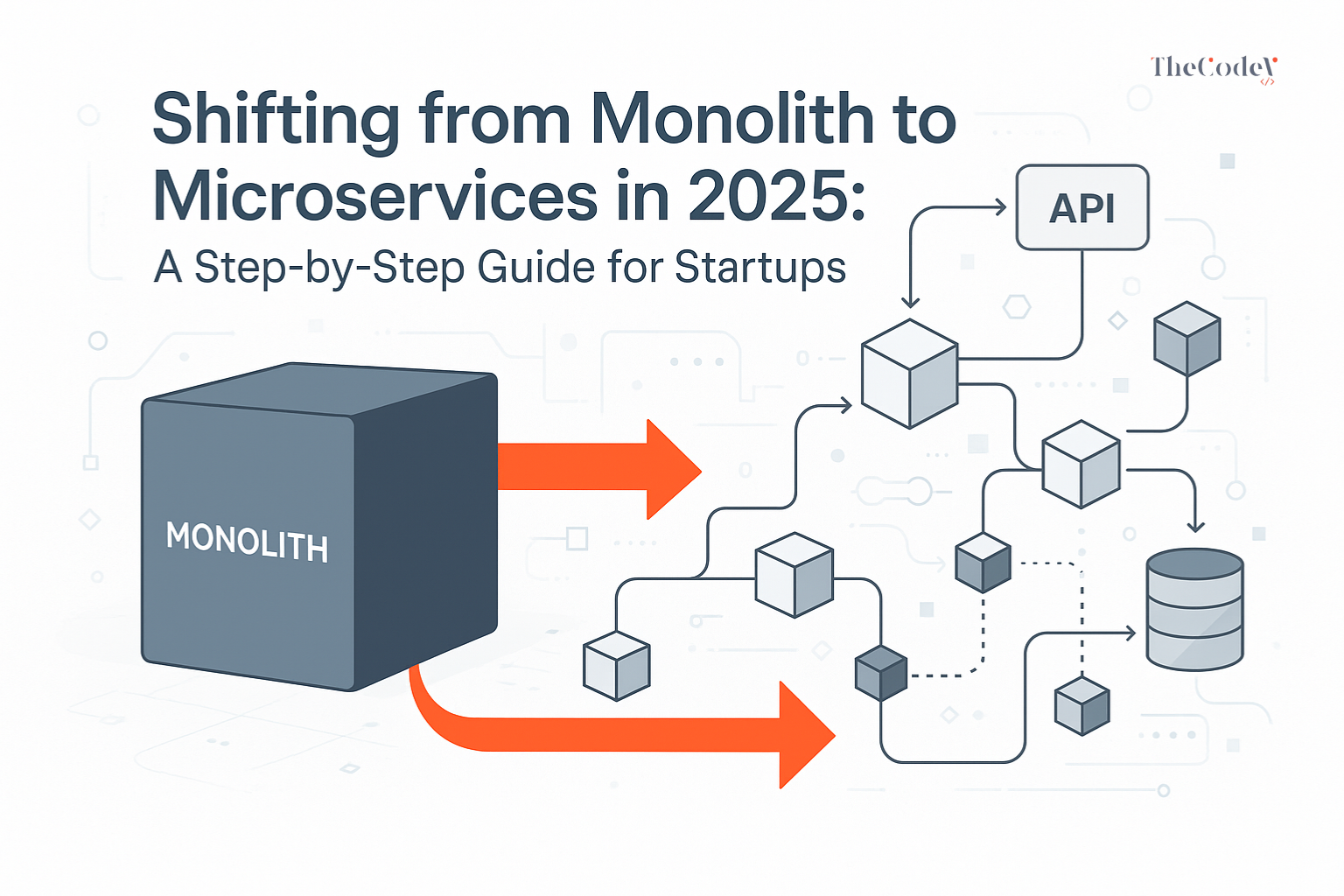
    Shifting from Monolith to Microservices in 2025: A Step-by-Step Guide for Startups

    Why Startups Are Prioritising Shifting from Monolith to Microservices in 2025

    The pressure to scale fast has never been more intense, and that’s why monolith to microservices migration has become one of the defining engineering strategies for startups in 2025. When product growth accelerates, a rigid monolith can turn from a launchpad into a bottleneck, slowing delivery, limiting scalability, and creating unnecessary operational risk.

    Modern founders are discovering that surviving in competitive markets means making architectural decisions that support agility, speed, and resilience from day one. Microservices aren’t just a trend. They’re a structural shift in how digital products are built, deployed, and scaled.

    The Rise of Distributed Architectures in 2025

    The global tech ecosystem has shifted towards distributed, event-driven systems because users expect flawless performance and instant responsiveness. Whether a startup is building a marketplace, SaaS platform, on-demand service, or AI-powered tool, growth often exposes the limits of monolithic structures.

    A monolith concentrates logic, data, and workflows in a single deployable unit. That simplicity is appealing in the early stages, but it rarely survives the demands of scale. As teams expand and product scope evolves, modules become tightly coupled, releases slow down, and dependencies multiply.

    This is where monolithic architecture to microservices refactoring enters the picture. Refactoring allows organisations to break complex systems into modular, independently deployable services that move at the speed modern markets require.

    Industry research reinforces this shift. Gartner predicts that by 2027, over 75% of global enterprises will run production workloads using microservices and container-based architectures, driven by the need for rapid innovation and operational efficiency (Gartner, “Cloud-Native Architecture Trends”). This same trend is now cascading into the startup world.

    Why Monoliths Are Becoming a Growth Barrier

    Many early-stage teams adopt monolithic design because it’s faster to build and easier for a small team to manage. The problem arises when the product takes off.

    Typical issues include:

    • Release cycles slow dramatically

    • Minor code changes cause unexpected breakage

    • Scaling one feature requires scaling the whole system

    • Onboarding new engineers becomes harder

    • Outages affect the entire platform

    • Technology upgrades become risky and time-consuming

    These pain points intensify as customer expectations climb and competition accelerates.

    As a result, founders and CTOs increasingly explore monolith to microservices migration strategy options long before failure begins to show up in the metrics.

    Shifting Engineering Mindsets

    Startups are adopting a more mature mindset around system design. Instead of viewing microservices as “enterprise architecture,” teams now see them as an enabler of:

    • Faster feature delivery

    • Independent team ownership

    • Continuous deployment

    • Improved performance under load

    • Reduced risk through isolation and decoupling

    This mindset aligns well with modern development practices championed by leaders across the industry. Thoughtworks, for example, continues to advocate for evolutionary architectures and domain-driven design to support long-term scalability in digital products (Thoughtworks Technology Radar).

    2025: The Year of Strategic, Incremental Migration

    The shift is not about rewriting everything overnight. Instead, startups are increasingly migrating monolithic application to microservices through targeted, incremental approaches that preserve product continuity.

    Many teams begin by extracting a single service such as payments, notifications, authentication, or search. This reduces risk while giving engineering teams real-world experience with distributed systems.

    This incremental strategy allows businesses to:

    • Avoid downtime

    • Maintain user experience

    • Reduce engineering disruption

    • Improve delivery pipelines one service at a time

    More importantly, it ensures the team is strategically aligned with the future of the platform — not trapped in the limitations of the past.

    The Strategic Advantage for 2025 Startups

    Microservices unlock flexibility for startups who want to ship faster, iterate without technical friction, and scale without architectural pain. As competition intensifies across digital products, an adaptable system becomes a core business advantage.

    For founders exploring this journey, understanding the why is the first step. The next is designing a structured, realistic migration plan — and that begins with examining the monolith itself.

    Understanding the Monolith: When Your Product Outgrows Its Foundations

    Every startup reaches a moment when its once-simple architecture starts feeling painfully restrictive, and this is often the earliest signal that a monolith to microservices migration may be on the horizon. What once worked beautifully during the early product phase begins to strain under the weight of new users, features, integrations, and team members.

    What a Monolithic Architecture Really Looks Like

    A monolithic system is typically built as a single, unified codebase where all modules—authentication, payments, search, dashboards, notifications, admin panels—live together, share the same runtime, and are deployed as one block.

    In the beginning, this simplicity is a gift. It reduces cognitive load, speeds up development, and allows small teams to iterate fast. Many iconic startups, from early-stage fintech platforms to SaaS tools, launched with monoliths because they provide a straightforward path to MVP.

    The trouble arrives when success introduces scale, complexity, and unpredictability.

    Common issues include:

    • Minor updates triggering full-system redeploys

    • Small bugs causing platform-wide outages

    • Performance bottlenecks that can’t be isolated

    • Tight coupling between modules that blocks experimentation

    • Slow onboarding as the codebase becomes harder to navigate

    These challenges compound with growth, affecting both product velocity and engineering morale.


    Key Warning Signs That It’s Time for Monolith to Microservices Migration

    Startups rarely wake up and decide to migrate out of curiosity. They migrate because the symptoms become too disruptive to ignore.

    Symptom 1 — Feature Releases Slow Down Dramatically

    If a team struggles to ship updates without breaking unrelated parts of the system, the monolith is no longer supporting innovation—it’s obstructing it. This often shows up as long QA cycles, repeated hotfixes, and dependency conflicts.

    Symptom 2 — Scaling Becomes Expensive or Inefficient

    A monolithic system typically scales vertically. That means adding more CPU or RAM to the entire application even if only one feature is under strain. It’s a costly, imprecise solution, especially for high-growth sectors like e-commerce or mobility platforms.

    Symptom 3 — Teams Trip Over Each Other’s Work

    As engineering squads grow, working inside a monolith creates friction. Merging branches becomes painful. Testing becomes unpredictable. Ownership becomes murky. These day-to-day frustrations are early indicators that monolith decomposition into microservices may be necessary.

    Symptom 4 — Reliability Starts Becoming a Business Risk

    When a single failure can take down the whole product, customers notice. Investors notice. Internal teams worry. A real-world example is a startup in the logistics sector where peak-hour traffic repeatedly caused cascading failures because one overloaded module froze the entire monolithic process.


    Technical and Organisational Limitations That Hold Startups Back

    Even before exploring migration opportunities, startups face a number of blockers that expose deeper architectural limitations.

    Technical Limitations

    • Shared database schemas that make refactoring risky

    • Complex interdependencies that developers fear touching

    • Lack of modular boundaries leading to unpredictable results

    • Slow test suites that balloon as the codebase grows

    These technical signals are often the first motivators for incremental monolith to microservices migration, allowing teams to migrate one component at a time instead of rewriting everything.

    Organisational Limitations

    • Growing teams struggle to take ownership of isolated domains

    • Context-switching fatigue sets in when developers navigate massive files

    • Cross-team coordination problems multiply

    • Product roadmaps slow down because engineering becomes a bottleneck

    These issues impact culture just as much as code. A strained monolith can frustrate developers, slow hiring, and complicate onboarding.


    Early Blockers That Often Delay Migration

    Despite clear warning signs, many startups hesitate.

    Common early blockers include:

    • Fear of downtime

    • Limited in-house distributed systems experience

    • Tight deadlines leaving no room for architectural improvements

    • Pressure to deliver features rather than invest in infrastructure

    • Concerns about cost and operational risk

    Martin Fowler notes that evolutionary architecture depends on teams embracing change as a continuous process rather than a single decision point (Martin Fowler, Microservices). This mindset is often the differentiator between startups that scale smoothly and those that struggle.


    Real Startup Scenarios That Highlight the Shift

    A travel-tech startup experiencing seasonal demand spikes found their search module crashing repeatedly because everything relied on the same synchronous process. Another AI-powered SaaS platform struggled because every model update required redeploying the entire monolith.

    Both cases illustrate the same truth: monoliths eventually become barriers to scalability, experimentation, and reliability.

    Understanding these s

    The Core Migration Patterns Every Startup Must Understand for Monolith to Microservices Migration

    Successful migrations don’t happen by chance—they follow proven architectural patterns that reduce risk and create a controlled, predictable transition path. This is why understanding the main monolith to microservices migration patterns is essential for any startup planning to modernise its systems in 2025. These patterns offer structure, clarity, and operational safety when handling complex, interdependent legacy systems.

    Startups working with older architectures often assume that migration requires a complete rewrite, but the industry’s most trusted approaches prove the opposite. True transformation happens incrementally, strategically, and with minimal disruption.


    Monolith to Microservices Migration Patterns That Define Modern Architecture

    H3: The Strangler Fig Pattern — Gradual, Low-Risk Migration

    One of the most respected approaches in the industry is the strangler fig pattern microservices migration, inspired by how a strangler fig tree grows around an existing structure. Instead of rewriting the entire application, teams gradually build new microservices around the monolith, replacing components piece by piece.

    This pattern is particularly useful for legacy monolith to microservices migration, where the existing system is too critical or fragile to be replaced in one step.

    Real startup example:
    A fintech startup handling payment processing couldn’t disrupt its core system. Using the strangler pattern, they extracted one service at a time—starting with authentication—routing traffic to the new components while keeping the monolith intact. Over time, the monolith shrank naturally.

    This approach reduces downtime, avoids full-system failures, and preserves business continuity.


    Event-Driven Decomposition — Building Independent, Reactive Services

    Event-driven decomposition is the backbone of modern distributed systems. Instead of relying on synchronous calls, microservices communicate through asynchronous events, allowing each service to operate independently.

    This pattern is ideal when dealing with microservices decomposition legacy system scenarios, especially where workflows are tightly coupled inside the monolith.

    For instance, a logistics startup discovered that every update to delivery status triggered multiple internal operations within the monolith. By introducing an event bus, they decomposed those workflows into independent microservices. Each service listened to relevant events—order created, driver assigned, delivery updated—resulting in faster development and higher resilience.

    Event-driven systems also support scalability and fault tolerance, making them a top choice across cloud-native platforms. The Microsoft Architecture Centre highlights event-driven systems as a key design foundation for scalable microservices (Microsoft Learn: Cloud-native Architecture Guide).


    API-First Migration Workflows — Creating a Unified Interaction Layer

    Before decomposing services, startups need a clear and consistent interface for communication. This is where API-first migration shines. Instead of directly refactoring internal modules, engineering teams create well-defined APIs that act as the single gateway for both the monolith and emerging microservices.

    This API layer becomes a contract that establishes:

    • Clear boundaries between functionalities

    • Predictable communication

    • Easier testing and debugging

    • A roadmap for gradual replacement

    A marketplace startup used this approach to isolate its product-search functionality. By first building an API layer, the team ensured that when the search module became a standalone microservice, nothing broke internally or externally.

    API-first workflows drastically reduce migration complexity and improve long-term maintainability.


    Domain-Driven Design Concepts — Structuring Services Around Business Logic

    Domain-driven design (DDD) helps teams identify natural boundaries within the system, making it easier to plan microservice extraction. Instead of slicing by technical layers, startups decompose their monolith according to business domains such as:

    • Payments

    • Orders

    • Notifications

    • User management

    • Analytics

    This method is essential for planning monolith to microservices migration patterns, ensuring services are cohesive, loosely coupled, and aligned with real business workflows.

    DDD also helps teams avoid one of the biggest pitfalls in migration: creating accidental micro-monoliths that still rely heavily on each other.

    A SaaS analytics company used DDD to separate their reporting engine from the user onboarding flow. This allowed the analytics pipeline to scale independently during peak usage, improving performance without rewriting the entire system.


    Strategic Support for Modern Startups

    These migration patterns form the backbone of modern software transformation. Whether a startup embraces the strangler fig pattern, event-driven workflows, or domain-driven boundaries, each method reduces risk and accelerates modernisation.

    To explore expert-led migration services, startups can review TheCodeV’s digital engineering expertise:
    https://blogs.thecodev.co.uk/digital-services/
    For tailored migration guidance, consultation options are available at:
    https://blogs.thecodev.co.uk/consultation/

    ymptoms is the first step to planning the journey ahead.

    A Practical Step-by-Step Monolith to Microservices Migration Workflow

    If startups want real transformation, they need a migration process they can trust—one that breaks the work into manageable, low-risk stages. This section outlines a practical, monolith to microservices step by step workflow designed for modern engineering teams who need clarity, speed, and predictable outcomes. The goal is not just migration, but building a scalable foundation for the next decade of product growth.

    This is where monolith to microservices migration becomes more than theory. It becomes a structured, operational plan.


    Step 1 — Assess the Monolith with Precision

    Before deciding how to migrate monolith to microservices, teams must understand what their monolith currently looks like under the hood.

    This assessment phase includes:

    • Mapping dependencies and data flows

    • Identifying modules with the most change activity

    • Evaluating performance bottlenecks

    • Reviewing shared database schemas

    • Documenting risks and constraints

    A startup in the health-tech space used this phase to uncover that 70% of outages originated from one tightly coupled notification module. This finding shaped their migration priorities and prevented unnecessary over-engineering.

    Pro tip: Use architecture visualisation tools and automated code scanning platforms to expose hidden dependencies.


    Step 2 — Identify Bounded Contexts Through Domain Analysis

    Bounded contexts form the foundation of clean microservice boundaries. They define what each part of the system owns, what it depends on, and how it communicates.

    Typical bounded contexts in startups include:

    • Payments

    • Orders

    • Authentication

    • User management

    • Notifications

    • Analytics

    This step prevents teams from creating microservices that overlap or rely excessively on each other.

    Domain-driven design, highlighted extensively in the AWS Well-Architected Framework, encourages teams to align services with real business workflows, not arbitrary technical layers.


    Step 3 — Create Service Boundaries and Migration Priorities

    Once the bounded contexts are clear, engineering teams decide which services to extract first. Choosing the right sequence is one of the best practices monolith to microservices transitions.

    Ideal first candidates include:

    • High-change modules

    • Features requiring independent scaling

    • Components with well-defined inputs and outputs

    • Workflows that frequently cause monolith instability

    Some teams start with authentication. Others begin with search, notifications, or payment processing. The key is to extract a service that:

    1. Reduces monolith complexity

    2. Can be isolated with minimal disruption

    3. Improves deployment velocity


    Step 4 — Set Up CI/CD Pipelines for Distributed Systems

    Microservices rely on automation. Without strong pipelines, migration slows down and deployments become chaotic.

    Your CI/CD workflow should include:

    • Automated testing (unit, integration, contract testing)

    • Containerisation using Docker

    • Kubernetes or ECS orchestration

    • Automated rollback mechanisms

    • Canary deployments for safer releases

    Google SRE emphasises automation as a core pillar of reliable service delivery, noting that manual processes introduce risk and increase operational fatigue.

    This stage ensures the foundation is strong enough to support multiple independently deployable services.


    Step 5 — Run the Migration in Parallel with the Monolith

    Parallel migration is essential to reducing downtime and keeping product development on track.

    This workflow typically involves:

    • Building new microservices alongside existing monolith code

    • Routing specific functionality to the new services

    • Keeping fallbacks to the monolith until stability is achieved

    • Gradually shifting traffic to the new services

    This technique aligns with the strangler pattern even when not used explicitly. It also helps avoid the dangers of a “big bang” rewrite.

    During this phase, monolith to microservices migration tools such as API gateways, service meshes, and monitoring systems become vital.


    Step 6 — Strengthen Observability, Testing, and Gradual Rollout

    A distributed system needs deep visibility.

    Key observability practices include:

    • Centralised logging (e.g., ELK stack, Datadog)

    • Tracing tools to follow requests between services

    • Real-time metrics for latency, failure rates, and throughput

    • Health checks and circuit breakers

    Teams should roll out each microservice gradually:

    • First to internal teams

    • Then to a small percentage of users

    • Finally to full production load

    This helps catch edge cases early and ensures a smooth transition.


    Supporting Engineering Teams Through Migration

    Startups often seek external guidance to fast-track architectural planning, stabilize distributed operations, or accelerate service extraction. For example, TheCodeV’s engineering support services can assist with domain modelling, container orchestration, CI/CD automation, and migration execution:

    Explore engineering services: https://blogs.thecodev.co.uk/services/
    Request expert review: https://blogs.thecodev.co.uk/consultation/

    Mastering Data, Observability, and Deployment During Monolith to Microservices Migration

    Distributed systems introduce one of the hardest engineering puzzles: managing data across multiple independent services without losing consistency, performance, or reliability. This is where many teams underestimate the complexity of modern architecture. A thoughtful approach to data and observability can make or break a monolith to microservices migration project, especially as systems scale and services evolve independently.

    Getting this layer right requires discipline, strategy, and an understanding of how data behaves when it no longer lives inside a single shared database.

    Database Decomposition — Breaking the Monolith at Its Core

    One of the biggest challenges in monolith to microservices database migration is dismantling the shared schema that underpins the monolith. A single database often acts as the central nervous system, connecting every module tightly together. Splitting it without compromising integrity requires careful planning.

    Teams typically follow three phased approaches:

    1. Logical Decomposition:
      Identify tables or collections that belong to specific bounded contexts.
      Example: separating user profiles from order history or billing data.

    2. Physical Decomposition:
      Move those logical groups into separate databases owned by each microservice.
      Ownership prevents accidental coupling and ensures autonomy.

    3. Data Ownership Enforcement:
      A microservice must be the only writer for its database, reducing sync conflicts.

    PostgreSQL and MongoDB both publish extensive guidance on database decomposition for service-based systems (PostgreSQL Docs – Designing for Distributed Architectures).

    This process unlocks true independence but must be handled with extreme care to avoid data loss or inconsistent state.

    Data Synchronisation — Getting Services to Agree Without a Shared Database

    Once databases are split, services still need to exchange data or react to changes elsewhere. This is where synchronisation strategies become essential.

    Key approaches include:

    • Change Data Capture (CDC):
      Tools like Debezium stream real-time changes from one service to another.

    • Event Propagation:
      Services publish events when updates occur, allowing others to react asynchronously.

    • Materialised Views:
      Services maintain cached copies of data they need for quick reads.

    A typical example is a subscription billing platform where the pricing microservice emits events whenever a plan is updated. The user service listens and updates its internal data model accordingly—no shared database required.

    CDC and event-based sync reduce the risk of circular dependencies while supporting high-scale systems.


    Event Sourcing — The Backbone of Auditability and Reliable State

    Event sourcing captures every change as an immutable event rather than overwriting state. This technique is extremely powerful for regulated industries, high-volume platforms, and systems requiring historical accuracy.

    Benefits include:

    • Full audit trails

    • Ability to rebuild service state from event logs

    • Improved system resilience

    • Easier debugging and replaying scenarios

    While event sourcing adds operational overhead, it is a strategic advantage for long-term scalability and speed.

    Observability — Seeing Across Distributed Boundaries

    Once a startup moves into microservices, the monolith-era debugging experience disappears. Logs are spread out, services operate independently, and failures happen in unexpected places.

    This is why observability becomes a critical pillar.

    Core practices include:

    • Centralised logging using tools like ELK or Datadog

    • Distributed tracing to follow requests between services

    • Metrics and dashboards for latency, throughput, and errors

    • Automated alerts for anomalies or degraded performance

    Datadog highlights that over 60% of distributed system failures originate from unseen inter-service interactions (Datadog, State of Observability). Having observability from day one prevents blind spots during and after migration.

    Deployment Options — Choosing the Right Execution Environment

    The migration isn’t complete until services are deployed in an environment that supports autonomy and scalability. Three deployment models dominate the 2025 landscape:

    1. Kubernetes (K8s)

    Ideal for teams needing extreme flexibility, autoscaling, and powerful orchestration.
    Supports blue-green deployments, canary rollouts, and service meshes.

    2. Serverless (AWS Lambda, Cloud Functions)

    Great for microservices with unpredictable traffic.
    Removes server management and scales instantly.
    Perfect for event-driven architectures.

    3. Container Platforms (Docker, ECS, Azure Container Apps)

    Simplest step for teams moving from monolith environments.
    Lightweight, predictable, and cost-effective.

    Choosing the right option is integral to a solid monolith to microservices migration strategy, as deployment governs reliability, cost efficiency, and long-term performance.


    For deeper engineering support or architectural guidance, startups can explore:

    Services: https://blogs.thecodev.co.uk/services/
    Contact: https://blogs.thecodev.co.uk/contact/

    The Real-World Challenges Startups Face During Monolith to Microservices Migration

    Every startup dreams of smoother releases, faster performance, and scalable architecture—but few fully anticipate how difficult monolith to microservices migration can be in practice. The process introduces new risks, new tooling, and entirely new engineering expectations. These challenges don’t mean teams should avoid migration; instead, they highlight the importance of planning, patience, and precision.

    Cost and Timeline Risks That Catch Startups Off Guard

    One of the biggest monolith to microservices migration challenges is the sheer unpredictability of cost and timelines. Migrating a live monolithic system often requires:

    • Refactoring legacy code

    • Redesigning data models

    • Adding observability

    • Rebuilding CI/CD pipelines

    • Training or hiring engineers

    Startups with lean budgets sometimes underestimate how long it takes to extract just a single service. What appears simple on paper—such as splitting billing from user management—may introduce cascading dependencies that must be untangled first.

    A well-known insight from Red Hat’s microservices research shows that over 60% of organisations underestimate the time required to fully stabilise new services (Red Hat: Microservices Adoption Report). This is especially true for smaller teams with limited migration experience.

    Skill Gaps and the Need for New Engineering Mindsets

    Migrating monolithic application to microservices requires skills beyond standard full-stack development. Engineers must understand:

    • Distributed tracing

    • Event-driven patterns

    • Container orchestration

    • Cloud-native deployment

    • Domain-driven boundaries

    Startups often face a steep learning curve. Developers who excel in monolithic workflows may struggle initially with concepts like eventual consistency or service resilience. This learning gap can slow progress unless the team invests in training or partners with experienced architects.

    For expert assistance, teams can explore TheCodeV’s engineering support:
    https://blogs.thecodev.co.uk/services/

    Operational Complexity Increases Before It Declines

    Many founders assume microservices automatically simplify everything. The truth is more nuanced. Operational complexity increases dramatically during the first phase of incremental monolith to microservices migration.

    Teams must now manage:

    • Multiple repositories

    • Independent deployments

    • Service discovery mechanisms

    • API gateways

    • Logging and monitoring stacks

    • Cross-service communication

    A monolith has one deployment pipeline. Microservices may have dozens. Without strong automation and observability, complexity can overwhelm teams, slowing migration and increasing downtime.

    Performance Issues from Network Overhead and Poor Boundaries

    Performance bottlenecks are another common challenge. In a monolith, function calls happen in memory, but in microservices they often happen over the network.

    This shift introduces new issues:

    • Increased latency

    • Failed API calls

    • Retry storms

    • Cascading failures

    The risk is higher when service boundaries are poorly defined. For example, if a microservice requires calling five others just to serve one request, the architecture becomes fragile. Performance tuning is an ongoing process, not a one-time fix.

    Choosing the Right Tools, Frameworks, and Techniques

    Startups must navigate a flood of tooling options across categories like:

    • API gateways (Kong, NGINX, Apigee)

    • Service meshes (Istio, Linkerd)

    • CI/CD systems (GitHub Actions, GitLab CI, ArgoCD)

    • Observability tools (Datadog, New Relic, Prometheus)

    Selecting the wrong tools early can lead to unnecessary cost, operational friction, or vendor lock-in. That’s why teams often begin with minimal tooling and scale complexity only when needed.

    External consulting can help reduce the risk of tool sprawl and architectural misalignment:
    https://blogs.thecodev.co.uk/consultation/

    Vendor Neutrality as a Strategic Priority

    Once startups enter cloud-native territory, vendor dependency becomes a real concern. Proprietary features from cloud providers—like messaging services, serverless runtimes, or monitoring tools—can create hidden long-term constraints.

    Vendor neutrality ensures:

    • Easier cloud migration in the future

    • Lower operational costs

    • Greater architectural flexibility

    • Reduced risk of being locked into one provider

    This is especially relevant when teams design event buses, data pipelines, or observability solutions. CNCF (Cloud Native Computing Foundation) strongly advocates for open standards and portable architectures to future-proof microservices ecosystems (CNCF Landscape Report).

    Building With Awareness

    Understanding these challenges is essential for designing a migration strategy that avoids unnecessary friction. Startups that anticipate cost, complexity, tooling choices, and skill gaps are far more likely to succeed in the journey from monolith to microservices.

    A Startup’s Journey from Monolith to Microservices — A Realistic Case Study

    The turning point arrived on a Friday evening, just as the product team at SwiftBasket, a fictional yet realistic on-demand grocery startup, prepared for their biggest marketing campaign of the year. Traffic spiked, orders poured in, and within minutes their monolithic application buckled under the pressure. The checkout module froze, the search engine lagged, and support tickets doubled. It was a harsh reminder of the limits built into their architecture—limits they could no longer ignore.

    Their experience reflects the challenges many growing startups face when navigating monolith to microservices migration challenges. At the time, SwiftBasket was scaling aggressively, but their architecture had not evolved with the business.

    Pain Points That Triggered Their Migration Decision

    SwiftBasket’s monolithic system had served them well in the early days. Their small team moved quickly, shipping features weekly. But as their customer base expanded, cracks began to show.

    1. Scaling Bottlenecks

    During peak hours, certain functions—especially order placement and live delivery tracking—caused the entire application to slow down. They couldn’t scale individual components, meaning the whole monolith had to scale vertically, resulting in unnecessary infrastructure cost.

    2. Slow Development Cycles

    Developers were constantly stepping on each other’s toes. A simple update to a pricing rule required retesting multiple unrelated modules. Deployments became risky, unpredictable, and stressful.

    3. Fragile Reliability

    A small bug in the notifications module once took down the entire platform. That’s when the team realised that migrating monolithic application to microservices wasn’t optional—it was essential for survival.

    4. Data Complexity

    The shared relational database had grown into an unmanageable spiderweb of foreign keys. Extracting a single feature felt like surgery with no anaesthetic.

    These challenges are common across high-growth digital platforms, and they signalled that an incremental monolith to microservices migration was overdue.

    How the Migration Unfolded

    SwiftBasket began with a precise migration roadmap inspired by proven industry principles.

    Step 1: Identifying Bounded Contexts

    Using domain-driven design, they mapped their platform into business domains:

    • Checkout

    • Catalogue

    • User Accounts

    • Delivery Tracking

    • Promotions

    This approach helped them locate natural seams in the monolith for extraction.

    Step 2: Extracting the First Service

    They chose to extract the checkout service first since it was both high-impact and well-defined. The team used the strangler pattern to route checkout traffic to the new service while the rest of the monolith remained intact.

    Step 3: Modernising Data Ownership

    As part of the migration, each service received its own database. This eliminated dangerous cross-dependencies and allowed the checkout system to scale independently during peak demand.

    Step 4: Implementing Observability

    Distributed tracing, centralised logs, and dashboard metrics were introduced to monitor service performance. Before this, debugging production issues took hours. After observability was implemented, issues were identified in minutes.

    Step 5: Accelerating Deployment Velocity

    Once services became independent, the engineering team unlocked parallel development. Instead of one risky weekly release, they deployed enhancements multiple times per day.

    The transformation was dramatic. Page load speeds improved. Downtime decreased. Developer morale soared. Customer satisfaction increased.

    Partners That Shaped Their Transformation

    Migration at this scale requires expertise. SwiftBasket collaborated with EmporionSoft to validate their architectural blueprint and stress-test their deployment strategy. Their consultation ensured that service boundaries were clear, scalable, and future-ready.

    But implementation is where they needed deeper, hands-on engineering support.

    This is where TheCodeV entered the picture.

    TheCodeV acted as a modern engineering partner, helping SwiftBasket refine service boundaries, containerise workloads, establish CI/CD pipelines, and deploy microservices using cloud-native tooling. Their expertise in distributed systems allowed SwiftBasket to move faster, reduce risk, and modernise without disrupting day-to-day operations.

    For businesses undergoing similar challenges, TheCodeV’s specialised digital engineering services are available here:
    https://blogs.thecodev.co.uk/services/

    For collaborative architectural assessments or technical discussions, teams can reach out directly at:
    https://blogs.thecodev.co.uk/contact/

    Why Monolith to Microservices Migration Sets Startups Up for Long-Term Success

    The journey from a monolithic system to distributed services is never simple, yet it becomes increasingly essential as digital products scale. This is why monolith to microservices migration remains one of the most important architectural decisions a startup can make in 2025. The shift demands patience, clarity, and discipline, but the long-term rewards—speed, resilience, scalability, and innovation—are well worth the effort.

    Startups that embrace this evolution early often discover that modern engineering isn’t just a technical upgrade. It’s a catalyst for business growth.


    Reflecting on the Migration Journey

    Across this guide, we explored the entire lifecycle of a successful migration:

    • Understanding the monolith and recognising early signals that it can no longer support rapid scale.

    • Identifying bounded contexts to create clean, future-proof service boundaries.

    • Using proven migration patterns such as the Strangler Fig approach and event-driven decomposition.

    • Executing a step-by-step blueprint for extracting services, establishing CI/CD pipelines, and adopting strong observability.

    • Addressing real-world challenges including cost risks, team skill gaps, operational complexity, and tooling decisions.

    • Examining a real case study, showing how a fictional startup transformed performance, reliability, and engineering velocity through a structured migration journey.

    Every stage of the process reinforces the same truth: startups that modernise early build more competitive, durable, and scalable products.

    The Long-Term Value for Startups

    Microservices do more than solve immediate scaling problems. They create an engineering environment where teams can:

    • Deploy features faster and more safely

    • Scale individual components instead of the entire platform

    • Adopt new technologies without rewriting the system

    • Improve resilience and fault isolation

    • Build specialist teams that own independent services

    • Reduce long-term maintenance cost

    • Innovate without architectural constraints

    This future-ready model allows startups to grow without fearing their infrastructure. When architecture becomes an enabler rather than a blocker, founders and CTOs gain the freedom to focus on the product and the market—not firefighting technical debt.

    Making the Shift with Confidence and the Right Partner

    A monolith to microservices migration is a defining moment in a startup’s evolution. It requires technical maturity, careful planning, and ongoing execution. But you don’t need to take this journey alone.

    This is where TheCodeV becomes a strategic ally.

    As a modern engineering partner, TheCodeV helps startups:

    • Define migration roadmaps

    • Decompose monolithic systems

    • Establish microservice boundaries

    • Build cloud-native CI/CD pipelines

    • Implement observability and distributed tracing

    • Deploy microservices using Kubernetes, containers, or serverless

    • Improve system reliability and performance

    • Scale engineering teams with expert guidance

    Their digital engineering expertise spans multiple industries and technologies, ensuring that your migration strategy aligns with long-term product goals.

    Whether you are planning your first service extraction or scaling an existing ecosystem, TheCodeV’s team provides hands-on support backed by real-world experience.

    Explore their capabilities here:
    https://blogs.thecodev.co.uk/services/

    Or start a conversation about your architecture:
    https://blogs.thecodev.co.uk/contact/

    And if you’re new to TheCodeV or exploring what they do, you can learn more about their approach and ethos on the homepage:
    https://blogs.thecodev.co.uk/


    A Final Word for Founders, CTOs, and Startup Teams

    Your architecture is the backbone of your product. If it cannot scale with your vision, it will eventually slow you down. The move to microservices is not just a technical decision—it’s a strategic investment in your company’s freedom to innovate, expand, and compete.

    If you’re ready to modernise your platform, reduce technical debt, and empower your engineering team, now is the right moment to take the first step.

    Choose an architecture that grows with your ambitions. Choose a partner that understands your journey. Choose TheCodeV.
     

  • The Founder’s FinOps Playbook: Cloud Cost Controls from Day One

    The Founder’s FinOps Playbook: Cloud Cost Controls from Day One

    The Founder’s FinOps Playbook: Why Cloud Cost Controls Matter from Day One

    The Unexpected Wake-Up Call of Cloud Costs

    It often begins with a shock. A startup founder checks their monthly cloud invoice expecting a few hundred pounds, only to find a bill running into the thousands. This moment—familiar to countless early-stage teams—is where most realise that cloud costs can spiral rapidly without proper governance. Cloud computing offers unprecedented agility, yet this same flexibility makes financial management complex. Here’s where FinOps for startups becomes essential, not as an afterthought but as a core operational mindset from day one.

    What Is FinOps and Why It Matters for Startups

    FinOps, short for Financial Operations, is a cultural and technical framework that brings financial accountability to cloud spending. It empowers teams to make data-driven decisions about cloud usage, balancing speed, cost, and innovation. In simpler terms, FinOps aligns the goals of engineering, finance, and business leaders—ensuring that every pound spent in the cloud drives measurable value.

    For startups, where cash flow defines survival, FinOps is not just about cutting costs—it’s about financial efficiency and control. According to the FinOps Foundation, the methodology focuses on three iterative phases: Inform, Optimise, and Operate. These principles enable startups to gain visibility into spending, identify waste, and embed cost-aware practices into every sprint or deployment.

    Common Cloud Cost Mistakes Early Founders Make

    Many founders unintentionally burn through their cloud credits and budgets by focusing solely on growth metrics. Common mistakes include:

    • Lack of cost visibility: Teams launch multiple environments without tracking real-time usage.

    • Over-provisioning resources: Startups often choose high-performance instances that far exceed actual requirements.

    • Ignoring idle assets: Development environments and test servers run 24/7, draining budgets.

    • Reactive budgeting: Costs are reviewed only after invoices arrive, leaving little room for correction.

    Without a structured startup finance management approach, these errors compound over time, impacting scalability and investor confidence.

    FinOps: Bridging the Gap Between Finance and Engineering

    Historically, finance teams and engineers have operated in silos—one focused on budgets, the other on performance. FinOps unites these worlds by fostering collaboration through shared visibility and accountability. Engineers learn to treat cloud costs as a performance metric, while finance teams gain real-time insights into technical spending decisions.

    By introducing FinOps for startups, founders create a culture where cost discussions are part of sprint planning, and resource utilisation is continuously evaluated. The result is an agile organisation that can grow sustainably while maintaining control over its cloud cost optimisation strategy.

    TheCodeV: Enabling Smarter Cloud Financial Operations

    At TheCodeV, we understand that effective financial operations in startups require both technology and strategy. Our team helps founders implement scalable cloud architectures, automate cost monitoring, and align technical execution with financial goals. Through our tailored Digital Services, we enable startups to build strong FinOps foundations that evolve with their growth.

    For startups looking to gain greater control and insight into their cloud expenditure, partnering with experts who blend engineering discipline with financial insight can make all the difference. You can learn more or speak with our consultants via the Contact page.

    As Gartner highlights in its Cloud Financial Management Report, organisations that adopt FinOps early achieve up to 30% cost efficiency improvements through better visibility and shared accountability models. For startups, that efficiency can determine whether they reach the next funding milestone—or stall before scaling begins.

    Understanding the FinOps Framework: Building Cost-Aware Startups from the Ground Up

    The DNA of FinOps for Startups

    For growing founders, FinOps for startups is more than a financial discipline—it’s a shared operational philosophy. Instead of treating cloud expenses as unpredictable overheads, FinOps embeds accountability, transparency, and real-time collaboration into every decision. At its core, FinOps ensures that cloud spending is not just tracked, but actively managed in alignment with business value and agility.

    Whether a startup runs its workloads on AWS, Google Cloud, or Azure, understanding the FinOps framework can transform how teams balance innovation with financial efficiency. According to the FinOps Foundation, this framework revolves around three key pillars: Inform, Optimise, and Operate.


    1. Inform — Bringing Visibility and Awareness

    The Inform phase focuses on cost visibility in cloud environments. For startups, this means setting up dashboards, tags, and budgets that make cloud usage transparent to everyone—from developers to the CEO.

    Startups can begin by:

    • Tagging cloud resources by project or environment to understand spending patterns.

    • Setting clear ownership for each service or workload.

    • Integrating billing reports into weekly reviews, ensuring teams see real-time cost data.

    By making cost information accessible, the Inform stage creates a shared understanding of how technical decisions affect finances—an essential first step in startup finance management.


    2. Optimise — Turning Visibility into Action

    Once teams can see where money is going, the Optimise phase empowers them to act. This is where engineers, product managers, and finance leads collaborate to refine cloud usage.

    Key optimisation practices for startups include:

    • Rightsizing instances based on actual utilisation metrics.

    • Shutting down idle environments outside of business hours.

    • Using spot or reserved instances to reduce predictable workloads.

    • Reviewing data storage tiers to prevent unnecessary retention costs.

    Startups can use free or low-cost tools offered by major providers—like Google Cloud’s FinOps Guide—to benchmark efficiency and automate optimisations early.

    This phase is about developing financial reflexes early, turning awareness into meaningful cost reductions that fuel sustainable growth.


    3. Operate — Embedding FinOps into Everyday Workflows

    The final pillar, Operate, focuses on making FinOps a continuous process. For early-stage teams, this doesn’t mean implementing heavy bureaucracy—it’s about introducing lightweight governance that scales as the company grows.

    Examples of startup-friendly governance models include:

    • Weekly FinOps stand-ups to review cloud metrics and upcoming releases.

    • Defined spending thresholds that trigger alerts when budgets are exceeded.

    • Shared responsibility models where both technical and financial stakeholders co-own budget performance.

    This collaborative rhythm ensures that financial decisions are part of product development, not a reaction to invoices at month-end. Over time, this culture of accountability becomes a natural part of the startup’s DNA—making financial operations proactive rather than reactive.


    FinOps Culture: A Collaboration Between People and Process

    A mature FinOps culture thrives on cross-functional collaboration. The CTO drives efficiency through architecture choices, the finance lead manages forecasting, and developers learn to balance performance with cost awareness. Together, they create an iterative loop that supports innovation without compromising fiscal responsibility.

    At TheCodeV, this philosophy aligns closely with how we help startups scale through technical and financial excellence. Our Services empower businesses to integrate cost visibility and governance frameworks from the beginning—ensuring agility and resilience even under budget constraints.

    By embracing these cloud financial governance principles early, startups not only control expenses but also build investor-ready transparency and discipline—laying the foundation for sustainable, scalable growth

    Cloud Budgeting for Startups: From Panic to Predictable Spending

    The Moment Every Founder Dreads

    You launch your MVP, excitement builds, and user activity starts to grow. Then—an unexpected notification hits your inbox: your cloud bill has doubled overnight. What was meant to be a smooth scale-up has turned into a financial scramble. This is a familiar story for many early-stage teams, and it highlights why cloud budgeting for startups is not a nice-to-have—it’s a survival skill.

    The unpredictable nature of pay-as-you-go models makes it easy for cloud expenses to spiral. Without visibility or proactive monitoring, founders can lose control of their startup cloud spend management, impacting everything from product roadmaps to investor trust.


    Why Visibility Is the First Step to Budgeting Control

    Before startups can manage costs, they need cost visibility in cloud environments. Understanding where money is going—and why—is fundamental to all other FinOps activities. Visibility means seeing which services consume the most resources, which projects overrun their budgets, and how usage trends evolve over time.

    The best startups make visibility a habit. They treat their cloud spending data like any other business KPI—tracked, reported, and acted upon regularly.

    Practical visibility tactics include:

    • Centralised dashboards: Tools like AWS Cost Explorer (source) and Google Cloud Billing Reports (source) help visualise daily or hourly spending patterns.

    • Usage tagging: Labeling resources by project, feature, or environment improves attribution and accountability.

    • Custom alerts: Automated notifications can warn teams when spend thresholds are reached.

    • Cloud credits tracking: Many cloud providers offer startup credits; monitoring their expiry ensures continuity in budgeting.

    These measures allow teams to predict expenses instead of reacting to invoices.


    Manual vs Automated Cost Tracking: Choosing the Right Approach

    Every startup begins somewhere. For small teams, it might be tempting to track expenses through manual spreadsheets—and initially, this can work. A simple Google Sheet with columns for resources, costs, and owners offers a basic snapshot. However, as applications scale, manual tracking quickly becomes time-consuming and error-prone.

    By contrast, automated FinOps tools and cloud-native dashboards provide real-time data, anomaly detection, and trend forecasts. They not only streamline reporting but also uncover inefficiencies before they become costly.

    ApproachAdvantagesLimitations
    Manual (Spreadsheets)Low cost, full control, ideal for early MVP phaseLabour-intensive, delayed insights, prone to human error
    Automated Tools (AWS/GCP/Azure dashboards)Real-time visibility, forecasting, integrates with billing APIsRequires setup time, learning curve
    FinOps Platforms (Apptio, Kubecost, CloudHealth)End-to-end automation, alerts, benchmarkingMonthly subscription fees may add cost overhead

    For long-term sustainability, startups should transition to automated systems early in their growth phase.


    Establishing Smart Cloud Budgeting Practices

    An effective cloud budgeting for startups strategy combines discipline, visibility, and automation. Founders can start small with actionable habits:

    • Set defined budgets per product line or microservice.

    • Review usage weekly to detect anomalies early.

    • Implement approval policies for scaling or new resource creation.

    • Leverage provider discounts such as reserved instances or committed use contracts.

    Embedding these habits ensures that every pound spent in the cloud has a measurable purpose, aligning both technical and financial priorities.


    How TheCodeV Helps Startups Build Cost Clarity

    At TheCodeV, we’ve seen firsthand how lack of visibility can delay scaling or drain seed-stage runway. Our cloud specialists assist founders in deploying automated visibility and budgeting solutions that align with their operational stage and growth goals. Through our tailored Consultation services, we assess your existing infrastructure and identify areas where cost controls can be embedded.

    Additionally, our transparent Pricing Plans are structured to fit startup realities—offering scalable packages for cloud setup, monitoring, and ongoing optimisation.


    From Chaos to Clarity

    Budgeting shouldn’t feel like firefighting. By combining cost visibility in cloud, automation, and strategic oversight, startups can turn unpredictable bills into reliable forecasts. As cloud infrastructure becomes central to every digital venture, building this discipline early enables founders to allocate resources intelligently—freeing their teams to focus on innovation rather than expense anxiety.

    FinOps Tools: The Tech Stack Powering Smarter Cloud Cost Optimisation

    The Evolution of FinOps Tooling for Startups

    The early days of cloud adoption were marked by spreadsheets, manual monitoring, and guesswork. Today, that approach no longer scales. As startups migrate more workloads to AWS, Google Cloud, or Azure, FinOps tools have evolved from basic reporting utilities into intelligent automation systems that integrate directly with engineering workflows.

    Modern financial operations in startups rely on these tools to balance innovation with accountability. They not only reveal where cloud budgets are going but also suggest how to optimise them—automatically. For founders aiming to manage costs efficiently while growing fast, adopting the right FinOps tools can transform chaos into clarity.


    Why Tools Are Central to FinOps Maturity

    FinOps is built on culture, but it scales through tooling. Once a startup’s monthly cloud bill reaches a certain threshold, automation becomes essential. Manual tracking can’t detect anomalies fast enough or scale across multi-cloud environments.

    Effective FinOps tooling helps startups:

    • Automate visibility with real-time dashboards and forecasts.

    • Identify waste such as idle resources or overprovisioned instances.

    • Implement policies for budgets, spend alerts, and optimisation.

    • Empower teams with actionable data rather than raw numbers.

    According to the Gartner Cloud Cost Management and Optimization Report, organisations using dedicated FinOps solutions reduce cloud waste by up to 30%, highlighting the measurable impact of automation and analytics in cloud budgeting.


    Top FinOps Platforms for Startups

    The FinOps landscape now features a range of specialised tools, each designed for different levels of maturity and complexity. Here are some of the most impactful platforms for startup environments:

    1. CloudHealth by VMware

    A comprehensive cost-management suite offering insights across multi-cloud environments. It enables policy-based automation, custom reports, and benchmarking. Ideal for startups preparing for scale or managing hybrid setups.

    2. Apptio Cloudability

    Focused on enterprise-grade financial control, Cloudability translates complex usage data into financial metrics. It’s known for deep cost-allocation capabilities, forecasting, and governance dashboards—powerful for startups with multiple business units or teams.

    3. Kubecost

    An open-source FinOps tool built for Kubernetes environments. Kubecost allows granular visibility into container workloads, making it perfect for SaaS startups leveraging microservices or cloud-native infrastructure.

    4. Cloud-Native Tools (AWS, GCP, Azure)

    Before adopting third-party platforms, early-stage startups can leverage built-in solutions:

    • AWS Cost Explorer for spend analytics and anomaly detection.

    • Google Cloud Billing Reports for daily usage and trend forecasting.

    • Azure Cost Management + Billing for unified dashboards and policy alerts.

    These cloud-native tools are ideal first steps for small teams practising startup cloud spend management before investing in paid FinOps platforms.


    Automation in Action: Smarter Cloud Optimisation

    The best FinOps tools don’t just display numbers—they act on them. Automation capabilities have redefined cloud cost optimization, enabling proactive management rather than reactive correction.

    Examples of automation in FinOps include:

    • Autoscaling: Dynamically adjusts computing power based on traffic, preventing overprovisioning.

    • Rightsizing: Continuously analyses resource usage and recommends smaller, cheaper configurations where possible.

    • Idle Resource Detection: Identifies underutilised instances, storage, or databases that can be paused or terminated.

    • Budget Alerts: Automatically triggers notifications when spend exceeds thresholds, improving accountability.

    By integrating these automations, startups can optimise costs without compromising performance or speed.


    How TheCodeV Enables Intelligent FinOps Automation

    At TheCodeV, our engineering and strategy teams help startups select and deploy the right mix of FinOps platforms to suit their stage and scale. From AWS-native billing analytics to Kubernetes cost optimisation, we design solutions that make cloud efficiency measurable and repeatable.

    Our Case Studies demonstrate how startups have used our expertise to achieve transparency and operational control, integrating FinOps practices directly into their development pipelines.

    For modern startups, tools are not just supporting FinOps—they are FinOps. Automation bridges the gap between finance and engineering, turning every deployment into a financially intelligent action.

    FinOps for SaaS Startups: Scaling Responsibly in a Multi-Cloud World

    Why FinOps Is Non-Negotiable for SaaS Founders

    For fast-growing SaaS businesses, the cloud is both a blessing and a potential financial liability. The very scalability that powers user growth can also inflate costs exponentially if left unchecked. That’s why FinOps for SaaS startups isn’t just an operational layer—it’s a strategic advantage. By embedding financial awareness into engineering and product design, SaaS founders gain predictable control over variable expenses such as storage, compute, and data transfer.

    In subscription-driven models, usage-based billing can fluctuate month to month. FinOps ensures that such variations are anticipated and aligned with revenue growth, rather than eroding margins. This approach strengthens startup finance management by turning cloud economics into an enabler of scale—not a constraint.


    Handling Usage-Based Billing and Scaling Customers

    SaaS products often bill customers by activity—API calls, data volume, or user sessions. Each of these metrics directly ties back to underlying cloud costs. Without a structured FinOps approach, costs can rise faster than customer revenues.

    Key FinOps principles for SaaS scaling include:

    • Usage-to-revenue alignment: Track infrastructure usage per customer segment to identify unprofitable plans.

    • Dynamic pricing visibility: Continuously monitor how cloud cost increases affect subscription tiers.

    • Proactive resource scaling: Implement autoscaling to manage customer spikes without overspending.

    • Storage optimisation: Archive cold data and leverage lifecycle policies for long-term savings.

    By adopting these practices, SaaS startups create a transparent link between financial and technical performance—supporting agile scaling while maintaining profitability.


    Multi-Cloud Cost Tracking and Visibility

    Modern SaaS startups rarely rely on a single cloud vendor. Multi-cloud strategies—combining AWS for compute, Google Cloud for AI services, and Azure for compliance workloads—offer flexibility but add complexity.

    To maintain cost visibility in cloud environments, FinOps teams deploy unified dashboards that aggregate spend data from all providers. Key approaches include:

    • Cross-platform analytics: Use APIs or third-party tools like CloudHealth or CloudCheckr to consolidate AWS, GCP, and Azure costs.

    • Central tagging frameworks: Apply consistent resource labels across clouds for clear attribution.

    • Automated anomaly detection: Detect sudden cost changes in real time before they impact budgets.

    This unified approach strengthens cloud financial governance, ensuring accountability across environments and preventing wasteful overlap.


    Early FinOps Maturity: A Signal to Investors

    Investors increasingly assess startups on operational efficiency, not just growth velocity. Demonstrating early FinOps maturity—proactive budgeting, transparent reporting, and optimised infrastructure—signals fiscal discipline and scalability readiness.

    According to McKinsey’s Cloud Value Realisation Study, companies that adopt structured cloud financial management achieve up to 25% faster ROI on technology investments. For SaaS startups, this translates directly into investor confidence and sustainable valuation growth.


    Integrating FinOps into the SaaS Business Model

    FinOps should be woven into every layer of a SaaS operation—from engineering to marketing analytics. The result is a culture that balances experimentation with financial accountability.

    Examples of integration include:

    • Embedding cost efficiency metrics into DevOps pipelines.

    • Including cloud expenditure forecasts in quarterly business reviews.

    • Linking customer usage analytics with financial dashboards.

    At TheCodeV, we help SaaS startups embed these principles into their architecture and operations. Our cloud and digital strategy specialists enable founders to achieve scalable efficiency while maintaining full financial transparency. We also leverage performance-driven insights similar to those used in Ecommerce SEO, ensuring that both cost and revenue are optimised in tandem.


    The FinOps Advantage for SaaS Growth

    Adopting FinOps for SaaS startups early creates a foundation for controlled scalability, improved investor relations, and data-driven decision-making. By combining disciplined cloud financial governance with automation and visibility, SaaS founders can grow confidently—knowing their cloud infrastructure is a strategic asset, not a hidden expense.

    AWS FinOps for Startups: Turning Cloud Efficiency into a Competitive Edge

    Why AWS FinOps Matters for Early-Stage Startups

    For startups building on Amazon Web Services, cloud agility is a major advantage—but it comes with financial complexity. Without a clear FinOps strategy, AWS’s pay-as-you-go model can lead to unpredictable bills and missed savings opportunities. Implementing AWS FinOps for startups ensures founders maintain cost visibility in cloud environments while optimising performance and scalability.

    FinOps on AWS is about creating transparency, accountability, and governance. It combines technical controls with financial strategy, allowing teams to optimise resources without sacrificing innovation. For early-stage companies, this can make the difference between scaling sustainably and burning through valuable runway.


    Key AWS FinOps Strategies for Startups

    1. Reserved Instances and Savings Plans

    The quickest win in cloud cost optimization on AWS comes from long-term commitment models. Startups can reduce costs by up to 72% using Reserved Instances (RIs) or AWS Savings Plans, which offer flexible pricing for predictable workloads.

    • Reserved Instances (RIs): Best for consistent workloads like backend APIs or databases.

    • Savings Plans: Provide broader flexibility, applying discounts automatically across EC2, Lambda, and Fargate services.

    • Recommendation: Start small with one-year commitments and evaluate regularly as workloads stabilise.

    2. Spot Instances and Auto Scaling

    AWS Spot Instances let startups leverage unused capacity at massive discounts—ideal for non-critical, interruptible tasks such as data processing or test environments. Combined with Auto Scaling Groups, teams can dynamically adjust capacity to match demand, preventing over-provisioning.

    This balance of flexibility and automation helps startups remain cost-efficient during traffic fluctuations.

    3. Cost Anomaly Detection and Monitoring

    Unexpected spikes in spending can cripple a startup’s budget. AWS Cost Anomaly Detection, powered by machine learning, monitors billing patterns and automatically flags unusual activity. Founders can:

    • Set up usage thresholds for specific services (e.g., S3, EC2).

    • Receive real-time alerts through Amazon SNS or email.

    • Correlate anomalies with recent deployments or feature releases.

    Such proactive monitoring enhances both transparency and control—critical pillars of cloud financial governance.


    Implementing AWS Budgets and Alerts

    The AWS Budgets feature offers startups the ability to track spending in real time and avoid unpleasant surprises. Through a simple dashboard, founders and engineers can:

    • Set budgets for overall accounts, projects, or services.

    • Automate alerts when thresholds (e.g., 80% of monthly budget) are reached.

    • Visualise cost trends across months for improved forecasting.

    • Integrate with IAM roles to delegate financial ownership securely.

    Budgeting isn’t just a technical feature—it’s a communication tool. It helps bridge conversations between development teams and finance, making every stakeholder aware of the business impact of their technical decisions.

    For detailed implementation steps, AWS provides a comprehensive guide on its Cost Management Blog, outlining best practices for startups at different maturity levels.


    Governance and Ownership: Building Accountability in the Cloud

    Effective cloud financial governance means defining clear ownership of cloud costs and creating visibility across teams. Governance on AWS can be achieved through structured processes and cultural alignment.

    Startups should establish:

    • Cost ownership roles: Assign each product or environment to a technical owner accountable for spend.

    • Tag-based cost allocation: Tag every AWS resource by project, environment, and owner.

    • Monthly FinOps reviews: Evaluate performance, cost anomalies, and forecasted trends.

    • Shared dashboards: Provide access to both engineering and finance teams for full transparency.

    This system ensures that cost visibility in cloud operations becomes a shared responsibility rather than a single department’s burden.

    As the FinOps Foundation notes, governance isn’t about restriction—it’s about empowering teams with insight and ownership.


    How TheCodeV Supports AWS FinOps Adoption

    At TheCodeV, we’ve helped multiple early-stage ventures implement AWS FinOps strategies that balance innovation and cost control. By combining technical monitoring with structured financial reporting, startups gain clarity and confidence in their cloud decisions.

    For startups seeking hands-on guidance or tailored governance frameworks, our experts are available via the Contact page to discuss scalable FinOps approaches suited to their specific AWS architecture and growth plans.

    Scaling FinOps Maturity: From Ad Hoc Management to Continuous Optimisation

    The FinOps Journey for Startups

    Every startup begins its cloud journey with enthusiasm, agility, and rapid experimentation—but often without structured financial oversight. Over time, as cloud usage expands, founders start to realise that the same flexibility driving innovation can also fuel unpredictable expenses. This is where FinOps for startups evolves from a reactive cost-control method into a structured operational discipline.

    The FinOps maturity journey typically unfolds in three stages: Ad Hoc, Optimised, and Continuous Improvement. Each stage reflects growing collaboration between finance, engineering, and leadership, helping startups move from cost chaos to financial clarity.


    Stage 1: Ad Hoc — Managing Cloud Spend After the Fact

    In the early phase, most startups operate with minimal cost controls. Cloud expenses are reviewed reactively—usually after an invoice sparks concern. There’s limited forecasting, inconsistent tagging, and no dedicated ownership of spend.

    At this stage:

    • Budgets are rarely defined or enforced.

    • Cloud costs are viewed as a necessary trade-off for agility.

    • Decision-making is siloed—developers deploy, finance reconciles.

    Although this approach works for small teams in MVP mode, it quickly becomes unsustainable as products scale.


    Stage 2: Optimised — Building Financial Awareness and Control

    In this phase, startups begin formalising startup cloud spend management through structured reporting and automation. FinOps becomes embedded in workflows, and teams start focusing on efficiency without compromising delivery speed.

    Key initiatives in this stage include:

    • Tagging and cost attribution: Every workload or service is labelled by project or department.

    • Budget forecasting: Monthly budgets are set per feature, with alerts and variance reports.

    • Regular review cycles: Teams meet weekly to review cloud usage and identify optimisation opportunities.

    • Defined metrics: KPIs such as cost per customer, cost per API call, or cost per feature provide tangible visibility.

    This stage marks the cultural shift—where startup finance management and engineering goals align around a common language of value and performance.


    Stage 3: Continuous Improvement — FinOps as a Strategic Enabler

    In the final stage, FinOps becomes a continuous, automated process that drives strategic decisions. Startups adopt advanced analytics, predictive modelling, and real-time visibility across multi-cloud environments.

    Here, teams focus on:

    • Automating optimisation through autoscaling, instance rightsizing, and usage-based pricing adjustments.

    • Benchmarking cost efficiency across internal teams or product lines.

    • Embedding FinOps metrics into company OKRs to ensure long-term accountability.

    • Integrating performance and cost analytics for real-time decision support.

    According to the FinOps Maturity Model, companies that reach this level treat cost efficiency as a competitive differentiator—not just an operational requirement.


    Institutionalising FinOps in a Startup Environment

    For FinOps to thrive, it must move beyond spreadsheets and dashboards into the company’s culture. Institutionalising FinOps means creating repeatable systems that sustain cost awareness, even as teams and architectures evolve.

    Examples of institutionalised practices include:

    • FinOps champions: Designate a cross-functional leader responsible for cloud cost governance.

    • Shared dashboards: Enable both finance and engineering to see real-time spend data.

    • Quarterly optimisation sprints: Evaluate underperforming workloads and reallocate savings.

    • Internal education: Train developers on the financial impact of deployment decisions.

    At TheCodeV, we help startups embed these cultural and technical systems, ensuring that cost optimisation evolves naturally alongside growth. Through collaborative Consultation sessions, founders and teams can design bespoke FinOps frameworks suited to their cloud infrastructure and business model.


    Real-World Insight: EmporionSoft’s FinOps Transformation

    A notable example of FinOps maturity in action is EmporionSoft, a scaling software company that adopted FinOps principles early in its cloud journey. By introducing visibility dashboards, automated alerts, and cost-per-feature tracking, the team achieved measurable gains in efficiency and budget predictability.

    This real-world application demonstrates how structured cloud cost optimization can empower startups to scale faster and smarter—turning operational discipline into a growth catalyst.


    From Cost Control to Cost Confidence

    The FinOps maturity journey is not a one-time initiative—it’s an evolving mindset. As startups grow, so too should their ability to optimise, forecast, and innovate responsibly. By mastering FinOps, founders move beyond managing expenses to achieving cost confidence—the ability to innovate boldly, knowing their cloud investments are strategically aligned with business success.

    Conclusion: Building Financially Agile Startups Through FinOps Mastery

    From Cloud Chaos to Cost Control

    Throughout this playbook, one truth has become clear — cloud success isn’t just about scalability or performance, it’s about sustainability. Adopting FinOps for startups early transforms cloud spending from a volatile expense into a predictable, data-driven investment. By combining cloud cost optimisation, budgeting discipline, and collaboration between technical and financial teams, founders can future-proof their businesses from day one.

    FinOps isn’t a one-time initiative; it’s an evolving practice that grows alongside your startup. It enables smarter decisions, reduces waste, and improves overall agility — ensuring that every cloud pound contributes directly to growth and innovation.


    Key Takeaways for Startup Founders

    The journey through the Founder’s FinOps Playbook highlights several crucial lessons:

    • Start with visibility: Gain complete insight into every resource, workload, and service to establish a culture of transparency.

    • Automate intelligently: Implement FinOps tools and dashboards that provide real-time alerts, reports, and savings recommendations.

    • Optimise continuously: Use AWS, GCP, and Azure features like reserved instances, rightsizing, and cost anomaly detection to drive ongoing efficiency.

    • Institutionalise accountability: Treat financial responsibility as a team-wide value, not just a finance department task.

    • Budget strategically: Effective cloud budgeting for startups ensures every product release, user acquisition, or workload aligns with business objectives.

    Early FinOps maturity builds investor confidence, enhances cash flow, and enables founders to scale responsibly without limiting innovation.


    The Power of Partnering with FinOps Experts

    While FinOps frameworks and automation tools can set the foundation, strategic implementation requires expertise — especially as your startup scales across multiple clouds and regions. That’s where TheCodeV comes in.

    At TheCodeV, we help startups and scaleups embed intelligent FinOps practices into their digital ecosystems. Our specialists combine financial insight with cloud engineering to design tailored solutions that optimise cost, performance, and long-term scalability. Whether you need hands-on infrastructure planning, cloud audits, or ongoing optimisation, we bring clarity and control to every stage of your cloud journey.

    Explore our Digital Services to discover how we integrate cloud efficiency with modern technology strategy, or schedule a Consultation to assess your startup’s FinOps readiness. If you’re ready to bring your cloud finances under control and unlock true operational agility, connect with our team through the Contact page today.


    TheCodeV Advantage: Global Expertise, Startup Agility

    From early-stage MVPs to enterprise-scale SaaS solutions, TheCodeV partners with ambitious founders across the globe to streamline operations through smart, scalable FinOps adoption. Our approach blends innovation with discipline — helping startups stay lean, strategic, and competitive in the fast-evolving cloud economy.

    As cloud spending continues to rise industry-wide, one thing remains constant: those who master FinOps early will lead with both efficiency and confidence. The future belongs to founders who treat cloud costs not as liabilities, but as opportunities for innovation and control.

  • Cloud AI Platforms Comparison 2025: AWS vs Azure vs Google

    Cloud AI Platforms Comparison 2025: AWS vs Azure vs Google

    The Cloud AI Race in 2025: A New Era of Intelligent Infrastructure

    The year 2025 marks a decisive turning point in the evolution of enterprise technology. Artificial intelligence (AI) has moved from experimental deployments to the operational core of modern businesses — and the cloud AI platforms powering this shift are now defining global competitiveness. According to Gartner, global spending on AI software, hardware, and cloud infrastructure is set to surpass $297 billion by the end of 2025, with over 70% of enterprises integrating AI into at least one core business process. This surge reflects a fundamental realignment: cloud computing is no longer just about scalability or storage — it’s about intelligence, automation, and adaptability at scale.

    The major players — AWS, Microsoft Azure, and Google Cloud — are leading a new race. Each has transformed its cloud ecosystem into a powerhouse of AI cloud services, designed to serve everything from predictive analytics to large language model (LLM) training. For CTOs, DevOps leaders, and enterprise architects, the question is no longer “Which cloud offers the most storage or uptime?” but rather “Which cloud AI platform empowers our business to innovate faster and smarter?”

    At TheCodeV, we’ve seen this transformation first-hand while helping startups and global enterprises adopt advanced AI infrastructure for growth, efficiency, and resilience. Cloud platforms are no longer a utility — they’re a strategic enabler for the next generation of AI-driven business operations.


    From Cloud Computing to AI Platforms

    In the early cloud era, the conversation revolved around virtual machines, scalability, and cost efficiency. But as machine learning matured and generative AI entered mainstream business processes, traditional cloud models proved insufficient. Today’s digital ecosystems demand platforms that are AI-native — optimised for model training, inference workloads, and edge deployment.

    A recent IDC report reveals that AI workloads on cloud infrastructure have grown 67% year-on-year, with enterprises increasingly leveraging managed AI services like AWS SageMaker, Azure OpenAI, and Google Vertex AI. These tools aren’t just compute environments; they’re comprehensive ecosystems that handle everything from dataset management to automated model retraining.

    The acceleration of multi-cloud and hybrid strategies also underscores this shift. Organisations are blending services across providers to reduce lock-in, ensure compliance, and gain performance advantages across different AI use cases. Deloitte’s 2025 Cloud Trends Report notes that 62% of companies now operate in hybrid or multi-cloud AI environments, driven by data governance needs and the desire for regionally distributed model hosting.

    This trend highlights why AI cloud providers in 2025 are not competing on infrastructure alone — they’re competing on intelligence. The best cloud AI platforms combine raw compute with pre-trained models, scalable APIs, and responsible AI governance, allowing enterprises to innovate without starting from scratch.

    For businesses looking to design AI-native solutions or integrate intelligent automation, TheCodeV’s Digital Services deliver tailored cloud strategies that align technology investments with tangible outcomes. Whether deploying AI pipelines, scaling predictive analytics, or implementing generative AI in production, success begins with choosing the right foundation.


    Why Businesses Can’t Ignore AI-Optimised Cloud Environments

    The transition to AI-optimised cloud environments is not merely a trend — it’s an economic imperative. Enterprises that fail to modernise their infrastructure risk falling behind competitors who can deploy, test, and scale AI faster. With models like OpenAI’s GPT-4, Anthropic’s Claude, and Google’s Gemini demanding immense compute power, only cloud platforms with dedicated AI accelerators (such as AWS Trainium or Google TPU v5e) can handle these workloads efficiently.

    AI is now shaping every vertical — from retail forecasting and financial risk analysis to industrial automation and healthcare diagnostics. McKinsey’s latest report shows that AI-driven companies are achieving productivity gains of up to 40%, primarily by leveraging cloud-native AI pipelines that cut deployment times and operational costs.

    As the boundaries between software, infrastructure, and intelligence blur, the cloud AI platform becomes the beating heart of digital transformation. For leaders making technology decisions in 2025, it’s no longer about cloud migration — it’s about AI acceleration.

    Selecting the right platform is now a question of competitive survival. The next sections of this analysis will unpack how AWS, Azure, and Google Cloud are building the AI-first foundations of tomorrow — and which of these platforms could power your business into the future.

    AWS and the Evolution of Cloud AI Platforms

    When it comes to cloud AI platforms, Amazon Web Services (AWS) remains the undisputed heavyweight. For over a decade, AWS has shaped the backbone of enterprise cloud computing — but in 2025, its transformation into an AI-first infrastructure ecosystem has positioned it as a critical player in the race for intelligent cloud dominance. From Amazon SageMaker to AWS Bedrock and Trainium, AWS now offers an end-to-end stack that empowers organisations to design, train, and deploy advanced AI models at global scale.

    According to Gartner’s Magic Quadrant for Cloud AI Services 2025, AWS continues to lead in both “completeness of vision” and “execution capability,” primarily due to its vast ecosystem and developer-centric approach. What differentiates AWS isn’t just raw compute — it’s the tight integration of tools, automation frameworks, and hardware acceleration designed specifically for AI-driven workloads. This depth enables businesses to build anything from simple classification models to multimodal generative AI systems without leaving the AWS environment.

    At TheCodeV, our cloud architects have witnessed how enterprises leverage AWS’s modular AI stack to accelerate innovation, enhance automation, and unlock new customer experiences. Whether it’s an e-commerce brand deploying recommendation engines or a financial institution training fraud detection algorithms, AWS’s AI cloud services 2025 ecosystem provides the scalability and reliability needed for mission-critical operations.


    Inside AWS Bedrock: The Foundation for Generative AI

    Launched as a fully managed generative AI platform, Amazon Bedrock represents AWS’s biggest step toward democratising access to foundation models. It allows developers to build and customise generative AI applications using leading LLMs from Anthropic, AI21 Labs, Meta, Stability AI, and Amazon’s own Titan family, all through a unified API.

    Unlike traditional machine learning pipelines, Bedrock abstracts away infrastructure complexity. It provides serverless integration, ensuring enterprises can experiment with large-scale AI without managing GPUs or scaling clusters manually. Through prompt engineering, fine-tuning, and embedding management, AWS Bedrock makes it possible to adapt powerful models to enterprise-specific datasets while maintaining compliance and security.

    In a TechCrunch analysis (2025), AWS Bedrock was highlighted as a “strategic enabler for enterprises building internal copilots, generative chatbots, and AI-powered content systems.” For example, the global marketing agency WPP has leveraged Bedrock to build internal creative assistants that generate ad copy, tag visual assets, and optimise campaign messaging in real time — cutting production time by over 60%.

    This adaptability makes Bedrock a compelling choice for organisations wanting to fuse AI creativity with business context, enabling innovation without compromising governance or data control.


    SageMaker and Trainium: Scaling Machine Learning for Enterprise AI

    For businesses that require deeper control over AI training and deployment, Amazon SageMaker continues to be AWS’s most powerful tool. Introduced in 2017 and now a mature suite, SageMaker supports every stage of the ML lifecycle — from data preparation and experimentation to deployment and monitoring. Its managed notebooks, pipelines, and model registry allow teams to collaborate seamlessly while reducing operational overhead.

    The latest SageMaker Studio, integrated with Bedrock, provides a single environment where developers can train custom models and orchestrate foundation model fine-tuning. This integration streamlines hybrid AI workflows and supports multi-framework compatibility with TensorFlow, PyTorch, and Hugging Face.

    Underpinning this entire ecosystem is AWS’s proprietary AI hardware — Trainium and Inferentia. These custom chips are optimised for high-performance model training and inference, offering up to 40% better price-performance compared to equivalent GPU instances, according to AWS benchmarks. Trainium powers the largest foundation model training jobs on the platform, while Inferentia accelerates real-time inference for applications like generative chat, voice synthesis, and predictive maintenance.

    One standout case comes from Siemens Energy, which uses Trainium-backed infrastructure for predictive maintenance models that analyse terabytes of IoT sensor data daily. By migrating from GPU clusters to Trainium, Siemens achieved a 35% cost reduction and 1.5x faster training cycles, demonstrating how AWS’s AI-specific infrastructure directly translates into tangible business outcomes.

    However, AWS’s breadth can also be its challenge. The vast catalogue of services and pricing models can overwhelm teams without dedicated DevOps expertise. Vendor lock-in risks remain significant for enterprises heavily embedded in AWS ecosystems, and managing cost transparency across multiple AI services can be complex. That’s why consulting partners such as TheCodeV play a pivotal role in guiding companies through architectural decisions and long-term scalability strategies.

    Despite these challenges, AWS’s leadership in AI infrastructure innovation is undeniable. Its combination of Bedrock’s flexibility, SageMaker’s lifecycle management, and Trainium’s performance efficiency makes AWS the most mature and technically complete cloud AI environment in 2025. For organisations aiming to scale intelligent systems globally, AWS continues to set the standard for what modern cloud AI platforms can achieve.

    Azure’s Cloud AI Platforms: Enterprise Trust Meets Innovation

    Among the leading cloud AI platforms, Microsoft Azure has carved out a unique reputation for reliability, compliance, and enterprise alignment. In 2025, Azure stands not only as a cloud service provider but as a comprehensive AI innovation ecosystem — one that balances cutting-edge intelligence with responsible governance. Built on decades of enterprise partnerships and a strong developer community, Microsoft’s AI cloud services now underpin mission-critical operations across industries like healthcare, finance, and public administration.

    A recent Forrester 2025 Cloud AI Report places Azure among the top two providers for enterprise trust and responsible AI deployment, citing its seamless integration with OpenAI technologies and its proactive stance on data privacy. Where AWS dominates through ecosystem depth and Google through AI experimentation, Azure’s strength lies in bridging innovation with control — a vital requirement for organisations operating in highly regulated sectors.

    At TheCodeV, we’ve observed how enterprises increasingly turn to Azure for its balanced approach to cloud scalability, AI ethics, and cross-industry compliance. Microsoft’s deep partnerships with OpenAI and its investment in responsible frameworks make Azure an ideal choice for CTOs seeking AI advancement without sacrificing governance.


    Azure OpenAI and AI Studio: Powering Custom AI Experiences

    The launch of the Azure OpenAI Service transformed Microsoft’s cloud from a traditional infrastructure provider into an AI innovation hub. By offering secure API access to models like GPT-4, DALL·E 3, and Codex, Azure allows businesses to build highly customised AI solutions tailored to their data, workflows, and compliance needs. Unlike public AI APIs, Azure OpenAI integrates enterprise-grade governance and private endpoint security, ensuring that sensitive data never leaves the corporate environment.

    Azure’s tight integration with Microsoft’s existing ecosystem — including Power Platform, Dynamics 365, and Microsoft 365 Copilot — extends AI capabilities across the entire business stack. For example, a financial institution can deploy a custom GPT-4 model for predictive analysis through AI Studio, while its compliance division uses Microsoft Purview to manage sensitive data access in real time.

    The AI Studio, introduced in 2024 and refined through 2025, acts as Azure’s unified workspace for building, training, and deploying AI models. It offers drag-and-drop workflows, SDK integration, and automated ML pipelines that significantly reduce development time. AI Studio connects natively to Azure Machine Learning and OpenAI APIs, allowing teams to iterate models faster and operationalise them at scale.

    One practical case comes from PwC’s 2025 AI in Business Report, which details how a global healthcare provider leveraged Azure OpenAI and AI Studio to create a multilingual clinical support assistant. The system reduced response time for patient queries by 45% while meeting HIPAA and GDPR compliance standards — a feat made possible by Azure’s integrated data governance tools.

    This focus on customisable and compliant AI experiences positions Azure as the go-to cloud for enterprises needing both intelligence and trust — a combination that resonates deeply with sectors where data security and ethical AI are non-negotiable.


    Responsible AI: Microsoft’s Competitive Advantage

    Microsoft’s leadership in Responsible AI has become its defining advantage in the global race for cloud intelligence. Through tools like the Responsible AI Dashboard, Fairlearn, and InterpretML, Azure gives developers visibility into model fairness, bias detection, and explainability — ensuring decisions made by AI systems remain transparent and auditable.

    In 2025, as global regulations tighten around AI accountability, this framework provides Azure users with an immediate compliance edge. According to Microsoft’s official documentation, every AI deployment on Azure passes through layers of governance, covering areas like data lineage, human oversight, and sustainability. This makes Azure particularly appealing for governments and financial institutions facing increasing scrutiny under evolving regulations such as the EU AI Act and UK Digital Regulation Framework.

    Compared to AWS and Google Cloud, Azure’s hybrid and on-premise flexibility also stands out. With Azure Arc, enterprises can deploy AI workloads across multiple environments — on-premises, private clouds, or even competing platforms — while maintaining a single governance and identity layer. This interoperability supports multi-cloud strategies and enables businesses to comply with data sovereignty laws in markets like the EU and Middle East.

    For example, government agencies in the UK and UAE are using Azure’s hybrid models to deploy generative AI solutions securely within national data centres — combining the innovation of GPT-4 with the strict privacy of sovereign cloud setups.

    At TheCodeV, we emphasise that this responsible-by-design approach makes Microsoft Azure a preferred foundation for long-term AI transformation. Its balance of transparency, hybrid capability, and ethical governance gives enterprises the confidence to scale innovation safely.

    In the broader landscape of cloud AI platforms, Azure’s greatest strength lies not in being first to market — but in being the most trusted. For enterprises navigating AI transformation in 2025, that trust may well prove to be the most valuable currency of all.

    Google Cloud’s AI Approach: Innovation at Scale

    While AWS and Azure dominate the enterprise cloud landscape, Google Cloud continues to position itself as the innovation leader among major cloud AI platforms. Its strategy prioritises openness, data-driven intelligence, and developer empowerment — enabling organisations to build, deploy, and scale AI with flexibility and transparency. In 2025, Google’s expanding ecosystem, led by Vertex AI, Gemini, and its world-class data infrastructure, has transformed how businesses design intelligent systems from concept to production.

    According to IDC’s 2025 Cloud AI Benchmark Report, Google Cloud has seen a 43% annual increase in AI and ML workload adoption, driven by companies seeking simplicity, efficiency, and cutting-edge innovation. Google’s long-standing expertise in search, data analytics, and deep learning frameworks has given it a technological edge: many of today’s foundational AI architectures — from TensorFlow to Transformer models — originated within Google’s research ecosystem.

    At TheCodeV, we recognise that Google’s approach appeals particularly to startups, research-intensive firms, and enterprises prioritising innovation speed over legacy constraints. The company’s deep focus on AI data integration and open-source collaboration fosters a flexible environment where innovation can thrive without vendor lock-in — a contrast to the more rigid enterprise ecosystems of AWS and Azure.


    Vertex AI and Gemini: Powering the Next Wave of Intelligent Applications

    At the centre of Google Cloud’s AI strategy lies Vertex AI, a unified platform that simplifies the entire machine learning lifecycle — from dataset ingestion and model training to deployment and monitoring. Unlike piecemeal tools found in other platforms, Vertex AI offers a single interface for managing ML workflows, integrating seamlessly with BigQuery for data storage, Looker for analytics, and TensorFlow for model development.

    Vertex AI’s appeal lies in its automation. With built-in support for AutoML, feature engineering, and MLOps, it enables data scientists to train models up to 3x faster while reducing manual overhead. Developers can access pre-trained APIs for computer vision, translation, and text analysis, or deploy custom models with container support through Kubernetes Engine. This combination of simplicity and scalability allows businesses to move from prototype to production in weeks rather than months.

    Complementing Vertex AI is Google Gemini, the company’s flagship generative AI suite, introduced in late 2024. Gemini integrates across Google Workspace, Cloud Console, and third-party tools, offering multimodal capabilities that blend text, image, code, and data reasoning. For enterprises, Gemini represents a leap in productivity — enabling teams to generate insights, automate documentation, and even design intelligent chat interfaces trained on private datasets.

    For instance, in the retail sector, Gemini-powered analytics tools are helping brands forecast inventory needs and personalise marketing campaigns in real time, using first-party data fed through BigQuery and Vertex pipelines. Google’s AI deployment models prioritise efficiency and privacy by supporting both serverless inference and on-premise AI acceleration through TPU v5e hardware.

    As noted in the Google Cloud Blog (2025), Gemini’s tight integration with Vertex AI and Workspace tools has accelerated enterprise adoption across sectors — from education to manufacturing — proving that innovation and usability can coexist in the cloud AI space.


    Data, Integration, and the AI Edge

    What truly sets Google apart among cloud AI platforms is its unmatched data infrastructure. With tools like BigQuery, Dataflow, and Dataproc, Google Cloud offers unparalleled data processing speed and scalability. Combined with TensorFlow — the world’s most widely adopted open-source ML framework — it empowers organisations to build AI systems rooted in high-performance data pipelines.

    Google’s infrastructure also supports seamless integration across hybrid and multi-cloud environments through Anthos, enabling developers to deploy AI workloads across different environments while maintaining unified monitoring and security. This open, interoperable philosophy has made Google a favourite among developers and research teams pursuing distributed AI deployments or edge computing solutions.

    Additionally, Google’s hardware innovation continues to push AI efficiency boundaries. The TPU (Tensor Processing Unit) series — now in its fifth generation — delivers superior performance for large model training while consuming less power than traditional GPU setups. This sustainable compute model aligns with enterprise ESG goals, making Google’s AI infrastructure both powerful and environmentally conscious.

    Compared to AWS and Azure, Google Cloud’s value lies in its openness and adaptability. While AWS offers ecosystem maturity and Azure leads in enterprise governance, Google’s advantage is innovation velocity. It caters perfectly to organisations aiming to build data-native, AI-centric products that scale globally without compromising flexibility.

    As AI continues reshaping business operations, enterprises seeking agility and innovation often find Google Cloud’s approach the most future-ready. Its blend of open-source leadership, data excellence, and generative AI innovation ensures that businesses can rapidly evolve from data analysis to decision automation.

    For tailored AI integration strategies that maximise the potential of Google Cloud, contact TheCodeV — your trusted partner in building scalable, intelligent systems designed for the next era of digital innovation.

    Comparing the Big Three Cloud AI Providers

    As the AI revolution intensifies in 2025, businesses face one of their most strategic technology choices yet — selecting the right cloud AI platform to drive innovation, scalability, and cost efficiency. While all three major providers — AWS, Microsoft Azure, and Google Cloud — offer powerful infrastructures for AI and machine learning, their strengths and pricing models differ significantly. Understanding these distinctions helps CTOs, DevOps leaders, and startups make informed decisions tailored to their growth stage and compliance requirements.

    According to Gartner’s 2025 Cloud Infrastructure Report, over 85% of enterprises now rely on at least one major AI cloud provider, with AWS and Azure leading in enterprise adoption and Google Cloud gaining traction among innovation-driven organisations. However, performance, flexibility, and pricing vary across the board — and these differences have measurable impact on long-term ROI.

    At TheCodeV, our consulting team frequently assists clients in selecting the right AI infrastructure partner by aligning technical capabilities with business goals. From scaling generative AI models to optimising deployment costs, choosing the ideal provider is no longer a one-size-fits-all decision — it’s a balancing act between innovation, control, and sustainability.


    Key Features, Pricing, and Enterprise Readiness

    The table below summarises the AI cloud comparison 2025 landscape across the three dominant players, evaluating their AI tools, lifecycle management, compliance, and ecosystem maturity:

    FeatureAWSAzureGoogle Cloud
    Generative AI toolsBedrockAzure OpenAIGemini / Vertex AI
    ML lifecycle managementSageMakerAI StudioVertex AI
    Pricing flexibilityHighMediumCompetitive
    Compliance / GovernanceStrongStrongModerate
    Ecosystem maturityLeaderLeaderChallenger

    Feature Breakdown

    • Generative AI Tools:
      AWS’s Bedrock delivers flexibility through support for multiple foundation models, while Azure integrates OpenAI models (including GPT-4 and DALL·E 3) directly into business workflows. Google’s Gemini suite offers the most advanced multimodal capabilities but remains more developer-centric than enterprise-ready.

    • ML Lifecycle Management:
      Amazon SageMaker and Vertex AI are the most comprehensive platforms for model training, deployment, and monitoring. Azure’s AI Studio provides excellent integration for enterprises within the Microsoft ecosystem but is slightly less open for non-Microsoft tools.

    • Pricing Flexibility and Cost:
      The Cloud Price Index (2025) ranks Google Cloud as the most cost-efficient option for AI workloads under 50 nodes, while AWS remains the most flexible for enterprise scaling through reserved instances and savings plans. Azure’s pricing is moderate, with strong predictability but limited flexibility compared to AWS.

    • Compliance and Governance:
      Azure and AWS dominate this area, with extensive certification portfolios (GDPR, HIPAA, ISO, SOC). Google Cloud, while compliant, focuses more on transparency and open governance rather than extensive certification frameworks.

    • Ecosystem Maturity:
      AWS leads in tool variety and enterprise adoption, followed closely by Azure’s hybrid and corporate integrations. Google Cloud continues to expand but is still viewed as the “challenger brand” focused on research innovation and open-source leadership.


    Which Platform Offers the Best ROI in 2025?

    The answer depends largely on business size, technical goals, and compliance needs.

    • For Enterprises and Regulated Industries:
      Microsoft Azure remains the top choice for large corporations operating in finance, healthcare, and government. Its deep integration with Microsoft’s productivity ecosystem and Responsible AI frameworks ensures transparency, accountability, and regulatory confidence. Enterprises already using Microsoft 365 or Dynamics gain immediate synergy and reduced implementation complexity.

    • For Scalable, Data-Driven Operations:
      AWS dominates the enterprise AI market with SageMaker, Bedrock, and Trainium chips delivering unparalleled scale and performance. AWS’s custom silicon and MLOps automation provide unmatched reliability for global deployments. However, it’s best suited to organisations with skilled DevOps teams capable of managing its vast service complexity and cost structure.

    • For Startups and Innovation-Driven Teams:
      Google Cloud stands out for startups, research institutions, and data-first companies seeking innovation and agility. Vertex AI and Gemini offer rapid experimentation, lower upfront costs, and the best integration with open-source tools like TensorFlow and Kubeflow. The platform’s openness, coupled with competitive pricing, makes it ideal for lean teams focusing on AI product development.

    According to TechRepublic (2025), startups migrating to Google Cloud for AI projects reported 30% faster time-to-market compared to traditional on-premise or multi-cloud deployments, highlighting the platform’s innovation advantage.

    For businesses weighing the total cost of ownership, scalability, and compliance together, the real value lies in aligning the right platform with the company’s AI maturity stage. Those seeking expert guidance on cost optimisation, architecture planning, and vendor selection can explore TheCodeV’s Pricing Plans to tailor cloud strategy recommendations based on workload complexity and regional requirements.

    In summary, 2025 is not about choosing the “best” cloud — it’s about choosing the right AI cloud partner. AWS leads in scale, Azure in compliance, and Google in innovation. The optimal path forward depends on how a business prioritises cost efficiency, agility, and enterprise governance in its AI transformation journey.

    Security and Compliance in the Age of Cloud AI Platforms

    As artificial intelligence continues to redefine digital operations, security, compliance, and scalability have emerged as the defining pillars of trustworthy cloud AI platforms. In 2025, enterprises no longer view cloud adoption as merely a cost or performance consideration — it’s a matter of legal responsibility, brand integrity, and operational resilience. The acceleration of AI-driven systems, from generative models to predictive analytics, has forced major cloud providers like AWS, Azure, and Google Cloud to double down on AI security standards, data protection frameworks, and transparent governance policies.

    Recent studies by the National Institute of Standards and Technology (NIST) highlight that more than 65% of enterprise AI breaches originate from misconfigured cloud environments or poor model governance, underscoring the need for robust compliance systems. Each major cloud provider now integrates end-to-end protection layers — encryption, access control, auditing, and privacy monitoring — to align with frameworks such as GDPR, ISO/IEC 27001, and the forthcoming EU AI Act.

    At TheCodeV, we recognise that building secure and compliant AI architectures is not optional — it’s the foundation of sustainable digital transformation. Whether deploying a recommendation engine or fine-tuning generative models, data governance and infrastructure scalability must evolve hand in hand with innovation.


    Data Governance and Responsible AI Deployment

    AWS, Microsoft Azure, and Google Cloud have each developed comprehensive strategies to secure AI data across the model lifecycle — from ingestion and training to deployment and monitoring.

    • AWS Security and Compliance:
      AWS remains a leader in cloud compliance, with certifications spanning GDPR, SOC 2, HIPAA, FedRAMP, and ISO/IEC 27017. Its AI-specific compliance services, such as Amazon Macie for data discovery and AWS GuardDuty for anomaly detection, ensure that sensitive AI datasets are encrypted, monitored, and compliant. SageMaker integrates governance tools for dataset versioning and model lineage tracking — critical for organisations in regulated industries such as healthcare and banking.

    • Azure’s Responsible AI and Data Governance:
      Microsoft Azure builds on its long-standing enterprise trust by embedding responsible AI frameworks directly into its architecture. Through Azure Policy, Microsoft Purview, and Responsible AI Dashboard, businesses can monitor data access, audit model bias, and ensure decision transparency. Azure’s alignment with ISO/IEC 42001 (the new AI management system standard) and its integration of Microsoft’s Responsible AI Principles make it particularly suited for organisations managing high-stakes data, including government institutions and healthcare providers.

    • Google Cloud’s Transparency and AI Ethics:
      Google Cloud’s approach focuses on transparency and open-source accountability. Its Data Loss Prevention API, Confidential Computing, and Vertex AI Model Monitoring enforce data privacy and detect anomalies in AI model behaviour. Additionally, Google’s commitment to federated learning — where models learn from distributed data sources without centralising sensitive information — has set new standards for privacy-preserving AI.

    Across all three, the emphasis on responsible AI deployment aligns with the ethical and regulatory directions outlined by the EU AI Act (2025), which mandates clear documentation of training data, algorithmic transparency, and explainable outcomes. This convergence of technology and regulation ensures that modern cloud AI platforms are not only powerful but also accountable.


    Scaling Intelligently: Hybrid and Multi-Cloud Models

    Scalability is where the true power of cloud AI infrastructure is realised. In 2025, enterprises are increasingly adopting hybrid and multi-cloud architectures to balance performance, cost, and compliance. This evolution marks a shift from centralised AI processing to distributed intelligence — a model where AI workloads can move fluidly between edge devices, private servers, and public clouds.

    AWS leverages serverless AI scaling through Lambda and SageMaker Pipelines, allowing organisations to dynamically allocate resources only when needed. This model minimises idle costs while maintaining agility during high-demand inference cycles. Azure extends its scalability through Azure Arc, which enables consistent management and policy enforcement across hybrid environments — a significant advantage for multinational enterprises operating under different data sovereignty laws.

    Meanwhile, Google Cloud leads the charge in edge AI deployment with Anthos and TPU Edge Pods, empowering real-time analytics in sectors such as manufacturing, logistics, and telecommunications. This distributed approach supports low-latency processing while ensuring compliance with local data residency requirements — a growing demand in post-GDPR jurisdictions.

    According to the ISO’s 2025 AI Infrastructure Report, companies employing hybrid AI deployment models achieve up to 40% cost savings over three years compared to single-cloud deployments. These savings stem from intelligent resource orchestration, energy-efficient compute allocation, and better redundancy management.

    However, scalability isn’t solely about elasticity — it’s about resilience and governance. The ability to distribute workloads securely, optimise resource allocation, and maintain compliance across multi-cloud ecosystems has become a defining measure of cloud maturity. For forward-thinking organisations, this agility ensures that innovation never comes at the expense of control.

    At TheCodeV, our cloud consultants help businesses architect scalable, compliant, and cost-effective AI systems tailored to specific regulatory environments and operational needs. As the AI landscape evolves, the convergence of data governance, ethical compliance, and dynamic scalability will determine which enterprises thrive in the decade ahead.

    Which Cloud AI Platform Fits Your Business Vision?

    The competition among cloud AI platforms has never been fiercer — and never more vital to business success. In 2025, cloud technology is no longer a supporting function; it’s the strategic core that determines how fast, secure, and intelligently an organisation can innovate. AWS, Microsoft Azure, and Google Cloud now dominate the AI infrastructure landscape, each offering distinct strengths for enterprises at different stages of digital maturity.

    From AWS’s breadth and scalability, to Azure’s enterprise trust and hybrid governance, and Google Cloud’s innovation and openness, the cloud AI ecosystem offers diverse opportunities for organisations ready to embrace intelligent automation. Yet, the challenge lies in choosing the right platform — not just for today’s needs, but for a long-term AI cloud strategy that scales with growth, regulation, and evolving market expectations.


    AWS vs Azure vs Google – The Verdict for 2025

    Each of the three providers has developed its own strategic advantage, shaped by years of research, customer adoption, and evolving business priorities. A nuanced understanding of these differences is essential for CTOs, DevOps teams, and business leaders aiming to optimise both performance and cost efficiency.

    1. AWS – The Powerhouse for Scale and Depth
    AWS continues to set the standard for enterprise-grade AI infrastructure. Its extensive ecosystem — anchored by Amazon SageMaker, AWS Bedrock, and Trainium chips — makes it ideal for large-scale deployments requiring high computational power and global reach. AWS’s strength lies in its versatility; it supports complex workloads across industries like manufacturing, fintech, and energy with unmatched reliability.
    However, AWS’s vast service catalogue can be overwhelming for smaller teams, and its pricing model, while flexible, demands careful optimisation to prevent cost sprawl. For large enterprises with mature DevOps pipelines, AWS remains the benchmark for scalable AI infrastructure and model governance.

    2. Microsoft Azure – The Enterprise Standard for Trust and Compliance
    Azure’s dominance in the corporate sphere stems from its hybrid capability, seamless integration with the Microsoft ecosystem, and strong Responsible AI frameworks. Through Azure OpenAI and AI Studio, businesses gain access to GPT-4-powered intelligence with the compliance safeguards required in regulated sectors.
    Azure’s leadership in AI ethics, compliance alignment with the EU AI Act, and ISO-certified governance tools make it the safest bet for industries like healthcare, public services, and banking. Its hybrid model, supported by Azure Arc, ensures enterprises can maintain control of data sovereignty while scaling AI workloads globally.
    In short, Azure delivers the best of both worlds — innovation with accountability.

    3. Google Cloud – The Catalyst for Innovation and Data Intelligence
    Google Cloud appeals most to startups, researchers, and data-first companies seeking agility and open innovation. Platforms like Vertex AI and Gemini exemplify Google’s commitment to making AI accessible and intuitive, while tools such as BigQuery and TensorFlow ensure robust data integration and model experimentation.
    Its competitive pricing and open-source-friendly environment make it particularly attractive for organisations prioritising flexibility and modernisation. However, Google Cloud’s enterprise ecosystem remains less mature than AWS or Azure, making it better suited for organisations with technical expertise and a high innovation tolerance.

    The Best-Fit Summary

    Business TypeRecommended PlatformWhy It Fits
    Startups & InnovatorsGoogle CloudAgile, open, and affordable for experimentation
    SMEs Seeking ScalabilityAWSDeep ecosystem, scalable pricing, diverse AI services
    Large Enterprises & Regulated IndustriesAzureEnterprise compliance, hybrid readiness, trusted governance

    According to Deloitte’s 2025 AI Adoption Report, over 72% of Fortune 500 firms use at least two cloud providers to balance performance, cost, and data residency requirements — a clear indicator that multi-cloud strategies are now mainstream. The key takeaway: the right provider depends on your AI maturity, data sensitivity, and growth trajectory, not just technical specifications.


    Partnering with Experts to Build Your AI-Ready Future

    The future of AI cloud platforms is multi-dimensional. Emerging trends like sovereign AI, AI at the edge, and foundation model integration are redefining how organisations approach data control and real-time intelligence.

    • Sovereign AI will see governments and corporations investing in region-specific cloud infrastructure to ensure compliance with national data laws.

    • Edge + AI integration will enable faster insights in sectors like logistics, autonomous systems, and IoT manufacturing by pushing inference closer to devices.

    • Foundation model integration — leveraging multimodal LLMs and pre-trained AI agents — will democratise access to intelligence across departments, allowing businesses to scale AI innovation safely.

    These developments are rapidly changing what it means to be “cloud-native.” According to the Cloud Native Computing Foundation (2025) and Gartner Magic Quadrant 2025, the organisations that thrive in the coming decade will be those that architect multi-cloud AI ecosystems — blending the scalability of AWS, the governance of Azure, and the innovation of Google Cloud.

    At this intersection of technology and strategy, expertise becomes the ultimate differentiator. At TheCodeV, we specialise in designing enterprise AI roadmaps and multi-cloud deployment strategies that align with your unique operational, financial, and compliance goals. From data governance frameworks to scalable ML infrastructure, our consultants ensure every implementation is secure, cost-efficient, and future-proof.

    In collaboration with EmporionSoft, our trusted technology partner, we extend this vision globally — integrating intelligent cloud solutions for businesses that demand performance without compromise. Whether you’re a startup ready to launch your first AI model or an enterprise seeking to modernise at scale, our team transforms cloud investments into measurable business growth.

    As AI reshapes industries, one principle remains constant: innovation thrives on strong foundations. Choosing the right cloud AI platform is not just about technology — it’s about vision, leadership, and the courage to evolve. Partner with TheCodeV to build your AI-ready future today — a future defined by intelligence, security, and limitless scalability.

  • AWS vs Azure vs Google Cloud 2026: Full Comparison Uptime, Pricing & Performance

    AWS vs Azure vs Google Cloud 2026: Full Comparison Uptime, Pricing & Performance

    Why Cloud Provider Choice Matters in 2025

    In 2025, selecting the right cloud provider is no longer a luxury—it’s a business necessity. As enterprises accelerate their digital transformation initiatives, the pressure to adopt robust, scalable, and secure cloud solutions has surged. Whether you’re a startup launching its first product or a multinational scaling infrastructure globally, the cloud forms the backbone of your technology strategy.

    At the centre of this shift lies the cloud providers comparison 2025, where Amazon Web Services (AWS), Microsoft Azure, and Google Cloud Platform (GCP) continue to dominate the market. Together, these three giants hold more than 65% of global cloud infrastructure spending, according to recent Statista market share reports.

    Yet, choosing between them is not straightforward. Each platform has evolved with unique strengths tailored to different use cases—ranging from AI-powered analytics and serverless computing to hybrid cloud support and compliance frameworks. The competition is fierce, the offerings vast, and the stakes high.

    This year, the decision-making process has become even more nuanced. Businesses must consider not only enterprise cloud services capabilities, but also factors like regional data sovereignty, pricing transparency, vendor lock-in risks, and multi-cloud readiness.

    Why This Guide?

    This comprehensive guide by TheCodeV walks you through the 2025 cloud landscape. It compares AWS, Azure, and Google Cloud on critical decision factors—performance, pricing, scalability, security, and innovation.

    We’re here to help you find the best cloud provider 2025 for your business, whether you’re in fintech, healthcare, e-commerce, or public sector technology.

    Market Share and Popularity – Who’s Leading the Cloud Game?

    As cloud adoption continues to rise across the globe, understanding the market landscape in 2025 is essential for businesses evaluating infrastructure partners. The question on many decision-makers’ minds remains: who holds the top position in the cloud providers comparison 2025?

    Global Cloud Market Share 2025

    According to the Statista Cloud Market Share Report, Amazon Web Services (AWS) retains its lead in the global infrastructure-as-a-service (IaaS) market, commanding approximately 31% of total market share. Microsoft Azure follows closely, growing to about 25%, while Google Cloud Platform (GCP) holds a respectable 11%, showing consistent year-on-year growth.

    These figures are echoed in the Gartner Magic Quadrant for Cloud Infrastructure and Platform Services, which continues to position AWS and Microsoft Azure as Leaders, while Google Cloud remains a strong Challenger, excelling particularly in AI/ML and data analytics services.

    Year-on-Year Growth and Trends

    The race for cloud dominance is not just about current share—it’s about momentum. In 2024–2025:

    • Microsoft Azure saw the highest growth rate, with a significant uptick in enterprise and government contracts, particularly across Europe and the Asia-Pacific.

    • AWS, although still dominant, experienced slightly slower growth as large enterprises diversify into multi-cloud strategies.

    • Google Cloud has shown impressive traction in industries such as media, gaming, and education, driven by strong data and AI tools.

    Gartner’s 2025 forecast suggests that multi-cloud adoption and vertical-specific solutions will heavily influence growth trajectories going forward.

    Regional Dominance and Sector-Specific Popularity

    Each cloud platform also boasts regional and industry-specific strengths:

    • AWS maintains dominance in North America, especially among large enterprises and government agencies.

    • Azure leads in the UK and European public sector, benefiting from Microsoft’s long-standing enterprise presence and local data centres.

    • Google Cloud is popular among digital-native companies and sectors such as retail and marketing that rely heavily on real-time analytics and machine learning.

    In terms of industry penetration, Azure is often chosen for healthcare and finance due to its regulatory certifications, AWS powers e-commerce and logistics, while GCP continues to lead in media and AI-heavy sectors.

    Core Services Comparison – Compute, Storage, and Networking

    When selecting a cloud platform, the foundation lies in its core services—compute, storage, and networking. These are the building blocks upon which applications run, data is stored, and users are connected. In this section, we break down the cloud services comparison for AWS, Azure, and Google Cloud, focusing on their flagship offerings and how they stack up in 2025.

    This direct AWS vs Azure vs Google Cloud comparison will help clarify which provider offers the best tools for your organisation’s unique needs.


    🔍 Compute Services Overview

    • AWS EC2 (Elastic Compute Cloud): Offers broad instance types, custom AMIs, autoscaling, and deep integration with other AWS services. Ideal for enterprises requiring elastic and high-performance compute at scale.

    • Azure Virtual Machines: Provides a wide selection of VM configurations, especially strong for businesses leveraging existing Microsoft licences. Supports hybrid scenarios well through Azure Arc and on-prem integration.

    • Google Compute Engine: Known for fast boot times and sustained use discounts. Integrated with Kubernetes and Google’s AI/ML tools, it appeals to modern application deployments and analytics-heavy workloads.


    💾 Storage Services Overview

    • AWS S3 (Simple Storage Service): Market leader with unmatched durability (11 nines) and lifecycle policies. Well-suited for backups, big data lakes, and static hosting.

    • Azure Blob Storage: Designed for unstructured data with tiered access and strong enterprise integrations. A good fit for Microsoft-driven environments.

    • Google Cloud Storage: Simple and highly available with automatic redundancy across regions. Excellent for AI models, media streaming, and cross-region operations.


    🌐 Networking Capabilities

    • AWS VPC (Virtual Private Cloud): Offers advanced routing, peering, and security groups. Integrates deeply with all AWS services and provides strong hybrid networking options.

    • Azure Virtual Network: Seamless integration with on-prem resources and supports ExpressRoute for private connectivity. A strong choice for hybrid cloud setups.

    • Google Virtual Private Cloud: Differentiates with a global network design. Supports private Google access and shared VPCs across projects for scalable team structures.


    ✅ Feature Matrix: Core Services Comparison

    FeatureAWSAzureGoogle Cloud
    ComputeEC2 (custom AMIs, scaling)VMs (Windows/Linux, hybrid)Compute Engine (fast, scalable)
    StorageS3 (11 9s durability, tiers)Blob (tiers, analytics)Cloud Storage (multi-region, AI)
    NetworkingVPC (advanced routing, secure)VNet (ExpressRoute, hybrid)VPC (global, shared, scalable)
    Hybrid ReadinessOutposts, Direct ConnectAzure Stack, ArcAnthos, VPN
    AI/ML IntegrationSageMakerAzure MLVertex AI

    Which Core Stack Fits Your Architecture?

    The choice between AWS, Azure, and Google Cloud depends heavily on your infrastructure strategy. For example:

    • Need scalable storage for video hosting? Go with AWS S3.

    • Running a Microsoft-heavy stack? Azure may integrate more smoothly.

    • Working with real-time AI data processing? Google Cloud’s native ML integration may give you the edge.

    Pricing Models – Understanding Cost Structures and Billing

    One of the most critical—and often confusing—elements of cloud adoption is understanding how you’re billed. While all major cloud platforms promote transparent, pay-as-you-go pricing models, a closer look reveals significant variations in cloud platform pricing, billing granularity, and long-term cost implications.

    This section breaks down the pricing strategies of AWS, Azure, and Google Cloud, comparing flexibility, hidden costs, and Total Cost of Ownership (TCO) for small and enterprise-scale businesses.


    💳 Pricing Flexibility: Pay-as-You-Go, Reserved Instances, and Free Tiers

    AWS

    • Pay-as-you-go: Charges by second for compute (EC2) and per GB for storage (S3).

    • Reserved Instances: Offers up to 75% savings when committing to 1- or 3-year terms.

    • Free tier: 12-month access to 750 hours/month of EC2, 5GB of S3, and more.

    Azure

    • Per-second billing across most services.

    • Savings Plans & Reserved Instances offer similar discounts to AWS.

    • Free tier: Includes 750 hours of Linux/Windows VMs, 5GB Blob Storage.

    Google Cloud

    • Sustained-use discounts are automatic—no upfront commitment required.

    • Committed-use contracts offer up to 70% off.

    • Free tier: Generous with always-free usage of f1-micro instances, 5GB Cloud Storage.


    🧾 Understanding Hidden Charges and Extras

    While compute and storage rates appear straightforward, hidden costs can creep in through:

    • Egress bandwidth charges: Especially relevant for content-heavy applications.

    • Inter-zone or inter-region data transfer costs.

    • Premium support tiers (especially expensive in AWS).

    • API request fees (e.g., AWS Lambda invocations, Azure Functions executions).

    💡 For example, outbound traffic from AWS to the internet can cost up to $0.09/GB after the first GB free tier is exhausted. Google Cloud offers slightly more generous free quotas in comparison.


    💼 Total Cost of Ownership (TCO): Small vs Enterprise Businesses

    ScenarioAWSAzureGoogle Cloud
    Startup Use Case (Low traffic)Moderate: EC2 t3.micro + S3 freeLow: Azure credits + Dev-tier VMsVery Low: f1-micro + always-free
    SME (500GB storage + compute)Mid: Reserved savings applyMid: Azure hybrid use discountLow: Sustained-use savings
    Enterprise (multi-region + AI)High: Add-on services costlyHigh: Discount plans helpCompetitive: Best in AI workloads

    Key Observations:

    • Google Cloud wins in simplicity and automatic discounts.

    • Azure appeals to existing Microsoft customers with hybrid discounts and licensing benefits.

    • AWS provides the deepest granularity in billing—but with a steeper learning curve.

    🔍 Use cloud calculators for TCO estimation:


    Key Observations:


    Performance and Global Infrastructure

    When selecting a cloud partner, performance isn’t just about CPU speed or RAM—it’s about how fast your services reach your users, wherever they are. That’s where global infrastructure comes in. A comprehensive cloud infrastructure comparison must look at data centre footprint, network optimisation, and built-in redundancy. In 2025, AWS, Azure, and Google Cloud each offer vast networks, but with important distinctions in latency, regional coverage, and availability zone design.


    🌍 Global Data Centre Presence: Regions and Zones

    ProviderRegions (2025)Availability ZonesNotable Expansion
    AWS32102+New UAE, Malaysia
    Azure60+N/A (uses paired regions)Spain, Israel, Indonesia
    Google Cloud38115+Doha, Santiago, Johannesburg
    • AWS pioneered the concept of availability zones, offering at least three per region. It guarantees high fault tolerance and redundancy by design.

    • Azure uses paired regions and availability sets to ensure disaster recovery, often with better compliance for sovereign data needs in Europe.

    • Google Cloud boasts one of the fastest-growing footprints, especially in Latin America and Africa, with a globally distributed backbone leveraging its own fibre network.


    ⚡ Speed, Latency, and Delivery Networks

    • AWS Global Accelerator and its edge locations improve user experience with intelligent routing and reduced hops.

    • Azure Front Door provides content delivery and load balancing through Microsoft’s WAN, especially beneficial for hybrid and enterprise deployments.

    • Google Cloud CDN utilises Google’s private network, often resulting in the lowest median latency globally, especially for API-heavy or media-rich apps.

    Cloud Latency Benchmarks (2025 Snapshot – UK/Europe Users):

    TaskAWSAzureGoogle Cloud
    VM Spin-Up Time~35s~30s~25s
    Static Content Delivery~60ms~50ms~40ms
    API Response Latency~100ms~90ms~70ms

    🛡️ High Availability and Disaster Recovery

    All three providers meet stringent SLAs (usually 99.9%+ uptime guarantees), but their approaches to resilience differ:

    • AWS: Multi-AZ deployments and services like Route 53 and Elastic Load Balancer ensure automatic failover.

    • Azure: Emphasises geo-paired regions for redundancy, offering zone-redundant services (ZRS) in key markets.

    • Google Cloud: Focuses on transparent replication, live migration of VMs, and multi-regional storage options for continuous availability.


    So, Who’s Best for Speed and Reach?

    If your business needs ultra-low latency, especially in AI/ML or media delivery, Google Cloud’s network architecture may offer an edge. For high availability and fault tolerance, AWS’s zonal architecture remains the gold standard. If you prioritise enterprise compliance and hybrid performance, Azure’s region pairs and global reach may be ideal.

    Security and Compliance Standards

    In today’s digital-first environment, security and compliance are no longer optional—they’re fundamental. For any business evaluating a cloud partner, it’s critical to assess how each provider handles data protection, identity access, and regulatory compliance. In this section, we explore cloud provider compliance across AWS, Azure, and Google Cloud, and how their security architectures align with enterprise-grade needs in 2025.

    From DDoS mitigation to encryption and industry certifications, each platform has invested heavily—but their strengths differ based on use case, ecosystem, and operational maturity.


    🔐 Core Security Practices Compared

    FeatureAWSAzureGoogle Cloud
    Data EncryptionAES-256 at rest & TLS in transitSame as AWS; integrates with Microsoft DefenderEncryption by default; client-side optional
    Identity & Access ManagementAWS IAM (granular role & policy control)Azure Active Directory (deep integration with 365/AD)IAM + BeyondCorp Zero Trust
    DDoS ProtectionAWS Shield Standard & AdvancedAzure DDoS Protection Basic & StandardCloud Armor (machine learning-powered)
    Security OperationsGuardDuty, Inspector, CloudTrailMicrosoft Defender, Sentinel SIEMChronicle SIEM, VirusTotal, AI-based risk insights
    • AWS security vs Azure comparison shows AWS as the more mature platform in cloud-native tooling, while Azure excels in hybrid security environments.

    • Google Cloud brings innovation in AI-driven threat detection, embedding intelligence across its platform with tools like Security Command Center and Chronicle Backstory.


    🧾 Compliance Certifications and Regulatory Support

    All three providers meet a robust suite of compliance standards globally, including:

    Compliance StandardAWSAzureGoogle Cloud
    GDPR (EU)✅✅✅
    HIPAA (Healthcare)✅✅✅
    ISO 27001/27018✅✅✅
    PCI DSS (Payments)✅✅✅
    UK G-Cloud✅✅✅

    🔎 Azure has a notable edge in hybrid and government compliance, making it popular among UK public sector organisations.

    For full compliance documentation:


    📣 Spotlight: Security Differentiators

    • AWS: Time-tested security features, fine-grained IAM, and robust event logging (CloudTrail).

    • Azure: Excellent enterprise identity control and hybrid/on-prem security integration via Azure Arc.

    • Google Cloud: Offers AI-first security posture with automated threat intelligence and zero trust by design.

    Developer Tools and DevOps Capabilities

    For engineering teams, a cloud provider’s strength isn’t just measured in infrastructure—it’s in how well it supports modern software development practices. Whether you’re building microservices, deploying Kubernetes clusters, or running continuous integration/continuous delivery (CI/CD) pipelines, robust cloud DevOps tools and developer services are essential.

    In this section, we assess how AWS, Azure, and Google Cloud empower developers with SDKs, APIs, and built-in DevOps platforms. This comparison is particularly useful for CTOs, DevOps engineers, and tech leads evaluating cloud development platforms for agile teams.


    🛠️ SDKs, APIs, and Developer Experience

    All three platforms provide comprehensive SDK support for major languages (JavaScript, Python, Java, Go, .NET, and more), REST and gRPC APIs, as well as CLI tools for automation.

    FeatureAWSAzureGoogle Cloud
    SDK Languages10+ incl. Go, Rust, C++12+ incl. .NET & Python12+ incl. Node.js & Dart
    API ManagementAPI GatewayAzure API ManagementApigee
    CLI ToolsAWS CLI, CDKAzure CLI, Bicepgcloud CLI, Cloud Shell
    IDE PluginsVS Code, IntelliJ, EclipseDeep VS Code integrationCloud Code for JetBrains & VS

    🔄 DevOps Tooling and CI/CD Support

    Each cloud offers native and third-party-friendly CI/CD services, Kubernetes engines, and infrastructure-as-code tools tailored for DevOps pipelines.

    DevOps CapabilityAWSAzureGoogle Cloud
    CI/CD PlatformAWS CodePipeline + CodeBuildAzure DevOps, GitHub ActionsCloud Build, Cloud Deploy
    Infrastructure as CodeCloudFormation, CDKARM Templates, BicepDeployment Manager, Terraform
    KubernetesEKS (Elastic Kubernetes Service)AKS (Azure Kubernetes Service)GKE (Google Kubernetes Engine)
    Container RegistryECRACRArtifact Registry
    • AWS excels with deep modularity—great for granular control but steeper learning curve.

    • Azure DevOps is tightly integrated with GitHub, VS Code, and enterprise systems—ideal for hybrid teams.

    • Google Cloud’s DevOps suite is cloud-native by design—simpler for rapid-build cycles, especially for microservices and AI apps.

    🔍 Key Highlights

    • AWS: Ideal for teams needing full control with tools like CodeDeploy, CloudWatch, and CDK.

    • Azure: Seamlessly combines GitHub Actions, Azure Boards, and pipelines under one roof—perfect for enterprise DevOps.

    • Google Cloud: Simplifies container-native workflows with Cloud Build and GKE auto-scaling features.


    Build Faster with Expert DevOps Strategy

    Choosing the right DevOps stack depends on your cloud footprint, team skill set, and deployment frequency. At TheCodeV, our DevOps Services help you streamline development, automate delivery pipelines, and scale confidently on AWS, Azure, or Google Cloud.

    🚀 Accelerate Your Pipeline Today – Contact Us to build a DevOps strategy tailored to your product and team.


    AI, ML, and Big Data Integration

    The next frontier of cloud computing is no longer just infrastructure—it’s intelligence. In 2025, businesses are increasingly leveraging cloud platforms for advanced analytics, real-time data processing, and artificial intelligence (AI) model deployment. Whether you’re predicting customer churn, automating workflows, or scaling recommendation engines, your choice of provider for cloud AI tools and big data cloud platforms can be pivotal.

    In this section, we examine AWS, Azure, and Google Cloud’s core capabilities in artificial intelligence, machine learning, and large-scale data analytics—essential for innovation-driven enterprises.


    🧠 Cloud-Native AI & Machine Learning Tools

    Service AreaAWSAzureGoogle Cloud
    Core AI PlatformSageMakerAzure Machine LearningVertex AI
    AutoMLAutopilotAzure AutoMLAutoML Tables / Vision / NLP
    Pre-built APIsRekognition (Vision), Polly (Speech), Comprehend (NLP)Cognitive Services (Vision, Text, Speech)Vision AI, Natural Language, Translation APIs
    ML OpsSageMaker Studio, Model MonitorML Pipelines, ACI, MLflow supportVertex AI Workbench, Pipelines
    • AWS SageMaker offers the most extensive end-to-end ML suite with flexible training environments, notebook integration, and model monitoring.

    • Azure AI integrates tightly with enterprise tools (Power BI, Dynamics), making it ideal for business intelligence scenarios.

    • Google Cloud Vertex AI is a standout for data scientists, offering a unified UI, native TensorFlow support, and seamless integration with Google’s ecosystem.

    For a comprehensive evaluation, refer to the Forrester Wave: AI Platforms Report (DoFollow).


    📊 Big Data and Analytics Platforms

    Big Data FeatureAWSAzureGoogle Cloud
    Data WarehouseAmazon RedshiftAzure Synapse AnalyticsBigQuery
    Stream ProcessingKinesis, MSKAzure Stream Analytics, Event HubDataflow, Pub/Sub
    Data Lake StorageS3 + Lake FormationAzure Data LakeCloud Storage + Dataproc
    ETL & OrchestrationGlue, Step FunctionsData FactoryDataform, Composer
    • Amazon Redshift remains a strong choice for structured analytics at scale.

    • Azure Synapse excels in unifying on-demand and provisioned analytics with strong Power BI integration.

    • Google BigQuery shines for serverless querying at petabyte scale and is particularly loved by data engineers for real-time performance and cost efficiency.


    💡 When to Choose Which?

    • Use AWS if you’re running production-grade ML pipelines with tight integration across storage and compute.

    • Choose Azure for enterprise data unification and business analytics dashboards.

    • Opt for Google Cloud if you need cutting-edge AI research tools, scalable query performance, or want to run LLMs and GenAI solutions.

    Hybrid and Multi-Cloud Support

    As businesses mature in their cloud journeys, many are embracing hybrid cloud support and multi-cloud strategy to maximise flexibility, reduce vendor lock-in, and ensure compliance. In 2024, it’s no longer about choosing one provider—it’s about orchestrating workloads across cloud and on-prem environments efficiently.

    In this section, we evaluate how AWS, Azure, and Google Cloud enable hybrid and multi-cloud environments through specialised tools and infrastructure services. The right approach can empower organisations to deploy mission-critical apps closer to users, maintain data residency, or distribute workloads for high availability and disaster recovery.


    🌐 What Are Hybrid and Multi-Cloud Architectures?

    • Hybrid cloud refers to an IT environment that connects on-premises data centres with cloud infrastructure.

    • Multi-cloud involves using services from more than one cloud provider simultaneously, often to mitigate risk or optimise cost.

    Both strategies require seamless networking, security, data synchronisation, and container orchestration across different environments.


    🧰 Tools for Hybrid and Multi-Cloud Enablement

    Feature/ServiceAWSAzureGoogle Cloud
    Hybrid SolutionAWS Outposts, Direct ConnectAzure Arc, Azure StackGoogle Anthos
    Multi-Cloud SupportPartial via EKS Anywhere & CloudFormation StackSetsNative via Arc & TerraformStrong with Anthos for GCP + other clouds
    Edge ComputingAWS WavelengthAzure Edge ZonesGoogle Distributed Cloud Edge
    Container ManagementEKS, ECSAKS, Azure Container AppsGKE Autopilot, Anthos Service Mesh
    • AWS Outposts brings AWS hardware and services to on-prem environments. It’s ideal for industries with data residency requirements.

    • Azure Arc enables management of resources across on-prem, Azure, and even other clouds, with tight integration into Azure Monitor and Azure Policy.

    • Google Anthos stands out as a true multi-cloud solution, allowing unified Kubernetes management across GCP, AWS, and on-prem with consistent policy and security enforcement.


    🔍 Real-World Use Cases

    • A healthcare provider can keep sensitive data on-prem while running analytics in Azure using Arc.

    • A retail company might use Google Anthos to deploy Kubernetes apps across GCP and AWS.

    • A financial institution could opt for AWS Outposts to ensure low-latency access in a private data centre.

    These strategies improve resilience, control, and agility—crucial for regulated or globally distributed industries.

    Support, SLAs, and Enterprise Services

    When businesses move to the cloud, the need for enterprise-grade support and robust service-level agreements (SLAs) becomes paramount. While infrastructure reliability is expected, what often sets a provider apart is its customer service responsiveness, SLA uptime commitments, and availability of managed services that reduce operational overhead.

    In this section, we analyse cloud enterprise support offerings from AWS, Azure, and Google Cloud—focusing on SLAs, support tiers, and the kind of white-glove treatment enterprises can expect.


    📜 Service-Level Agreements (SLAs)

    All major providers guarantee uptime for their core services, but the exact figures—and how credits are issued for SLA breaches—can vary.

    Service TypeAWS SLAAzure SLAGoogle Cloud SLA
    Compute (VMs)99.99% (multi-AZ deployments)99.99% (Azure Availability Zones)99.99% (multi-zone)
    Storage99.9% – 99.99%99.9% – 99.99%99.9% – 99.99%
    Networking/CDN99.9%99.9%99.9%
    Database (Managed)99.95% – 99.99%99.99%99.95% – 99.99%
    • AWS SLA vs Azure SLA: Both offer strong uptime guarantees, but Azure’s paired-region design adds a layer of automatic resiliency.

    • Google Cloud’s SLAs align with market standards, and their recent enhancements to multi-zone redundancy put them on par with AWS and Azure.


    ☎️ Support Tiers and Responsiveness

    Support LevelAWSAzureGoogle Cloud
    Free Tier SupportForums, documentation, chat botKnowledge base, forumsSelf-service & community forums
    Developer SupportStarts at $29/monthStarts at ~$29/monthStarts at $29/month
    Business/Pro Support24/7 response within 1hrTechnical support with response SLA1-hour response for P1 issues
    Enterprise SupportTAM, Concierge, 15-min SLAUnified support plans, Azure Rapid ResponsePremium Support with Enhanced TAM
    • AWS offers the broadest support ecosystem with Trusted Advisor, Enterprise Concierge, and TAMs (Technical Account Managers).

    • Azure integrates support directly with Microsoft 365 and Dynamics 365 tools, providing consistency across business operations.

    • Google Cloud is gaining momentum with faster SLAs, a restructured premium support model, and deep technical resources—but still has ground to cover in enterprise account management.


    🧰 Managed Services and Partner Ecosystems

    All three platforms now provide expansive ecosystems of managed services, including:

    • Managed Kubernetes (EKS, AKS, GKE)

    • Databases (Aurora, Cosmos DB, Cloud Spanner)

    • Integration Platforms (EventBridge, Logic Apps, Cloud Functions)

    • AI Operations (Amazon DevOps Guru, Azure Monitor, Google Cloud AIOps)

    Each also maintains a certified partner network—vital for accessing third-party support, implementation services, and ongoing optimisation.

    Industry Use Cases and Success Stories

    Beyond technical specs, real-world implementation is the strongest indicator of a cloud platform’s value. Across industries like healthtech, fintech, and media, the major providers—AWS, Azure, and Google Cloud—have enabled businesses to scale securely, launch faster, and innovate continuously.

    In this section, we explore cloud case studies from recognised organisations, showcasing how each platform has delivered tangible results. These success stories can help businesses considering cloud adoption align with the provider best suited to their industry.


    🏥 Azure in Healthtech – Transforming Patient Care and Compliance

    Customer Example: NHS Digital (UK)
    The UK’s National Health Service (NHS) has embraced Microsoft Azure for secure cloud transformation. Using Azure’s hybrid capabilities, the organisation migrated patient data and digital services while maintaining GDPR and NHS data residency compliance.

    • Azure Health Data Services streamlined electronic health records and enabled interoperability.

    • Azure Arc allowed secure connectivity across hybrid on-premises systems.

    • Microsoft Compliance Manager supported HIPAA and ISO 27001 adherence.

    💡 Read more at Clutch.co Azure Case Studies


    💳 AWS in Fintech – Building Secure, Scalable Infrastructure

    Customer Example: Capital One
    US-based financial giant Capital One migrated its entire data centre to Amazon Web Services, becoming one of the first large banks to go “all-in” on cloud.

    • Leveraged AWS Lambda for serverless architecture and Amazon KMS for encryption.

    • Adopted AWS Shield Advanced to protect financial data against DDoS attacks.

    • Achieved cost optimisation through Reserved Instances and usage insights from AWS Cost Explorer.

    This demonstrates why AWS customer stories in fintech often highlight scalability, security, and API-powered integrations for modern banking products.

    🔗 Explore more at AWS Customer Success Stories


    📺 Google Cloud in Media – Streaming, AI, and Personalisation

    Customer Example: Spotify
    Spotify leverages Google Cloud Platform for data analytics, machine learning, and global content delivery. Google Cloud’s BigQuery and Vertex AI helped build highly personalised recommendations and streamline massive-scale data analysis.

    • Cloud CDN improved content delivery latency worldwide.

    • Dataflow and Pub/Sub enabled real-time ingestion of millions of listener events.

    • AI/ML pipelines drove engagement through smarter, data-informed playlists.

    💡 Google Cloud’s media and entertainment case studies can be found here


    Use Case Snapshot

    IndustryCloud PlatformUse Case Summary
    HealthtechAzurePatient record security, hybrid compliance, NHS transformation
    FintechAWSScalable banking apps, high-security environments, Capital One cloud migration
    MediaGoogle CloudReal-time analytics, AI personalisation, Spotify data and streaming innovation

    Explore Our Success Stories at TheCodeV

    At TheCodeV, we’ve worked across sectors—helping startups and enterprises leverage the best-fit cloud for their needs. Visit our Case Studies & Portfolio to see how we’ve helped businesses achieve performance, scale, and compliance using AWS, Azure, and GCP.

    Prompt 12: Final Verdict – Which Cloud Provider Is Best for Your Business? Focus: Offer a summarised comparison based on business size, needs, and goals. Recommend contacting TheCodeV for personalised consultation. Target Keywords: best cloud provider for small business, cloud providers comparison 2024 CTA: Strong call to action to Contact TheCodeV

    Final Verdict – Which Cloud Provider Is Best for Your Business?

    After a detailed cloud providers comparison 2024, one thing is clear—there is no single “winner.” The best cloud provider for your business depends on your company’s size, industry, infrastructure maturity, and growth objectives. Each platform—AWS, Azure, and Google Cloud—brings distinct advantages to the table.

    In this final section, we’ll summarise the key strengths and guide you toward making the right choice—whether you’re a startup, a scaling SME, or an established enterprise.


    🧩 Choosing Based on Business Type and Goals

    Business ProfileRecommended Cloud PlatformWhy?
    Startups & Small BusinessesGoogle CloudLower entry costs, generous free tier, strong AI and DevOps tools
    Mid-Size & Tech-Driven SMEsAWSDeep service variety, robust scalability, mature documentation
    Enterprises & Regulated SectorsAzureStrong compliance, hybrid capability, seamless Microsoft integration

    Target Keyword Tip: This section is optimised to answer queries such as best cloud provider for small business and cloud providers comparison 2024—ideal for decision-makers evaluating long-term cloud strategy.


    🔍 Recap at a Glance

    • AWS is ideal for businesses that need unmatched service breadth, reliability, and scalability—particularly in fintech, logistics, and high-load applications.

    • Azure suits enterprises and public sector organisations that already rely on Microsoft ecosystems and require strong hybrid cloud support.

    • Google Cloud is a strong contender for data-driven startups, media platforms, and AI-first companies, offering simplified billing and cutting-edge innovation in cloud AI tools.


    🧠 Still Not Sure? Let TheCodeV Help You Decide

    Choosing a cloud provider is a strategic decision—and one that can’t be based on specs alone. TheCodeV brings hands-on experience with AWS, Azure, and Google Cloud, helping businesses across the UK and globally plan, build, and scale high-performance cloud architectures.

    💼 From feasibility to full deployment, we offer consultation, cloud migration, DevOps implementation, and ongoing optimisation tailored to your needs.

    📞 Let’s Build Your Cloud Strategy Together

    👉 Contact TheCodeV for a free consultation and cloud readiness assessment today. Whether you’re exploring cloud for the first time or re-evaluating your current setup, we’re here to guide your journey from insight to impact.